Your digging level
Description
Old school hip hop is the earliest commercially recorded form of hip hop and the original template for the culture’s recorded sound. The term generally refers to music made from the early Bronx party era of 1973 through roughly 1983, before the harder, more sample‑dense “new school” sound took hold.
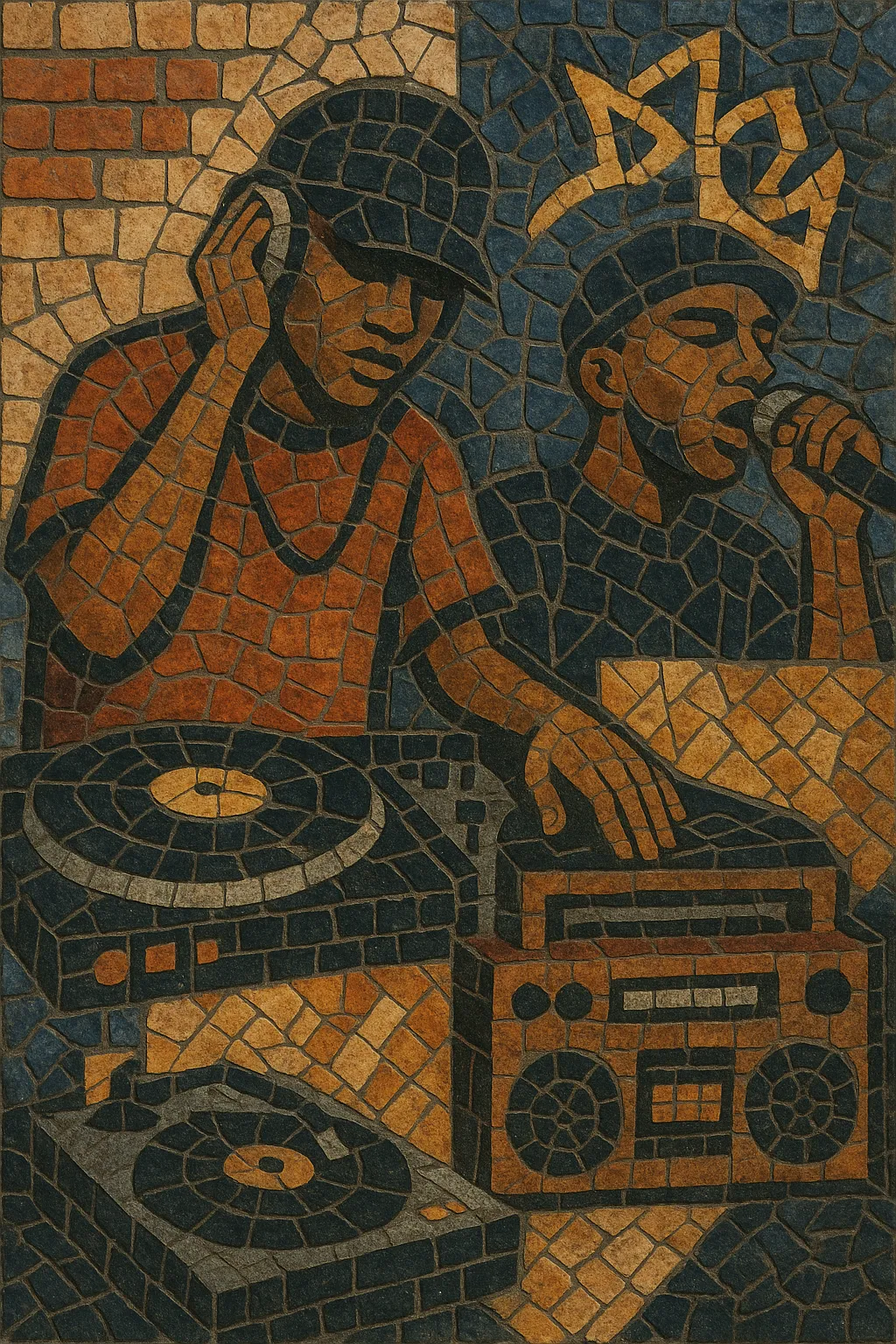
Musically, it centers on extended breakbeats drawn from funk and disco records, live turntable techniques (cutting, backspinning, and early scratching), simple but infectious drum programming (often with the TR‑808), and crowd‑engaging MC routines. Rapping tends to feature clear enunciation, party chants, call‑and‑response, braggadocio, and narrative vignettes, delivered over steady 4/4 grooves in the 95–112 BPM range.
Culturally, old school hip hop grew out of DJ‑led block parties, b‑boy/b‑girl dance breaks, and the Jamaican sound‑system tradition, and it codified the core pillars of the hip hop ethos: DJing, MCing, breaking, and graffiti.
History
Hip hop’s recorded story begins in the Bronx, New York, where DJs isolated percussion “breaks” from funk and disco records to keep dancers moving. At early block parties, MCs hyped the crowd with chants and boasts while DJs developed turntable techniques—backspinning, cutting, and, soon, scratching. This party format migrated from community centers and parks to clubs and, by the late 1970s, to recording studios.
Independent labels recognized the grassroots energy and began releasing rap singles that translated the live party format to vinyl. These records captured extended breaks, call‑and‑response hooks, and tight, simple rhyme schemes, introducing audiences far beyond New York to the new sound. Radio play, club rotation, and touring established MC crews and their DJs as recording artists.
As producers embraced drum machines (notably the TR‑808) and synthesizers, a sleek, electronic edge—often called electro‑funk—merged with rap performance. Studio craft grew more refined, scratching was foregrounded as a musical voice of its own, and narrative or socially aware lyrics began to appear alongside party themes, signaling that hip hop could be a vehicle for both celebration and commentary.
Old school tracks typically ride a steady 4/4 groove with tight, danceable breakbeats, bass patterns inspired by funk and disco, and prominent DJ techniques. MCs deliver clear, rhythmically locked flows with end‑rhyme couplets, internal rhyme emerging in spots, and crowd‑inclusive refrains. The vibe is communal and upbeat, rooted in the energy of the party and the b‑boy circle.
By the mid‑1980s, denser sampling, harder drum programming, and more complex rhyme cadences defined the “new school.” Yet the old school era established the foundational practices—DJ virtuosity, MC stagecraft, dance‑centered breakbeats, and a DIY neighborhood ethos—that would power hip hop’s global expansion and influence subsequent rap subgenres across regions and decades.