Your digging level
Description
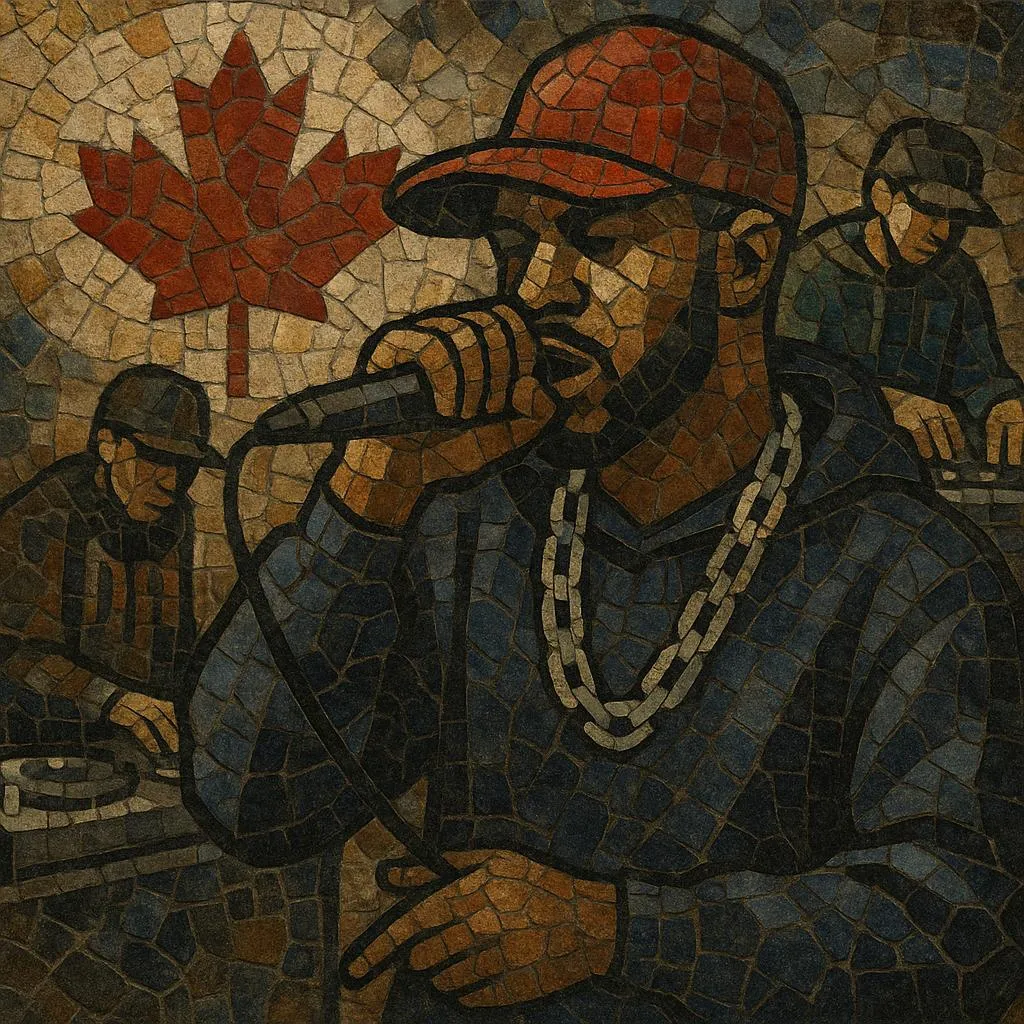
Canadian hip hop is the national hip hop scene of Canada, rooted in the same core elements as U.S. hip hop (MCing, DJing, breakdance, and graffiti) but shaped by Canada’s multicultural cities, regional identities, and media/industry conditions.
It includes English- and French-language rap (especially in Quebec), and it often blends North American boom bap and later trap aesthetics with local storytelling about immigrant life, inner-city realities, and Canadian social issues.
Historically, the scene grew more slowly than Canadian rock, staying largely underground for years, with a brief burst of mainstream attention around 1989–1991 and more sustained commercial visibility beginning in the early 2000s.



History
Canadian hip hop emerged in the 1980s, first taking hold in major urban centers such as Toronto, Montreal, and Vancouver. Early crews and DJs connected to the wider North American hip hop movement, but Canadian radio, labels, and touring infrastructure favored rock and pop, slowing national growth.
The scene experienced a short-lived burst of mainstream visibility from roughly 1989 to 1991. Despite this, the commercial momentum did not consolidate into a stable industry pipeline, and many artists returned to regional circuits and independent releases.
Throughout the 1990s, Canadian hip hop developed as a primarily underground culture. Local venues, community radio, mixtapes, and independent labels became crucial. Quebec also strengthened a distinct francophone rap ecosystem, while Toronto increasingly became the scene’s dominant national hub.
In the early 2000s, improved domestic support, changing broadcast environments, and the rise of internet distribution helped Canadian hip hop reach broader audiences. Toronto’s prominence increased further, and Canadian artists began achieving sustained international recognition, culminating in global mainstream success for select acts.
Use core hip hop drum programming: a strong kick/snare backbeat, syncopated hi-hats, and groove-driven swing.
For an older-school Canadian feel, start from boom bap patterns with sampled breaks and crisp snares; for modern radio-facing tracks, use trap-style 808s, rolling hats, and sparse percussive motifs.
Build beats with sampled chops (soul, funk, jazz), or use modern synth textures and sub-heavy bass.
Incorporate regional or multicultural influences subtly through timbres (e.g., Caribbean percussion nods in Toronto, or European/Francophone pop flavors in Montreal) while keeping the beat firmly hip hop.
Keep harmonic movement simple and loop-friendly, often centered on minor keys for grit or reflective moods.
Use short, memorable melodic hooks (sung or rap-sung) to support crossover appeal, or keep melodies minimal and let the MC carry the track.
Write verses with clear narrative focus and sharp internal rhymes.
Canadian hip hop commonly features either English rap or French rap (especially in Quebec); code-switching can work if it supports authenticity and character.
Aim for confident delivery and tight pocket control rather than exaggerated accents; regional identity usually comes through content and slang more than forced pronunciation.
Ground lyrics in local reality: city life (Toronto, Montreal, Vancouver, Halifax, etc.), immigrant experience, community pride, winter/urban resilience, and social commentary.
Balance braggadocio with storytelling; many key Canadian artists gained recognition through vivid narratives and message-driven writing.
Structure tracks around a strong hook and two to three verses, with dynamic drops and ad-libs to maintain energy.
For live performance, prioritize intelligibility and breath control, and consider a hype-person or call-and-response sections to translate well on stage.

Top albums