Your digging level

For this genre
0/8
🏆
Sign in, then listen to this genre to level up

Description

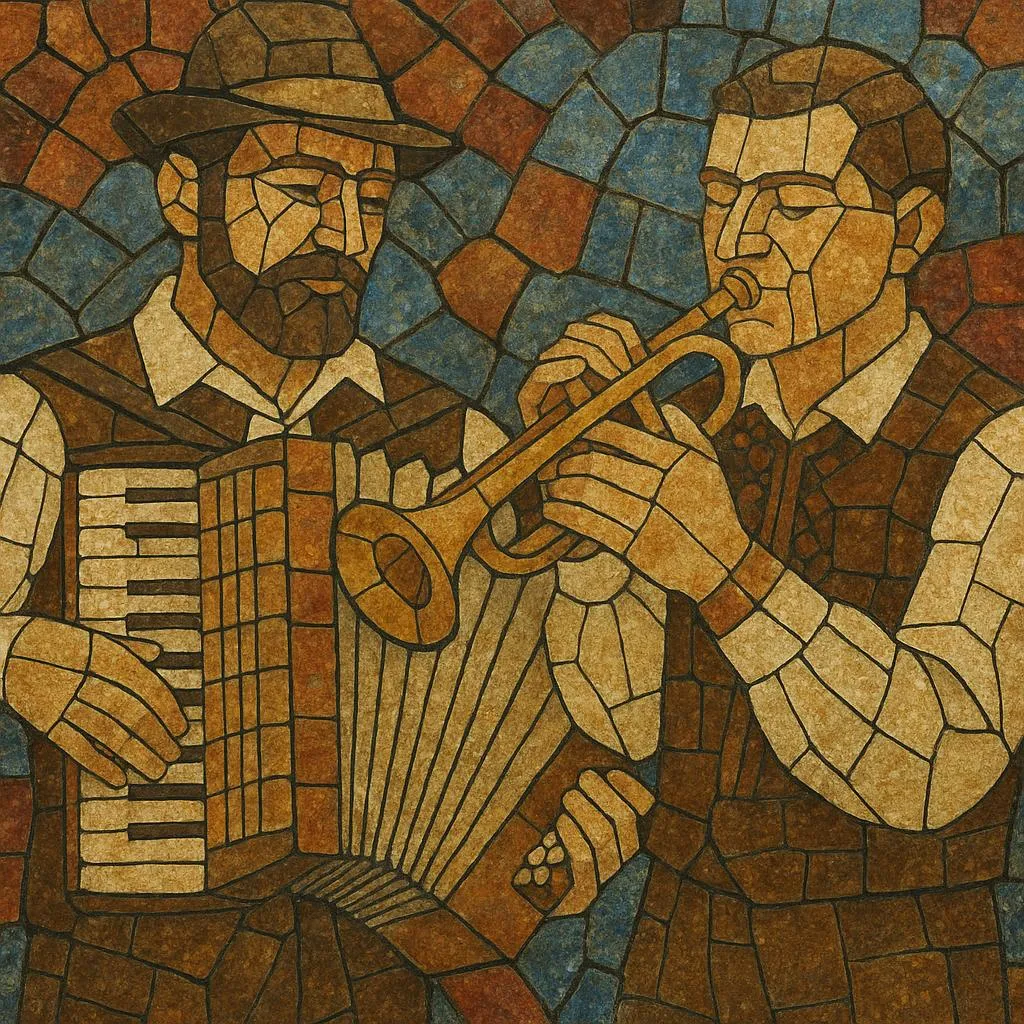
Oberkrainer is a popular folk-dance style from the Alpine region that crystallized in Slovenia’s Upper Carniola (Gorenjska) and spread through German‑speaking Europe via the ensemble of Slavko Avsenik (“Slavko Avsenik und seine Original Oberkrainer”).

Its signature is the compact “quintet” lineup: accordion providing harmony and figurations; clarinet and trumpet (or flugelhorn) carrying tuneful melodies often in parallel thirds; guitar supplying crisp off‑beat chops; and a bass voice (baritone/tenorhorn or double/electric bass) delivering the classic oom‑pah foundation. Vocals—typically a male or mixed duet—add simple, singable refrains in Slovene or German.

Repertoire revolves around lively polkas (2/4) and lilting waltzes (3/4), with bright major keys, tidy sectional forms, and ear‑catching instrumental interludes. Unlike many folk-pop offshoots, classic Oberkrainer bands use little or no drum set; the groove is created by the strumming guitar, bass/baritone, and the accordion’s rhythmic bellows.

The style blends village dance idioms with sleek mid‑century arranging, yielding music that is simultaneously danceable, melodically memorable, and warmly nostalgic.

Sources: Spotify, Wikipedia, Discogs, RYM, MB, user feedback and other online sources

History

Origins (1950s)
•   The Oberkrainer sound emerged in 1950s Slovenia, centered in Upper Carniola (Gorenjska). Brothers Slavko (composer/accordionist) and Vilko Avsenik (arranger) formed an ensemble that refined a tight, modernized village-dance quintet. Their radio appearances from Ljubljana and releases for the German market as “Slavko Avsenik und seine Original Oberkrainer” made the style a cross‑border sensation.
Golden Era and Cross‑Alpine Spread (1960s–1970s)
•   Through touring and television across Austria, Germany, Switzerland, and South Tyrol, Oberkrainer became a household sound associated with polka/waltz social dancing and weekend entertainment. Arrangements codified the idiom: clarinet–trumpet melody in parallel thirds, accordion counterlines, off‑beat guitar, and a bass/baritone providing the oom‑pah bed. Hit tunes (e.g., the famed “Trompetenecho/Na Golici”) modeled the buoyant, whistle‑able melodic style.
Consolidation and Scene Building (1980s–2000s)
•   Numerous Slovenian and Austrian groups adopted the “Oberkrainer‑style” quintet, recording for both Slovene and German‑language markets. The idiom fed into broader Volkstümliche Musik media formats and festivals, while remaining distinct from drum‑driven Schlager. Bands often marketed under German names for cross‑border recognition, helping standardize instrumentation and repertoire forms.
Revival and Continuity (2010s–present)
•   Legacy ensembles led by Avsenik family members and younger “Jungen Oberkrainer” groups maintain the repertoire while issuing new material. Conservatories, village brass/tenorhorn players, and accordion schools support a continuing musician pipeline. The style remains a staple at Alpine folk festivals, weddings, and televised folk shows, symbolizing a convivial, intergenerational dance culture.
Musical Traits at a Glance
•   Dance meters (polka 2/4, waltz 3/4), bright major keys, simple diatonic harmony with secondary dominants, two‑part vocal refrains, and compact instrumental forms. The aesthetic merges village conviviality with mid‑century arranging polish.

How to make a track in this genre

Core Instrumentation
•   Accordion (chromatic or button): arpeggios, vamping chords, countermelodies, occasional bass fills. •   Clarinet + Trumpet/Flugelhorn: lead melodies in parallel thirds/sixths; trade short motives; add ornamented turns. •   Guitar: steady off‑beat chops ("um‑pah" feel), lightly palm‑muted for punch; occasional four‑to‑the‑bar waltz comping. •   Bass/Baritone (tenorhorn/euphonium or double/electric bass): oom‑pah foundation—beat 1 root, beat 2/and supportive movement; in waltz, emphasize beat 1 then outline 2–3. •   Optional vocal duet: simple strophic verses, memorable choruses; two‑part harmony in 3rds/6ths.
Rhythm & Form
•   Polka (2/4) at roughly 112–132 BPM; Waltz (3/4) at 80–100 BPM. •   Common forms: A–A–B–A (with instrumental intro/outro), or A–B–A–C (middle “Trio” or key‑change section). Include short instrumental interludes for clarinet/trumpet and accordion.
Harmony & Melody
•   Keys: bright majors (F, Bb, Eb, C, G). Harmonies are diatonic with tasteful secondary dominants (V/V, V/II) and occasional diminished passing chords. •   Cadences: frequent I–V–I and I–IV–V–I; circle‑of‑fifths motion for turnarounds. •   Melodies: stepwise, singable, with clear 4‑ or 8‑bar phrases. Feature parallel horn lines, clarinet pickups, and brief accordion counterlines.
Arrangement Tips
•   Keep textures transparent: no drum kit needed—groove comes from guitar off‑beats + bass/baritone + accordion bellows rhythm. •   Feature a mid‑tune modulation (often up a whole step) for a final chorus lift. •   Add a short instrumental polka break (clarinet–trumpet unison/thirds) before the last vocal refrain.
Lyrics & Style
•   Themes: village life, mountains, seasons, courtship, conviviality. Use plain, inviting language; rhyme schemes that suit strophic refrains. •   Performance: buoyant articulation, clean intonation on parallel horns, tight ensemble stops, and dancers‑first phrasing.

Top tracks

Locked
Share your favorite track to unlock other users’ top tracks

Upcoming concerts

in this genre
Influenced by
Has influenced

Download our mobile app

Get the Melodigging app and start digging for new genres on the go
© 2026 Melodigging
Melodding was created as a tribute to Every Noise at Once, which inspired us to help curious minds keep digging into music's ever-evolving genres.
Buy me a coffee for Melodigging