Your digging level
Description
Musica indigena latinoamericana refers to the diverse musical practices of Indigenous peoples across Latin America, encompassing pre‑Columbian ceremonial repertoires, community dance music, narrative songs, healing chants, and contemporary creations in Indigenous languages.
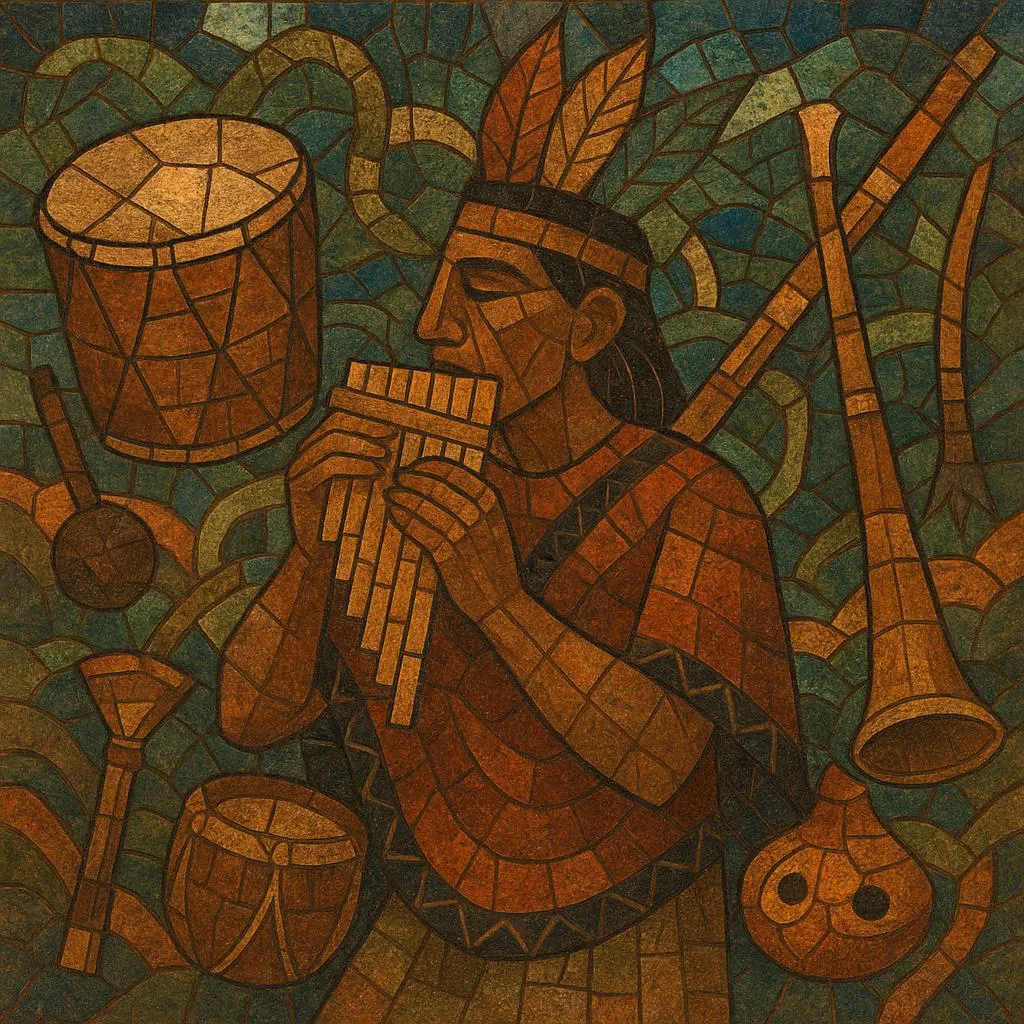
It features rich organological traditions: aerophones such as panpipes (siku/antara), end‑blown flutes (quena, pinkillo, kena kena), clay ocarinas, and long natural trumpets (trutruka); membranophones like the bombo legüero, huehuetl, and frame drums such as the Mapuche kultrún; and idiophones including rattles, seed shakers, and slit drums (teponaztli). Vocal delivery ranges from communal call‑and‑response and heterophony to solo laments and ritual invocations. Scales are often pentatonic or hexatonic, timbres are earthy and breathy, and rhythms can exhibit sesquiáltera (2:3 polymetric feel) and cyclic ostinati aligned with circle dances and processions. While deeply rooted in ancestral cosmologies and local ecology, the genre today also embraces syncretic and new forms—whether church‑mission legacies, pan‑Indigenous festivals, or Indigenous hip hop and electro‑folk that center language revitalization and sovereignty.
History
Archaeology, iconography, and surviving organological lineages show that Indigenous musical systems in Mesoamerica, the Andes, the Southern Cone, the Caribbean, and Amazonia long predate European contact. Courtly and temple complexes employed ensembles of flutes, ocarinas, slit drums, and conch trumpets for calendrical rites, agrarian cycles, healing, and warfare. In the Andes, ayllu‑based ensembles cultivated panpipe orchestras with interlocked parts; in Mesoamerica, huehuetl–teponaztli drum pairs anchored dance‑song genres tied to cosmology and polity.
Colonial encounter brought suppression and recontextualization, but also hybridization. Mission churches trained Indigenous singers and instrumentalists, generating rich archives of villancicos and masses performed by Indigenous choirs and bands. Local instruments and rhythmic logics persisted under new idioms (processional hymns, Christmas villancicos), while Indigenous ritual genres adapted, sometimes incorporating European chordophones (harp, violin, later charango).
As republics formed, elites alternately marginalized and “folklorized” Indigenous sound. Indigenismo valorized Andean timbres (panpipes, quena) as national symbols, yet often displaced Indigenous agency. Rural fiestas, communal dances, and healing ceremonies maintained transmission, while early recordings and radio circulated sikuri, huayno, and Mapuche song beyond their territories.
From the 1960s on, land rights movements, cultural centers, and intercultural festivals foregrounded Indigenous leadership. Community sikuri and sikus schools, Mapuche cultural workshops, Kichwa wind‑band traditions, and Amazonian healing chants entered urban and international stages, reframing Indigenous music as living heritage rather than static folklore.
Today the genre thrives both in ceremonial contexts and in new media. Artists compose in Quechua, Aymara, K’iche’, Kaqchikel, Mapuzugun, Guarani, Nahuatl, and other languages; fuse traditional aerophones and drums with electronics; and use music for language revitalization and political advocacy. Field recordists and community archives collaborate with elders to safeguard repertoire ethics, while Indigenous hip hop, electro‑folk, and experimental scenes carry ancestral aesthetics into global dialogues—on Indigenous terms.