Your digging level
Description
Folk metal latinoamericano is a regional strand of folk metal that fuses heavy and extreme metal with Indigenous, Andean, and other local folk traditions from Latin America.
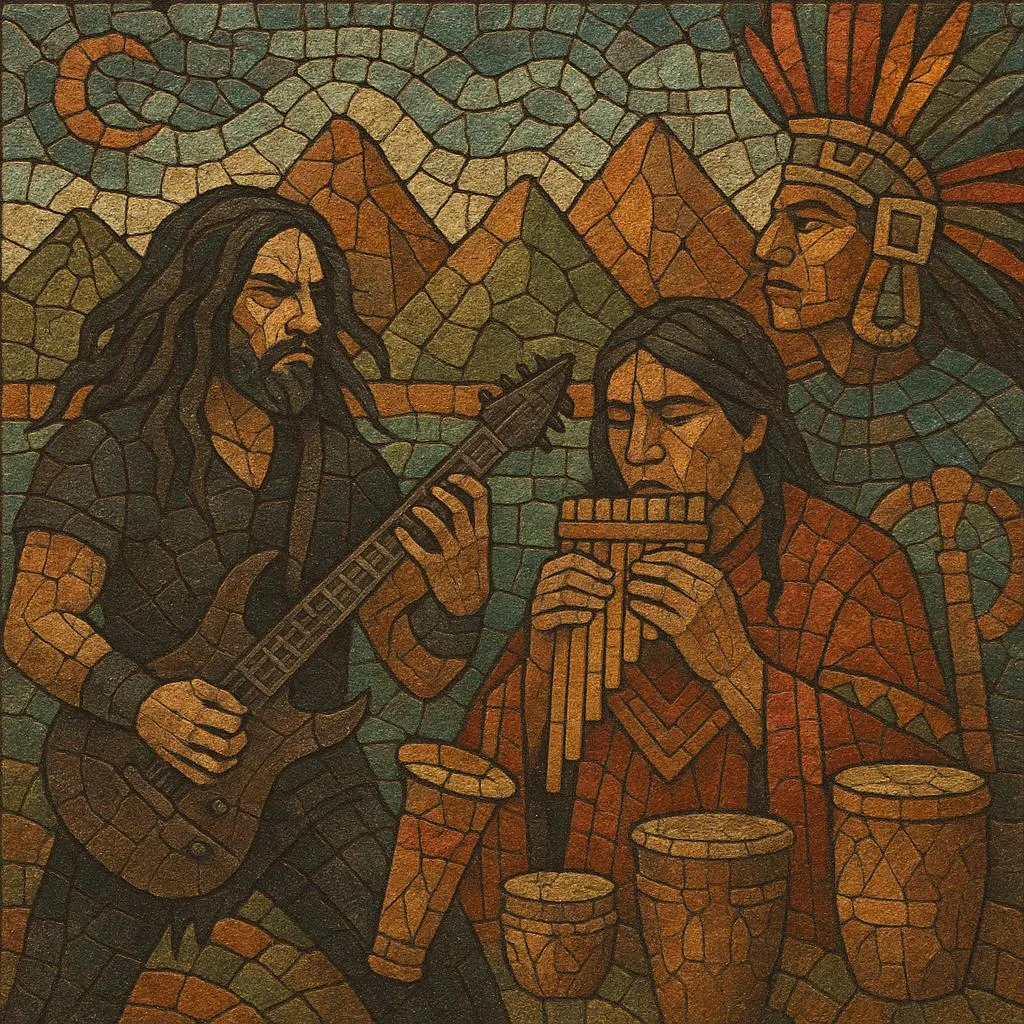
It commonly blends distorted guitars, double‑kick drumming, and harsh or powerful clean vocals with acoustic timbres such as charango, quena and siku (Andean flutes/panpipes), bombo legüero, ocarinas, and Indigenous drums like huéhuetl or teponaztli. Melodic materials often draw on pentatonic or Aeolian/Dorian scales and on motifs from huayno, carnavalito, cueca, saya, chacarera, and other regional dances, while lyrics explore pre‑Columbian mythologies (Inca, Mexica/Aztec, Maya, Mapuche, etc.), nature and mountainscapes, historical memory, and anti‑colonial/identity themes.
Stylistically it ranges from power‑metal uplift to blackened intensity, but the defining trait is the prominent, respectful integration of Latin American folk instruments, rhythms, and languages into a modern metal framework.
History
Latin American bands began adapting the European folk‑metal template in the early 2000s, but with local instrumentation and narratives. Early, visible catalysts included Argentinian groups that framed bagpipes/whistles and power‑metal harmony around South American stories, alongside acts in Mexico and Brazil that brought Indigenous instruments and Andean timbres into black‑/extreme‑metal contexts. The result was a distinct regional voice focused on pre‑Columbian cultures and highland sound worlds rather than on the Celtic themes common in Europe.
Through the 2010s, scenes solidified in Argentina, Brazil, Mexico, Chile, Peru, and beyond. Bands toured regionally, appeared at metal festivals and Wacken Metal Battle national finals, and released albums that codified a palette: distorted riffs paired with charango/quena/siku leads, bombo legüero or Indigenous percussion doubling or contrasting with the drum kit, and lyrics in Spanish, Portuguese, Quechua, Nahuatl, Mapudungun, and other languages.
Musically, groups combined power‑metal grandeur and melodic‑death riffing with black‑metal atmospherics; folk parts are not ornamental but structural—carrying hooks, counter‑melodies, and call‑and‑response panpipe lines. Lyrically, bands foreground Andean cosmology (Pachamama, Inti Raymi), Mexica/Maya deities and histories, and Mapuche resistance, often reframing colonial history and contemporary identity from Indigenous and mestizo perspectives.
The style continues to diversify: some bands lean symphonic or progressive, others intensify the blackened edge; cross‑border collaborations and digital distribution have widened the audience while keeping the core: Latin American folk as a living, central voice inside metal.
Alternate or superimpose 4/4 metal grooves with regional dance feels:
•Huayno/carnavalito: brisk 2‑feel with dotted pickup figures.
•Cueca/chacarera: hemiolas (3:2) and 6/8→3/4 cross‑accents.
•Let bombo legüero or Indigenous drums answer or reinforce the kit; use hand‑drum calls as intros/breakdowns.