Your digging level
Description
The music of Senegal encompasses a constellation of traditions and popular forms rooted in Wolof, Serer, Pulaar/Toucouleur, Mandinka, and Jola cultures, unified by griot (jeli) oral-poetic practices and distinctive drum ensembles. Its most globally recognized strand is mbalax, a high-energy urban style built on sabar and tama (talking drum) rhythms, popularized internationally by Youssou N'Dour.
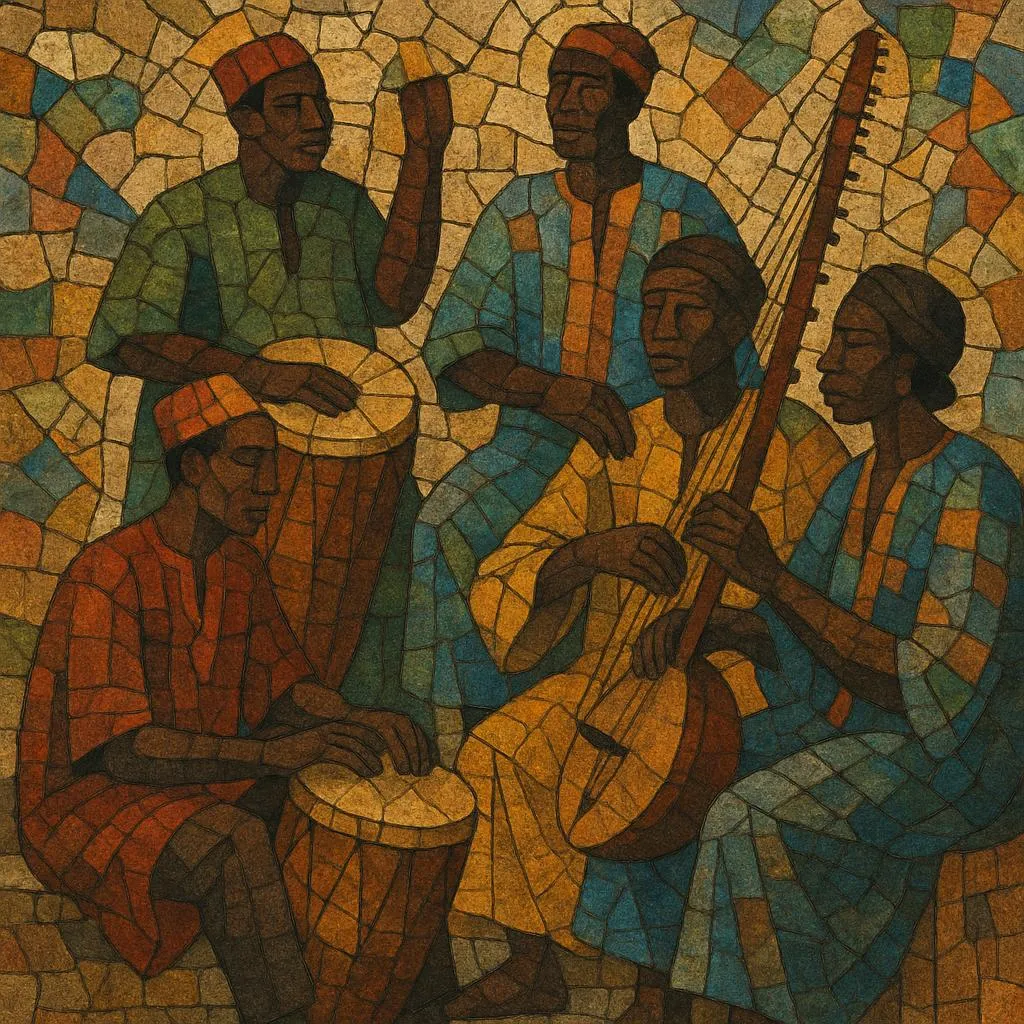
Alongside dance-driven urban genres, Senegal’s musical life includes praise-singing, Sufi devotional repertoires (especially in Mouride and Tijani orders), and acoustic lute- and harp-based music featuring xalam/hoddu and kora. Since the mid-20th century, Afro‑Cuban dance forms, jazz, funk, and reggae have interacted with local idioms in Dakar’s cosmopolitan scene, producing a modern sound that remains deeply anchored in indigenous meters, call‑and‑response vocals, and polyrhythmic drumming.
History
Centuries before nationhood, music in what is now Senegal flourished in courts, villages, and Sufi communities. Griot lineages cultivated praise epics, social commentary, and genealogies, accompanying themselves on xalam/hoddu (lutes) and kora/bolon (harps), while Serer, Wolof, and Jola communities maintained distinctive vocal and drum traditions. Sabar ensembles—featuring interlocking parts on n'der, tungune, and other drums—served both ritual and social dance contexts.
Dakar’s port economy and radio connected local musicians to Afro‑Cuban records and big‑band dance music. Pre‑independence urban ensembles adapted son, mambo, and cha‑cha‑chá harmonies to local rhythms and Wolof lyrics. After 1960 (independence), venues like Dakar’s Miami Club fostered bands such as Star Band de Dakar and, later, Orchestra Baobab, which blended Afro‑Cuban grooves with Senegalese melodic phrasing and griot singing.
From neighborhood sabar gatherings emerged a modern dance style: mbalax. Artists like Youssou N’Dour (and his Super Étoile de Dakar) and Omar Pene (Super Diamono) electrified sabar/tama patterns, added guitars, keys, and horn lines, and foregrounded Wolof vocal stylings. Mbalax became the national soundtrack—faster, more polyrhythmic than Afro‑Cuban fusions—yet still open to jazz, funk, and rock influences.
Global “world music” circuits amplified Senegal’s profile. Youssou N’Dour’s collaborations, Baaba Maal’s Pulaar-rooted innovations, and Ismaël Lô’s soulful songwriting brought international acclaim. Cheikh Lô’s mbalax‑meets‑Congo‑Cuba palette and Thione Seck’s ornate arrangements showcased stylistic breadth. Meanwhile, a powerful hip‑hop movement (Positive Black Soul, Daara J Family) and reggae‑inspired artists engaged social issues in Wolof and French.
Senegal’s scene remains vibrant and hybrid. Mbalax stays central to dance culture, while neo‑traditional projects revive xalam and kora settings. Hip‑hop and Afropop aesthetics, electronic production, and global collaborations coexist with Sufi devotional music and community sabar ceremonies, sustaining a living continuum from village square to international stage.