Your digging level for this genre
Description
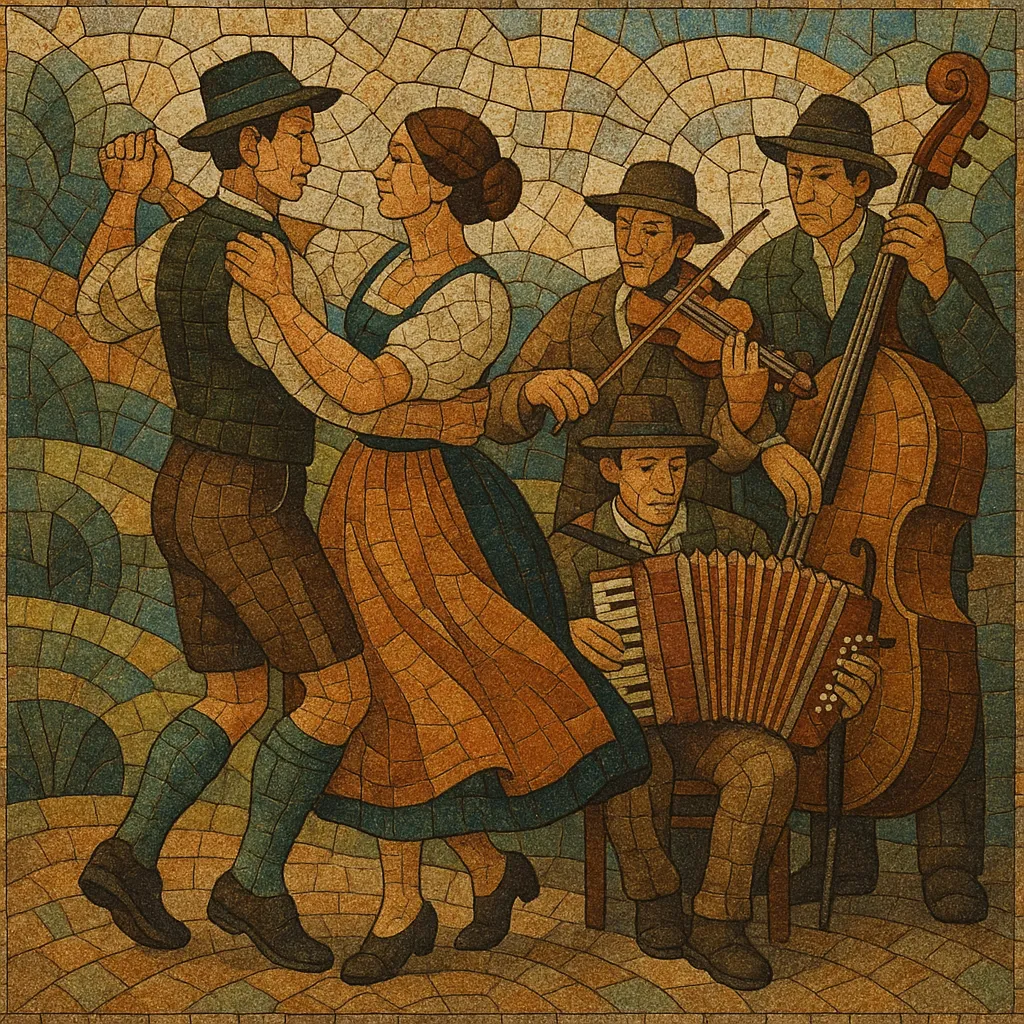
Ländler is a traditional Alpine couple-dance and its accompanying music in triple meter, characterized by a moderate tempo, strong accent on the first beat, and a rustic, swinging "oom-pah-pah" accompaniment. It emerged in rural Austria and spread across Bavaria (southern Germany) and Switzerland.
Melodies are typically diatonic and singable, often embellished with turns, slides, and mordents on fiddle or clarinet, and punctuated by shouted interjections or brief yodels (Juchzer). The core ensemble commonly features diatonic button accordion (Steirische Harmonika), fiddles, clarinet, zither or hammered dulcimer (Hackbrett), guitar, and double bass, with regional variants adding instruments such as the Schwyzerörgeli (Swiss button accordion).
Dancers turn in pairs with stamping steps and playful figures, giving the style its earthy, convivial character. Structurally, tunes frequently use two or three 8–16‑bar strains (AABB or AABBCC), with simple harmonies (I–IV–V) and occasional modulation to the dominant.
History
Ländler arose in rural Alpine communities of Austria in the late 1700s, drawing on regional village dances and song practice, including yodel interjections. The name derives from “ländlich” (rural/country), reflecting its peasant roots and outdoor festivity contexts.
By the early 1800s, Ländler moved from farmyards and inns into town and city dance halls. In Vienna it mingled with other triple‑meter dances, providing a crucial stepping stone to the smoother, more urbane Viennese waltz. Dance‑band leaders such as Joseph Lanner and the Strauss family drew directly on Ländler rhythms and figures while streamlining them for the ballroom.
Composers of the Classical and Romantic eras embraced Ländler idioms. Franz Schubert wrote dozens of Ländler for piano, while Beethoven, Bruckner, and Mahler incorporated Ländler‑style movements and scherzi into symphonies and chamber music, preserving its rustic swing within art‑music forms.
Across the Alps, distinct variants flourished: Austrian Steirische forms, Bavarian versions with pronounced stamping, and Swiss Ländlerkapellen centered on Schwyzerörgeli, fiddles, and clarinet. Typical textures feature a melody instrument over an “oom‑pah‑pah” accompaniment from guitar/accordion and a grounding double bass.
Radio, records, and festivals sustained the tradition, and a commercial style of Volkstümliche Musik drew on Ländler’s sound for mass audiences. Today Ländler remains central to Alpine folk identity, taught and danced in clubs and celebrated at regional festivals in Austria, Bavaria, and Switzerland.