Your digging level
Description
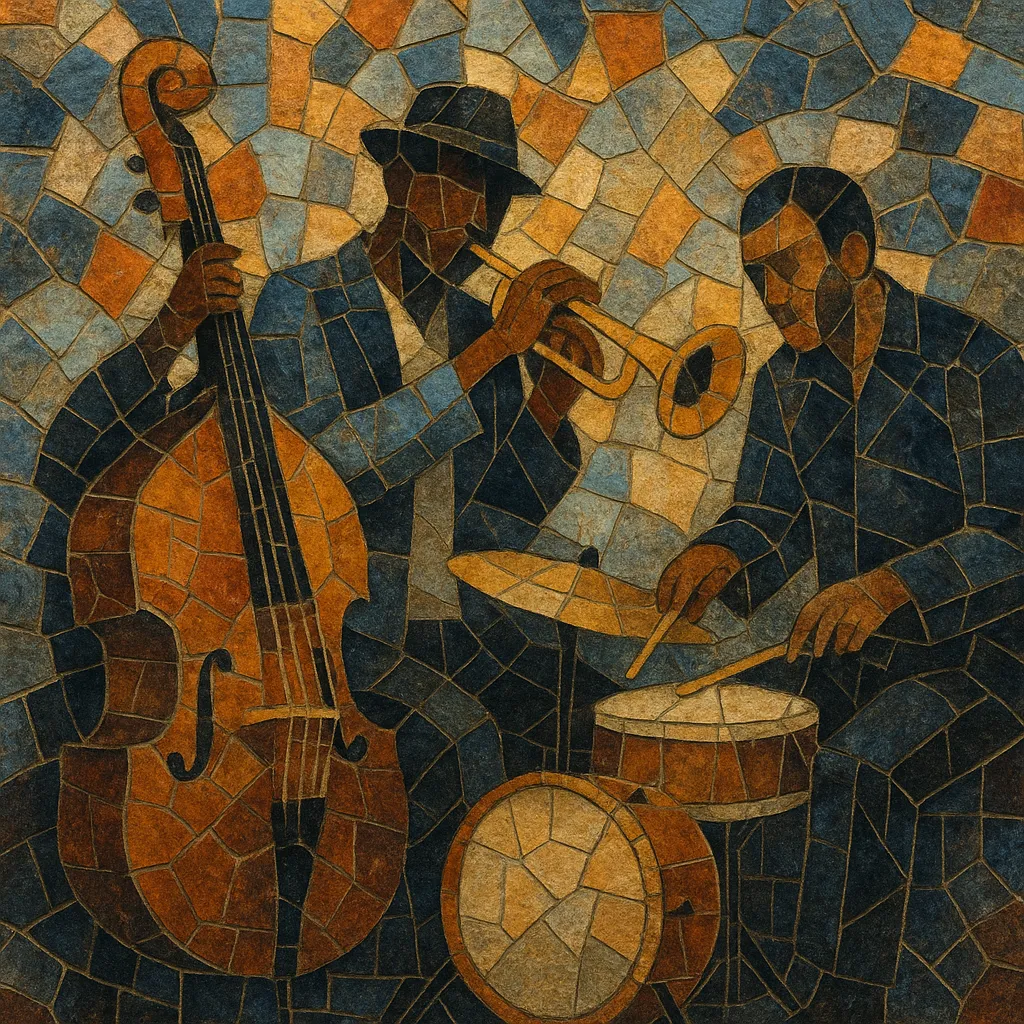
Instrumental jazz is jazz music performed without a lead vocalist, placing the expressive focus on melody instruments, rhythm section interplay, and improvisation. It typically features a "head–solos–head" structure, where a composed theme frames spontaneously created solos.
Harmonically, instrumental jazz is known for extended chords (9ths, 11ths, 13ths), ii–V–I cadences, modal harmony, and chromatic voice-leading. Rhythmically it draws on swing, syncopation, and groove-based feels from walking bass and ride-cymbal patterns to contemporary straight-8ths and odd meters. Ensembles range from intimate trios and quartets to large big bands, giving the style great timbral variety.
By removing lyrics, instrumental jazz emphasizes timbre, phrasing, and interaction—how players listen and respond to one another—making it a showcase for improvisational storytelling and ensemble conversation.
History
Instrumental jazz emerged in the United States in the 1910s as New Orleans ensembles blended blues feeling, ragtime syncopation, and brass band instrumentation. Early recordings by groups like the Original Dixieland Jass Band helped codify collective improvisation, with cornet/trumpet, clarinet, trombone, banjo or piano, tuba or bass, and drums forming the core sound.
In the 1930s, swing popularized instrumental jazz at dance halls and on radio. Big bands expanded the palette with sections of saxophones, trumpets, and trombones supported by a rhythm section, and arrangers developed call-and-response writing, shout choruses, and tightly voiced brass/sax harmonies. Even when singers appeared, much of the repertoire remained instrumentally driven.
Bebop revolutionized instrumental jazz in the 1940s with fast tempos, advanced harmony, and small-combo virtuosity led by Charlie Parker and Dizzy Gillespie. The 1950s and 1960s saw parallel streams: cool jazz’s relaxed textures, hard bop’s blues/gospel drive, modal jazz’s scale-based improvisation (e.g., Miles Davis’s “Kind of Blue”), and the exploratory freedom of Ornette Coleman and John Coltrane. Throughout, instrumentalists refined the language of linear improvisation and sophisticated harmony.
The 1970s fused jazz with rock, funk, and electronic instruments, creating jazz fusion and later influencing smooth jazz’s radio-friendly instrumentals in the 1980s–1990s. Since the 2000s, instrumental jazz has intersected with hip hop, beat culture, and electronic production, feeding into lo-fi hip hop and nu jazz while maintaining vibrant acoustic traditions in clubs, conservatories, and festivals worldwide.