Your digging level
Description
Fusion gugak is a contemporary style that blends Korea’s traditional music (gugak) and instruments with modern genres such as jazz, rock, post-rock, ambient, and electronic music.
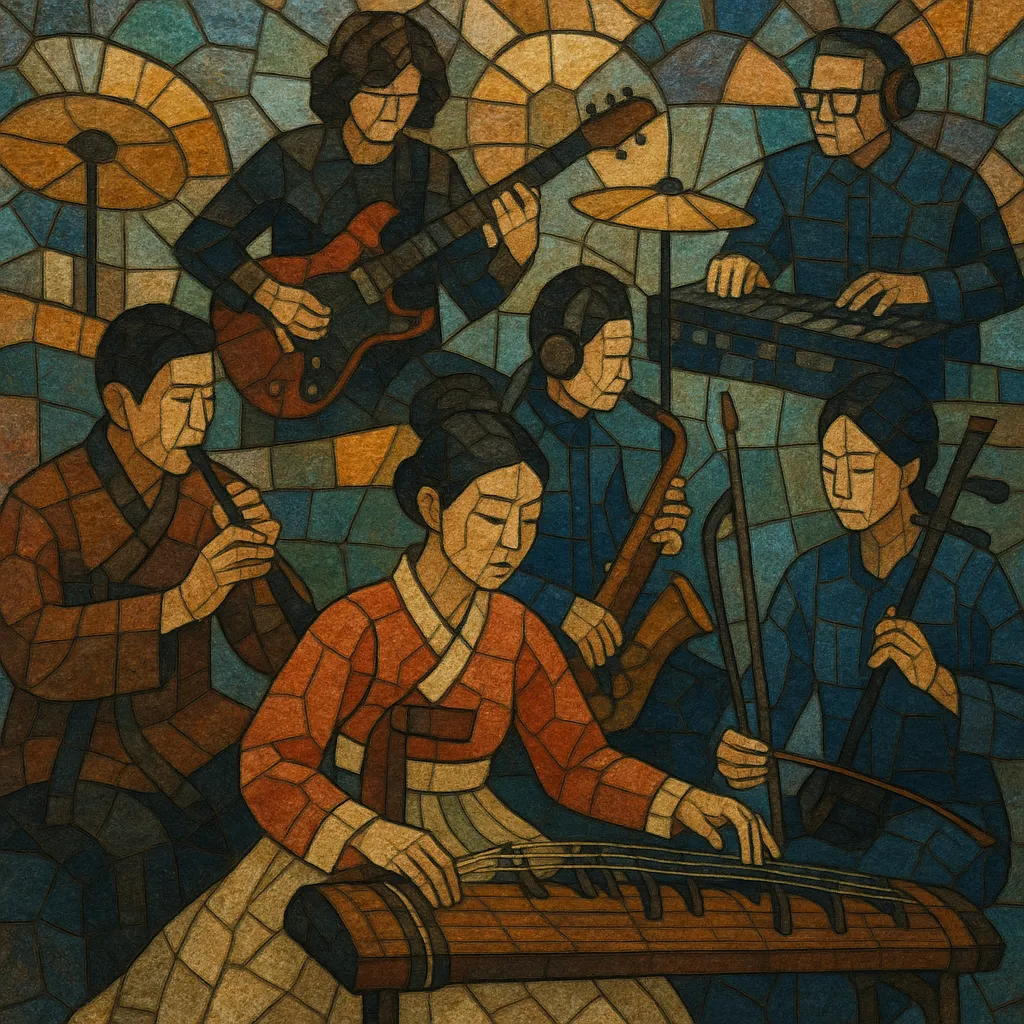
It keeps core gugak elements—traditional modes, ornamentation (sigimsae), cyclic jangdan rhythms, and timbres of instruments like gayageum, geomungo, haegeum, piri, daegeum, janggu, and buk—while adopting modern harmony, song forms, amplification, and studio production.
The result ranges from high-energy percussion- and groove-driven performances to atmospheric, minimalist soundscapes, making gugak accessible to new audiences without abandoning its identity.
History
Experiments to modernize gugak accelerated alongside the global “world music” boom. Ensembles rooted in traditional percussion (samul) and court/folk repertoires began collaborating with jazz and rock musicians. The ethos was to carry over gugak’s modal systems, cyclic meters (jangdan), and characteristic ornamentation into amplified, ensemble-based contexts.
In the 2000s, the term “fusion gugak” circulated widely as conservatory-trained performers formed bands with guitars, drum kits, keyboards, and electronics. Government and arts institutions (e.g., the National Gugak Center, festival circuits, and export programs) supported cross-genre projects. Groups such as Second Moon, Sorea, and Gong Myoung helped establish a popular template: recognizable traditional timbres presented with contemporary grooves, hooks, and stagecraft.
A new wave pushed further into experimental and post-rock territory. Jambinai introduced massive dynamic arcs and textural distortion with haegeum, geomungo, and piri alongside rock instrumentation. Black String’s improvisational language brought gugak into global jazz contexts. Park Jiha’s minimalist, ambient-influenced works reframed gugak instruments in spatial, meditative settings. Global touring and major festivals increased visibility.
Acts like LEENALCHI and Ak Dan Gwang Chil (ADG7) reframed pansori and shamanic/folk material within groove-oriented, danceable bands, yielding viral moments and TV/advertising placements. Fusion gugak now spans an ecosystem—from scholarly reimaginings to club-ready hybrids—while continuing to serve as a gateway for broader engagement with traditional Korean music.
Combine core gugak instruments—gayageum or geomungo (zithers), haegeum (bowed fiddle), daegeum and piri (bamboo flutes/oboes), taepyeongso (shawm), saenghwang (mouth organ), and traditional percussion (janggu, buk, kkwaenggwari, jing)—with modern rhythm section (drum kit, bass, guitar), keyboards, and electronics (synths, samplers, effects).
Build grooves from traditional cyclic patterns such as jinyang (very slow), jungmori, jungjungmori, jajinmori (faster), and gutgeori (12/8 feel). Layer a drum kit over jangdan to create propulsion; alternate between traditional percussion interludes and full-band sections for dynamic contrast.
Compose melodies in gugak modes and pentatonic frameworks. Emphasize sigimsae—slides, vibrato, bends, grace notes, and microtonal inflections—particularly on haegeum, gayageum, and piri. Allow soloists space for sinawi-like improvisation over drones or ostinati.
Favor modal harmony and pedal points rather than dense functional progressions. Use open fifths, quartal voicings, and drones to leave room for ornamentation. For post-rock aesthetics, employ long crescendos, textural layering, and dynamic swells; for jazz-leaning settings, introduce extended chords while keeping the modal center clear.
Blend through-composed traditional forms with verse–chorus or multi-section post-rock arcs. Spotlight timbral contrasts: unison heterophony of multiple traditional instruments, then widen to full-band tuttis. Insert breakdowns featuring solo zither or bamboo winds to reset energy.
Close-mic delicate instruments, then shape space with reverb and delay to enhance sustain. Use tasteful amplification and effects (e.g., overdrive on geomungo, granular/loop treatments of percussion) while preserving acoustic nuance. Align electronic pulses to jangdan rather than straight 4/4 when appropriate.
Draw on pansori narratives, folk songs (minyo), shamanic invocations (muga), and contemporary poetry. Modernize language while retaining storytelling cadence; call-and-response passages translate well to stage presentations.