

Your digging level
Description
Afro‑Colombian folklore (folclor afrocolombiano) is the umbrella for the music, songs, and dances created by Afro‑descendant communities in Colombia’s Caribbean and Pacific regions. It fuses West and Central African rhythmic thinking and call‑and‑response singing with Indigenous melodic resources and Spanish colonial idioms, and it is deeply tied to community ritual, labor, festivity, and dance.
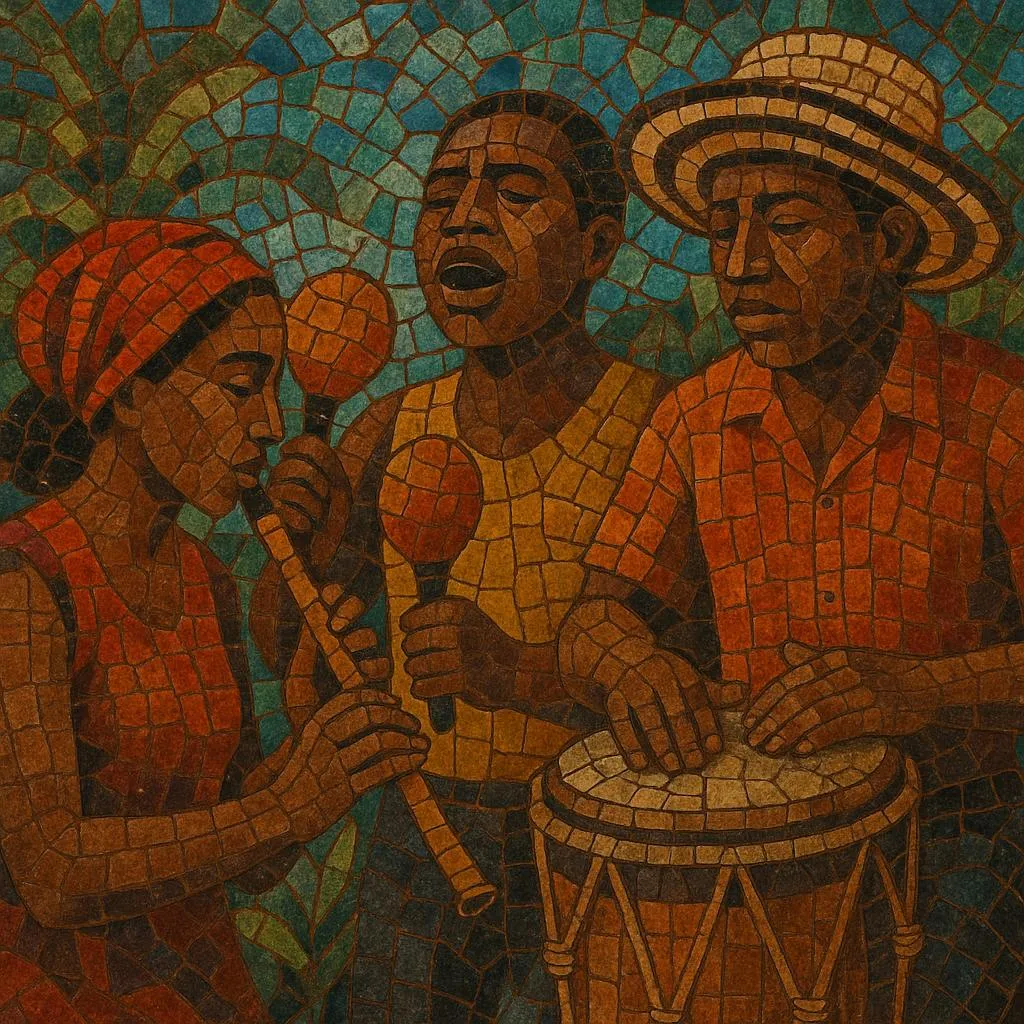
Two broad regional sound worlds stand out. On the Caribbean coast (e.g., Bolívar, Atlántico, Sucre), ensembles center on the tambora family (tambor alegre, llamador, tambora), maracas, handclaps, and long cane flutes (gaitas), powering genres such as bullerengue, porro, mapalé, son de negro, and chandé. On the Pacific coast (Chocó, Valle, Cauca, Nariño), the “marimba de chonta” with cununos, bombo and guasá (beaded shaker) sustains polyrhythmic 6/8–12/8 grooves for currulao and a family of ritual songs (arrullos, alabaos, bundes, abozáo, juga). Languages include Spanish, Palenquero (in San Basilio de Palenque), and local lexicons; lyrics invoke rivers, sea, mangroves, labor, praise, mourning, and collective memory.
Stylistically, the music favors cyclical grooves, overlapping ostinati, responsorial coros, pentatonic and modal tunes, and a flexible, dancer‑led performance energy. It is music of place and purpose—healing, mourning, worship, courtship, celebration—transmitted orally and continually re‑created in community life.
History
Enslaved Africans from West and Central Africa, brought to Colombia via the transatlantic slave trade, carried cosmologies, polyrhythms, instruments, and responsorial vocal practices that took root in riverine and coastal settlements. Maroon communities—most famously San Basilio de Palenque on the Caribbean coast—and the gold‑mining and mangrove zones of the Pacific nurtured distinct yet related musical cultures. Spanish Catholic ritual (processions, feasts) and Indigenous musical knowledge intersected with African musical logics, yielding repertoires for festivity (e.g., bullerengue, mapalé), devotion (arrullos), and mourning (alabaos, lumbalú).
Across the 20th century, folkloric troupes, radio, and national festivals brought Afro‑Colombian genres onto national stages, even as practices remained rooted in local lifeworlds of dance and ritual. On the Pacific coast, virtuosic marimba traditions flourished in community celebrations; on the Caribbean, drum‑and‑voice ensembles and gaita groups became emblematic of costeño identity. Culture bearers (cantaoras, gaiteros, marimberos) codified styles while maintaining the oral, participatory essence.
Global “world music,” heritage policy, and community cultural movements amplified visibility. UNESCO recognized the “Marimba music and traditional chants of Colombia’s Pacific coast” (2010) and the cultural space of San Basilio de Palenque (2005), underscoring their outstanding living heritage. Younger generations have revitalized bullerengue circles, currulao schools, and Palenquero traditions, and many artists now dialogue with jazz, hip hop, electronic production, and alt‑tropical scenes—carrying Afro‑Colombian aesthetics into contemporary creation without severing ritual and communal roots.



