Your digging level
Description
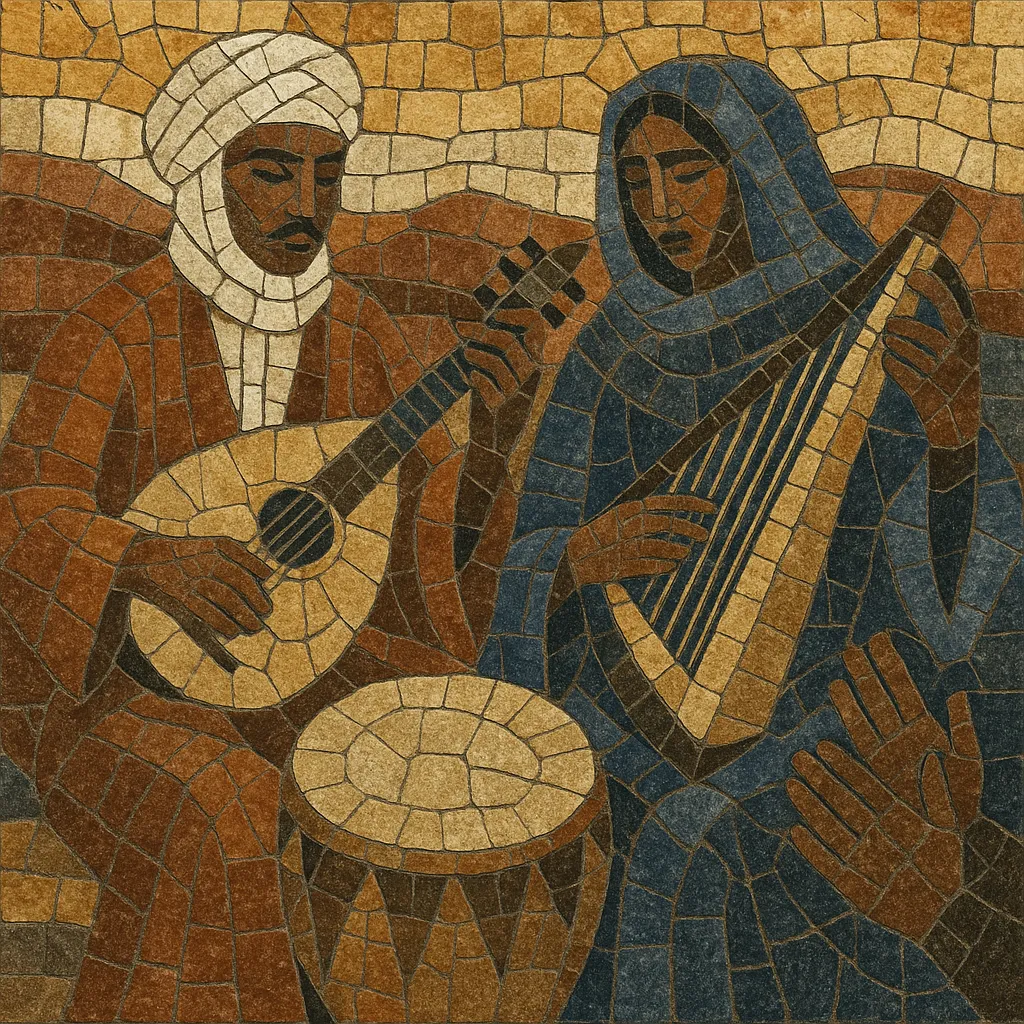
Western Saharan folk is the Sahrawi/Moorish-rooted music of the Western Sahara, sung largely in Hassaniya Arabic and grounded in the regional haul tradition. Its core sound is modal and trance-like, driven by the plucked tidinit lute (played by men), the ardin harp (played by women), the deep thump of the tbal frame drum, handclaps, and call‑and‑response vocals.
Melodies often unfold over a steady pulse in 6/8 or swaying 2/4, with cyclical ostinatos, drones, and subtle modal shifts that evoke the expanse of the desert. Lyrics are poetic—alternating between praise, romance, lineage, and the lived realities of exile and liberation—delivered with ululations and emphatic choruses. Since the late 20th century, amplified guitar and keyboards have sometimes replaced or doubled the tidinit/ardin roles, yielding a raw, buzzing desert-electric timbre without losing the music’s ceremonial intimacy.
History
Western Saharan folk emerges from the Sahrawi haul tradition shared with Moorish musical cultures of the southwest Sahara. For centuries, poets and musician lineages sustained a modal, largely oral practice centered on the tidinit lute (men) and the ardin harp (women), complemented by tbal drum, handclaps, and responsorial singing. This repertoire mingled praise poetry, love songs, genealogies, and communal celebration, all articulated in Hassaniya Arabic and shaped by broader Arabic and Maghrebi modal aesthetics.
In the mid‑1900s, urbanization, radio, and cross‑Saharan exchange broadened stylistic palettes. While the acoustic core remained, guitars and rudimentary amplification slowly entered ensembles, especially in towns like Laayoune and Dakhla. The late‑colonial and immediate post‑colonial period intensified political consciousness; musical gatherings became conduits for identity, memory, and solidarity.
With the Western Sahara conflict and the formation of Sahrawi refugee communities (notably around Tindouf), music took on an explicitly communal and historical role. Ensembles aligned with cultural units performed an electrified haul—translating tidinit/ardin lines to guitar and keyboards while retaining modal contours and cyclical rhythms. Touring and cassette circulation carried Sahrawi sounds across the Maghreb and into West Africa and Europe. Key singers and groups began to be documented by independent labels, preserving both acoustic and electric practices.
From the 2000s, archival reissues and field recordings, alongside the international careers of Sahrawi vocalists and bands, brought Western Saharan folk to wider audiences. Artists fused the classic poetic ethos with modern arrangements, festival stages, and collaborations, while maintaining the music’s ceremonial pulse and themes of longing, resistance, and belonging. Today, the genre stands as a living desert tradition—equally at home in intimate gatherings and on amplified stages—linking ancestral lineages with a global listening public.