Your digging level

For this genre
0/8
🏆
Sign in, then listen to this genre to level up

Description

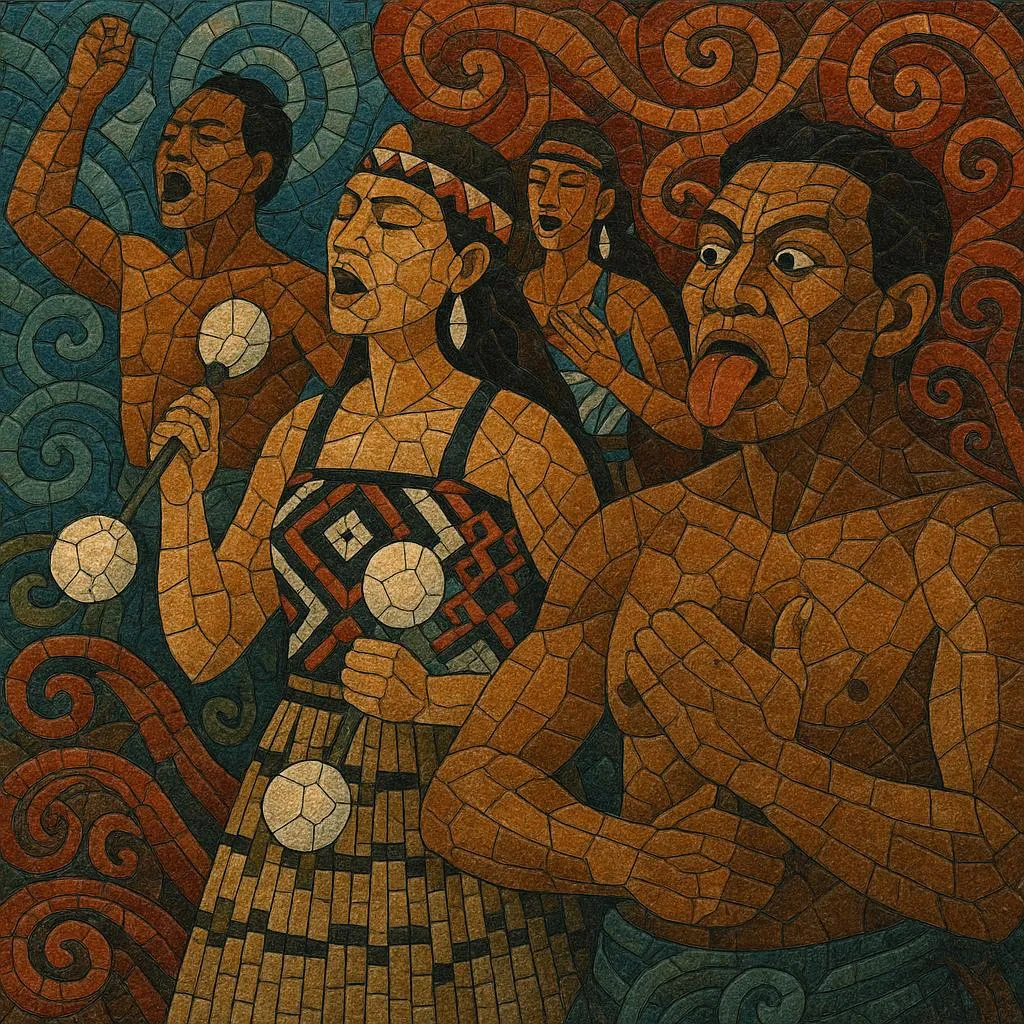
Kapa haka is the collective term for Māori action songs and the groups who perform them. The word combines kapa (group) and haka (dance), and today refers to a full suite of Māori performing arts presented as a coordinated bracket of chant, song, and dance.

A typical kapa haka performance blends traditional chant (mōteatea), posture dance (haka), poi (rhythmic dance with balls on cords), and waiata-ā-ringa (action songs) with rich group harmonies, synchronized movement, body percussion, and expressive facial gestures such as pūkana (dilated-eye gaze) and whētero (tongue protrusion). Performed primarily in te reo Māori, kapa haka is a vital way Māori communities express whakapapa (genealogy), identity, history, and contemporary issues through song and dance.

Sources: Spotify, Wikipedia, Discogs, RYM, MB, user feedback and other online sources

History

Origins and Early Practice
•   Kapa haka grows from pre-contact Māori chant and dance traditions, especially mōteatea (chant) and haka (posture dance), which accompanied ceremony, oratory, and community life. •   Poi and tititorea (stick games) provided rhythmic movement vocabularies that later folded into stage performance.
19th Century Transformations
•   Mission-era harmonization introduced European part-singing, which Māori composers wove into waiata-ā-ringa (action songs), expanding beyond monophonic chant. •   By the late 1800s, organized concert parties presented Māori music and dance to visiting audiences, helping standardize staged formats while sustaining cultural transmission.
20th Century: Formalization and Touring
•   Māori concert troupes and regional clubs (especially in tourist hubs like Rotorua and cultural centers across Aotearoa) popularized structured brackets that resemble modern kapa haka: whakaeke (entrance), waiata/chant forms (e.g., mōteatea, waiata-ā-ringa), poi, haka, and whakawātea (exit). •   Key composer-poets codified text, gesture, and harmonic language, ensuring te reo Māori remained central.
Competitions and Te Matatini Era
•   From the early 1970s, large festivals evolved into today’s Te Matatini (est. 1972 as the Polynesian Festival; modern form from 2004), the premier national competition that lifted artistic standards, regional styles, and innovation. •   Kapa haka flourished in schools and universities, strengthening youth involvement and language revitalization.
Contemporary Practice
•   Modern kapa haka embraces historical forms and contemporary composition, addressing land rights, language, and social issues while maintaining communal identity and protocol. •   International touring, recordings, and broadcast have made kapa haka an emblem of Aotearoa New Zealand’s cultural identity, while remaining first and foremost a living Māori performing art.

How to make a track in this genre

Ensemble and Roles
•   Build a balanced rōpū (group) with strong leaders (kaitātaki tāne and kaitātaki wahine) to cue tempo, entries, haka, and dynamics. •   Use a chorus of mixed voices for harmonic richness; integrate kaihaka (dancers) who can also sing.
Structure a Bracket
•   Follow the customary flow: whakaeke (entrance), waiata tira (choral warm-up—optional), mōteatea (chant), waiata-ā-ringa (action song), poi, haka, then whakawātea (exit). •   Design thematic coherence across items (e.g., whakapapa, whenua/land, community kaupapa) with scripted transitions and karanga/whakatau as appropriate.
Vocal Language, Melody, and Harmony
•   Write lyrics in te reo Māori with clear diction and poetic devices (whakataukī/proverbs, metaphor, whakapapa references). •   Blend traditional chant lines (often pentatonic/modal, speech-rhythm–driven) with 3–4 part European-influenced harmonies for waiata-ā-ringa. •   Use call-and-response between leader(s) and group; control dynamics for dramatic tension.
Rhythm, Movement, and Gesture
•   Align body percussion (stamps, claps, chest slaps), wiri (hand tremble), and expressive pūkana/whētero with musical phrasing. •   For poi, compose swinging rhythmic patterns (commonly in steady duple or gentle triple feels) coordinated with precise handwork; interlock voice-leading with poi accents. •   For haka, craft emphatic rhythmic syllables, strong unison movement, and percussive articulations—drive intensity through tightly locked ensemble timing.
Instruments and Timbre
•   Prioritize voices and body percussion; optionally color with traditional taonga pūoro (e.g., pūtātara conch, kōauau/pūtōrino flutes) for openings or transitions. •   Keep any non-traditional instrumentation minimal so vocal text and movement remain focal.
Rehearsal and Staging
•   Drill entrances/exits, spacing, and formations to keep sightlines and unison clean. •   Balance dramatic storytelling with tikanga (protocol), ensuring respect for kaupapa and iwi/hapū identity. •   Record rehearsals to refine blend, timing, and expressive detail; finalize costuming and adornment consistent with the narrative.

Top tracks

Locked
Share your favorite track to unlock other users’ top tracks

Upcoming concerts

in this genre
Influenced by

Download our mobile app

Get the Melodigging app and start digging for new genres on the go
© 2026 Melodigging
Melodding was created as a tribute to Every Noise at Once, which inspired us to help curious minds keep digging into music's ever-evolving genres.
Buy me a coffee for Melodigging