Your digging level

For this genre
0/8
🏆
Sign in, then listen to this genre to level up

Description

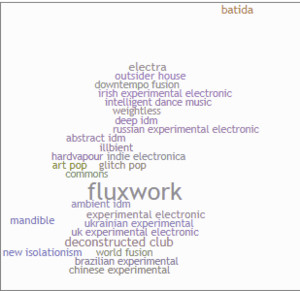
Fluxwork is a contemporary microgenre of electronic music optimized for sustained concentration and “flow state” listening. It blends the warmth and space of ambient with the pulse and structure of minimal techno and microhouse, emphasizing unobtrusive rhythms and gradual, textural movement.

Tracks usually feature understated four-on-the-floor or gently broken patterns, soft sidechained pads, subtle arpeggios, and carefully filtered transitions. Vocals, if present at all, are sparse and textural. The result is music that feels propulsive yet calm—capable of fading into the background while quietly supplying kinetic focus.


Sources: Spotify, Wikipedia, Discogs, Rate Your Music, MusicBrainz, and other online sources

History

Origins

Fluxwork emerged in the 2010s from the overlap of ambient, minimal techno, and microhouse. Producers and listeners sought music that could provide forward motion without demanding attention—a sound suited to coding, studying, design, and other “deep work” tasks. The name reflects its goal: maintaining a sense of continuous flux while supporting focused work.

Early Development

Artists working in UK and European minimal/ambient techno provided much of the template: restrained drums, soft sidechained pads, and long-form arrangements. As streaming platforms and productivity playlists grew, a distinct cluster of tracks with similar aesthetics coalesced—lighter than club techno, more kinetic than classic ambient, and more polished than lo‑fi beats.

Diffusion via Playlists and Algorithmic Curation

The genre’s visibility expanded through algorithmically curated “focus” and “productivity” playlists. These ecosystems favored steady BPMs, smooth spectral balance, and low lyrical content, reinforcing a shared production vocabulary across artists. Over time, Fluxwork established itself as a go-to sound for modern knowledge work and creative sessions.

Today

Fluxwork continues to evolve alongside adjacent scenes such as ambient lo‑fi and ambeat, incorporating gentle melodic motifs and refined sound design. It remains a reliable bridge between background functionality and musical craft, offering enough motion to energize without overwhelming.

How to make a track in this genre

Core Aesthetic

Aim for a balance between movement and unobtrusiveness. The track should feel like it’s quietly breathing—always advancing, never distracting.

Tempo and Rhythm
•   Tempo: typically 90–130 BPM, with 110–124 BPM common. •   Drums: soft kicks, light claps/snaps, gentle hi-hats; avoid aggressive transients. •   Grooves: subtle swing or microtiming for organic feel; keep fills minimal and smooth.
Harmony and Melody
•   Harmony: slow-moving progressions (minor/add9/sus2 chords) with extended voicings. •   Melody: short motifs, gentle arpeggios, or evolving textures instead of lead-driven hooks. •   Motion: use gradual filter sweeps, evolving pads, and layered drones to imply development.
Sound Design and Texture
•   Instruments: warm analog-style polysynths, soft FM bells, airy pads, and rounded bass. •   Techniques: tasteful sidechain compression (pad/bass to kick), subtle tape/chorus, and low-intensity saturation. •   Atmosphere: light field recordings or foley (room tone, distant noise) blended quietly for depth.
Arrangement
•   Structure: extended intros/outros; focus on long transitions over abrupt drops. •   Dynamics: maintain a moderate dynamic range; avoid sudden loudness spikes. •   Editing: automate filters, reverbs, delays, and spectral layers to maintain gentle forward motion.
Mixing and Mastering
•   Spectral profile: smooth low end, non-fatiguing highs; avoid harsh resonances. •   Loudness: moderate integrated level; prioritize clarity and low listener fatigue. •   Headphone translation: ensure mono compatibility and balanced imaging for focused listening.
Optional Elements
•   Vocals: if used, keep them textural (vocal chops, oohs/ahs) and low in the mix. •   Live elements: soft guitars, mallets, or pianos can add warmth if processed with restraint.

Top tracks

Locked
Share your favorite track to unlock other users’ top tracks
Influenced by
Has influenced
Challenges
Digger Battle
Let's see who can find the best track in this genre
© 2026 Melodigging
Melodding was created as a tribute to Every Noise at Once, which inspired us to help curious minds keep digging into music's ever-evolving genres.
Buy me a coffee for Melodigging