

Your digging level
Description
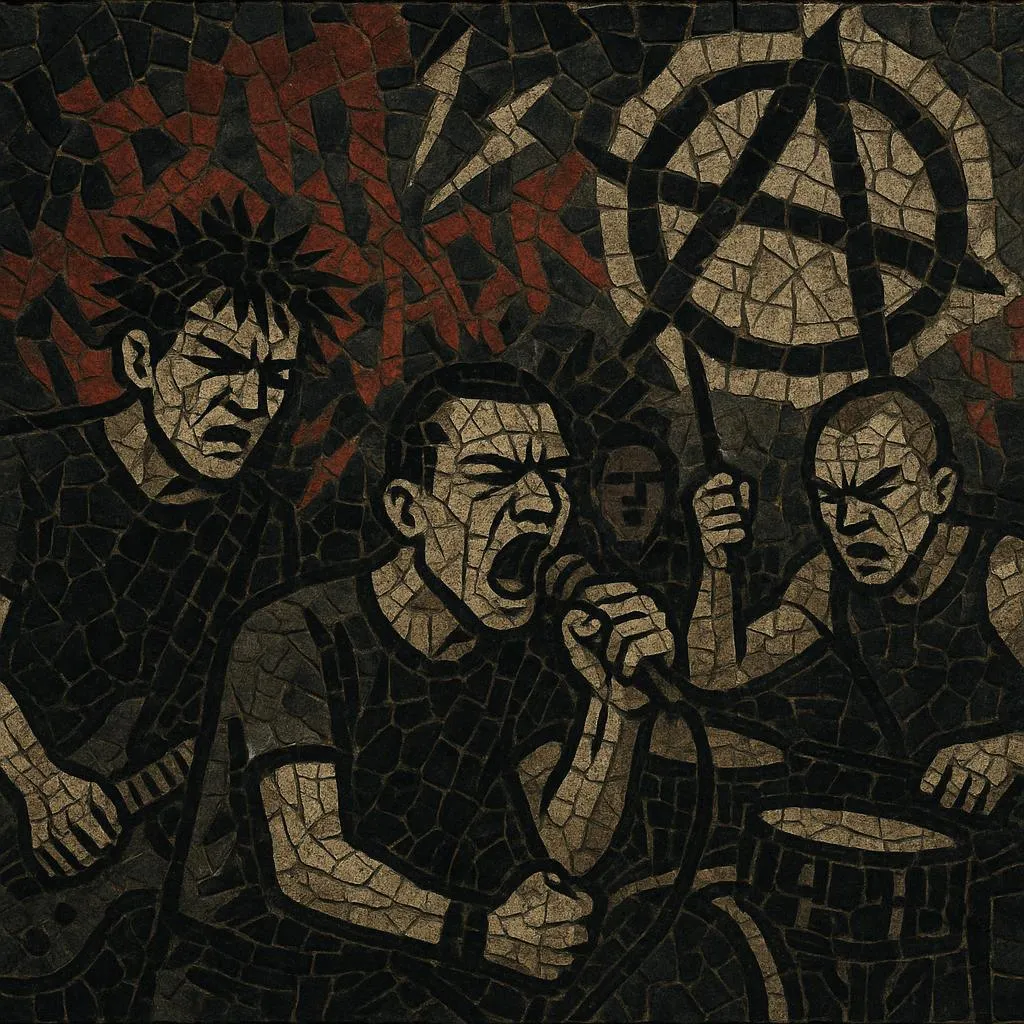
Deep hardcore punk refers to the rawest, most underground stratum of hardcore punk—bands and recordings that sit closer to the genre’s DIY core than to its crossover or mainstream offshoots.
It emphasizes speed, short song lengths, biting social or anti-authoritarian lyrics, unpolished recording aesthetics, and a ferocious, tightly locked band feel. Compared to broader “hardcore punk,” the “deep” lens privileges lesser-circulated 7-inches, rehearsal-room ragers, international scenes, and overlooked regional bands whose intensity and austerity shaped the genre’s DNA as much as its famous flag-bearers.
Expect blistering tempos, d-beat and two-step variations, gang shouts, caustic guitars, and performances that feel urgent, immediate, and deliberately abrasive.


History
Hardcore punk emerged in the United States at the turn of the 1980s as a faster, harsher acceleration of 1970s punk. The “deep” vein of hardcore took root in local DIY circuits—church basements, VFW halls, squats, and tiny clubs—where bands pressed their own 7-inches, booked their own tours, and built scenes around zines and tape trading. Regional sounds coalesced: Los Angeles (Black Flag, Circle Jerks), Washington, D.C. (Minor Threat, S.O.A.), Detroit (Negative Approach), Boston (SSD, Jerry’s Kids), and New York (Agnostic Front), alongside parallel eruptions in the UK (Discharge and the UK82 wave), Italy, Sweden, Japan, and beyond.
Quickly, international scenes refined the form. Discharge’s pummeling d-beat and politically charged minimalism catalyzed a worldwide underground, with Anti Cimex and Shitlickers in Sweden, Wretched and Raw Power in Italy, Gauze and later Death Side in Japan—all pushing the aesthetic toward ever-tighter, more severe permutations. These bands often prioritized immediacy over fidelity, capturing a palpable room-energy on tape that became a sonic signature of deep hardcore.
As the 1990s unfolded, deep hardcore’s most unrelenting edges helped seed powerviolence (shorter, faster, noisier), crust punk (hardcore’s pace fused with anarcho/metal grit), and the breakneck economy of thrashcore and early grindcore. Even as parts of hardcore intersected with metal (crossover thrash, proto-metalcore), the deep tradition persisted in basements and micro-labels, preserving the essential hardcore grammar: velocity, concision, and direct action.
Subsequent decades saw constant rediscovery—reissues of obscure EPs, archival uploads, international tours—and new bands adopting classic methods: raw recording, militant DIY ethics, and compressed song forms. In today’s landscape, “deep hardcore punk” often names both a curatorial focus (digging below canonical acts) and a living practice: high-BPM, high-stakes music that remains a vessel for community, confrontation, and catharsis.



Best playlists

![New York City Hardcore The Way It Is [Full Album]](https://i.ytimg.com/vi/aSREW7V3EBI/hqdefault.jpg)
![A.F.K - Ruled by the Insane [2019 Hardcore Punk]](https://i.ytimg.com/vi/M3-T0Xam7o4/hqdefault.jpg)
