Your digging level
Description
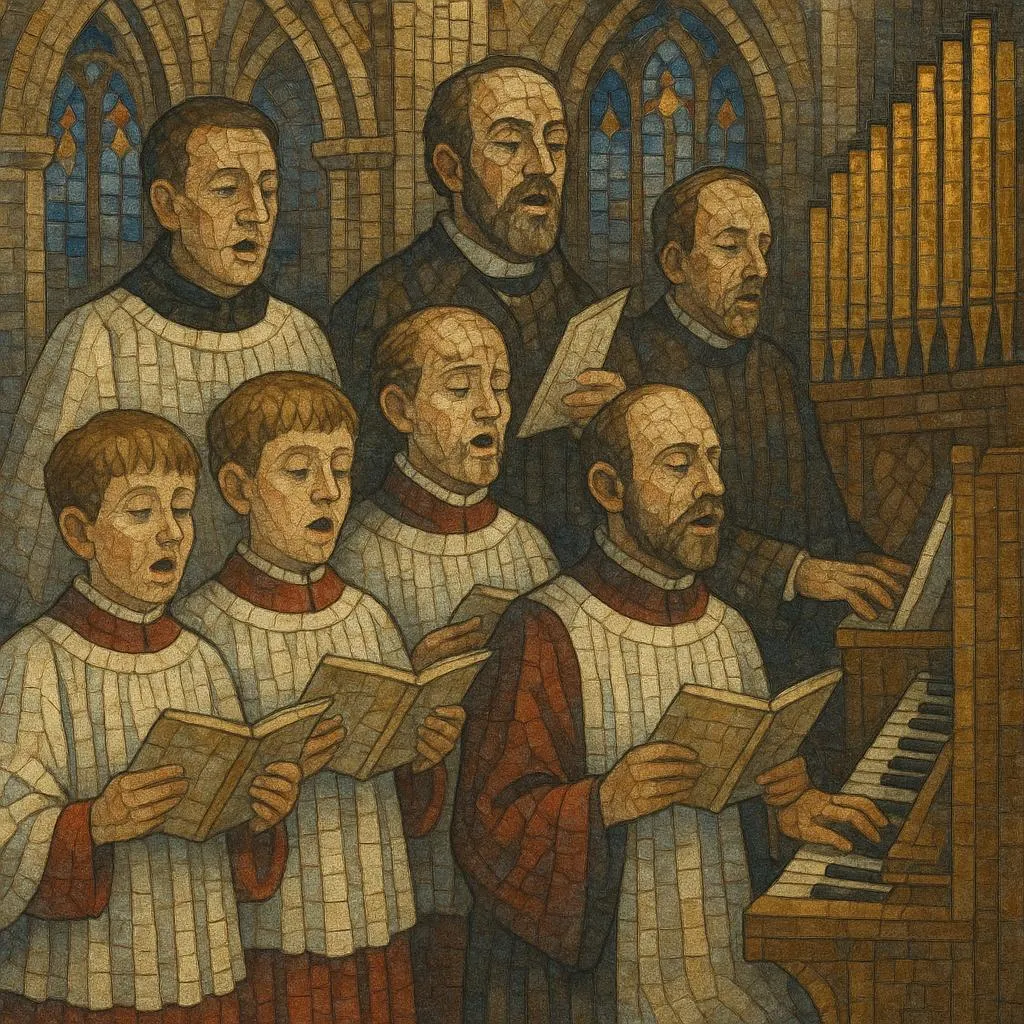
Cathedral choir is the choral tradition attached to Anglican and (later) Roman Catholic cathedrals in Britain, defined by daily liturgical singing in large, reverberant ecclesiastical spaces. The core sound emphasizes a pure, blended tone; treble lines historically sung by boys (in many places now also girls) supported by adult altos (often countertenors), tenors, and basses, with pipe organ accompaniment.
Its repertory spans psalmody (often to Anglican chant), anthems, services (settings of the Magnificat and Nunc dimittis for Evensong; canticles for Matins and Eucharist), and seasonal carols and hymns. Texts moved from Latin to English after the Reformation, yet Renaissance polyphony, Romantic and 20th‑century cathedral composers (e.g., Stanford, Parry, Howells), and contemporary church music all coexist in the living canon.
The hallmark aesthetic is luminous treble melody, long-breathed phrasing shaped by cathedral acoustics, dignified rhetoric, and organ-led harmonic color—at once devotional, architectural, and unmistakably English.
History
Cathedral choirs grow out of medieval monastic and secular cathedral “choirs” (choir schools) that maintained daily sung offices. Plainchant and late medieval English polyphony formed the musical bedrock. Following the English Reformation, choirs were reconstituted within the Church of England, and composers such as Thomas Tallis, William Byrd, and Orlando Gibbons supplied Latin and English service music, anthems, and psalm settings that set the template for Anglican worship.
After the upheavals of the 17th century, the Restoration revived cathedral music-making. In the 18th and, especially, the 19th century, the cathedral choir became a civic-cultural emblem supported by choir schools and flourishing organ-building. Composers like S.S. Wesley, Charles Villiers Stanford, and C. Hubert H. Parry defined a grand, harmonically rich “cathedral style,” codifying Evensong cycles and the anthemic repertory.
In the 20th century, the sound ideal—straight tone, clarity of diction, and treble-led luminosity—was sharpened by influential choirmasters and enhanced by radio recordings. Herbert Howells, Harold Darke, T.T. Noble, and later Kenneth Leighton and Jonathan Dove expanded the harmonic palette (lush extended tertian sonorities, modality, and expressive “Amen” cadences) while preserving liturgical clarity.
The cathedral model spread across the UK and Commonwealth and influenced professional and collegiate chapel choirs. Many cathedrals added girls’ choirs and mixed treble lines, while repertoire diversified to include newly commissioned works and ecumenical styles. Today, daily choral services (especially Choral Evensong) remain a living tradition, widely streamed and recorded, sustaining an evolving but continuous lineage from chant to contemporary sacred music.