Your digging level
Description
English Renaissance music refers to the flourishing of sacred and secular composition in England from the early 16th century through the early 17th century. It is characterized by rich modal polyphony, careful text setting, and a distinctive color that often features expressive cross-relations ("English false relations").
The tradition encompasses large-scale Latin and English church works (Masses, motets, anthems, and services), as well as an influential secular output including madrigals, lute songs (ayres), consort songs, and instrumental music for viols and keyboard (the Virginalist school). Dance-derived forms such as the pavan and galliard, and variation techniques over ground basses (e.g., romanesca, passamezzo) are hallmarks of the instrumental style.
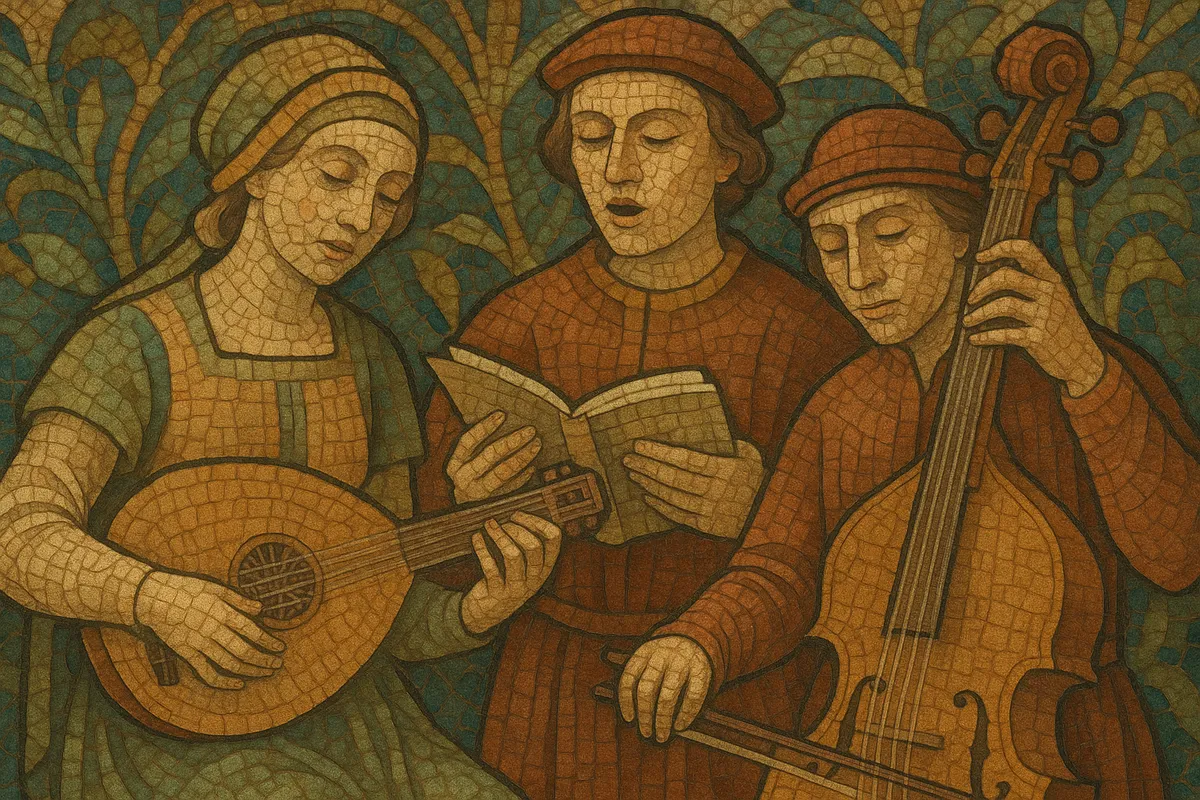
Instrumentation typically centers on choir, viol consort, lute, and virginals/harpsichord, with an idiom that balances imitative counterpoint and clear declamation. The period witnessed a golden age under the Tudors and early Stuarts, culminating in composers such as Tallis, Byrd, Morley, Dowland, and Gibbons.
History
The English Renaissance grew out of late medieval traditions nurtured in royal, collegiate, and monastic chapels, with the Eton Choirbook (c. 1500) signaling a sophisticated choral culture. Under the early Tudors, Latin polyphony flourished alongside courtly song and instrumental consort practice.
Religious upheaval reshaped musical language and function. While composers such as John Taverner established grand Latin works, the English Reformation introduced vernacular worship. This transition fostered the anthem and the service, genres designed for clear textual comprehension in English. Thomas Tallis, Christopher Tye, and Robert Parsons crafted both Latin and English music, moving fluidly between traditions during shifting confessional climates.
Under Elizabeth I, a remarkable synthesis emerged. William Byrd achieved unparalleled mastery in both Catholic Latin polyphony and Anglican forms, while Thomas Morley and Thomas Weelkes led the English madrigal school—sparked by the publication of Musica transalpina (1588), which imported Italian madrigals into England. John Dowland elevated the lute song (ayre), blending poetic melancholy with refined counterpoint and expressive text painting.
Instrumental music blossomed through viol consorts and keyboard repertoire. Dance pairs (pavan/galliard), fantasias, and variations over grounds became central. The Virginalist school—Byrd, John Bull, Giles Farnaby, and others—left a substantial legacy preserved in sources like the Fitzwilliam Virginal Book, showcasing brilliance in figuration, diminutions, and structural clarity.
Composers such as Orlando Gibbons and Thomas Tomkins bridged late Renaissance idioms with emerging Baroque sensibilities. The English choral and consort traditions left a deep imprint on the Anglican cathedral style, hymnody, and later English composers. Though political and religious turmoil in the mid-17th century disrupted patronage, the techniques and aesthetics of this era continued to inform English sacred and secular music for centuries.