Your digging level

For this genre
0/8
🏆
Sign in, then listen to this genre to level up

Description

Ballroom dance music is purpose‑built, strictly paced popular music written or arranged to support partner dances in the ballroom tradition. It emphasizes a clear, steady beat, predictable phrasing, and dance‑appropriate tempi so that figures and footwork align naturally with the music.

In practice it spans two internationally codified families: International Standard (Waltz, Tango, Viennese Waltz, Foxtrot, Quickstep) and International Latin (Cha‑Cha‑Cha, Samba, Rumba, Paso Doble, Jive), alongside the American Smooth/Rhythm syllabi used in the United States. Modern tempos and competition lengths are standardized by bodies such as the ISTD (UK) and NDCA (US), ensuring music is reliably “strict tempo” for teaching, social dancing, and Dancesport.


Sources: Spotify, Wikipedia, Discogs, Rate Your Music, MusicBrainz, and other online sources

History

19th‑century roots to early 20th‑century ballrooms

European and American social dance repertoires (notably the waltz and later foxtrot and tango) formed the musical bedrock that would become modern ballroom dance music. As these styles converged in urban dance halls and hotel ballrooms, bands arranged repertoire with steady, danceable tempos and eight‑bar phrasing to suit the floor.

UK codification and the rise of “strict tempo”

In 1924 the Imperial Society of Teachers of Dancing (ISTD) created a Ballroom Branch to unify technique and musical practice; in 1947 its Ballroom Committee standardized ballroom technique adopted worldwide. This codification cemented both step vocabulary and the musical parameters (time signatures, characteristic rhythms, and target tempos) that define ballroom dance music.

Dance‑band and big‑band era (1930s–1950s)

The interwar and postwar decades saw dance orchestras tailor repertoire to ballroom floors. In Britain, Victor Silvester popularized “strict tempo” recordings precisely matching ISTD tempos; in the U.S., hotel and radio dance bands (e.g., Glenn Miller, Guy Lombardo, Lawrence Welk) supplied waltzes, foxtrots, and swings for crowded ballrooms and supper clubs.

International Standard & Latin; the Ten‑Dance model

By the mid‑20th century, International Standard and Latin syllabi crystallized into five dances each, forming the Ten‑Dance format for competition (Waltz, Tango, Viennese Waltz, Foxtrot, Quickstep; plus Rumba, Samba, Cha‑Cha‑Cha, Paso Doble, Jive). Latin idioms drew directly from Afro‑Cuban sources (son/bolero‑son for ballroom rumba; later cha‑cha‑cha), adapted into strict‑tempo ballroom arrangements.

Contemporary practice and tempos

Today, national bodies publish tempo bands and round lengths so music remains comfortably danceable in lessons and at competitions. Current reference ranges (e.g., Waltz ~84–90 BPM; Quickstep ~200 BPM; Rumba ~88–108 BPM) guide arrangers, DJs, and adjudicators alike.

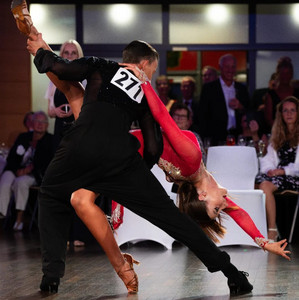
How to make a track in this genre

1) Pick the dance and lock the fundamentals
•   Choose a syllabus dance (e.g., Waltz, Tango, Foxtrot, Quickstep, Viennese Waltz; Rumba, Cha‑Cha‑Cha, Samba, Paso Doble, Jive). •   Set time signature and target tempo within sanctioned ranges (e.g., Waltz 3/4 at ~84–90 BPM; Foxtrot 4/4 at ~112–120 BPM; Rumba 4/4 ~88–108 BPM; Quickstep 4/4 ~192–208 BPM; Jive 4/4 ~168–176 BPM). Keep the tempo unwavering (“strict tempo”).
2) Arrange for clarity of pulse and phrase
•   Use 4‑ or 8‑bar phrase structure and 32‑bar song forms (AABA/ABAC) so figures resolve neatly on phrase boundaries. •   Ensure a clearly articulated downbeat and predictable cadences; avoid rubato. •   For Standard dances, favor smooth, legato melody over a steady rhythm section; for Latin, foreground groove and syncopation while retaining metronomic pulse.
3) Instrumentation & groove cues
•   Standard/Smooth: dance‑band or studio rhythm section (drum kit with closed hi‑hat on 2&4, upright/electric bass, comping piano/guitar), plus strings and/or reeds; use walking bass for Foxtrot, lilting “oom‑pah‑pah” for Waltz, clipped, staccato accents for Tango. •   Latin/Rhythm: add Latin percussion (claves, congas/bongos, timbales, maracas), montuno‑style piano or guitar, and bass tumbao; for Jive use a swinging backbeat and crisp ride‑cymbal pattern; for Paso Doble, build around “España Cañi”–style periods and the dramatic “crash” point (competition rounds often stop at the second crash).
4) Length, intros, and endings
•   Write/prepare 90–120‑second edits for most rounds (VW and PD have specific allowances); add a 2–4 bar count‑in and a clean, decisive ending.
5) Mix & production
•   Prioritize kick/bass clarity for floor feel; gentle bus compression for consistency; avoid large tempo maps or ritards. •   Verify with dancers/teachers and adjust BPM if the room or floor density demands micro‑tweaks.

Top tracks

Locked
Share your favorite track to unlock other users’ top tracks
Influenced by
Has influenced
Challenges
Digger Battle
Let's see who can find the best track in this genre

Download our mobile app

Get the Melodigging app and start digging for new genres on the go
© 2026 Melodigging
Melodding was created as a tribute to Every Noise at Once, which inspired us to help curious minds keep digging into music's ever-evolving genres.
Buy me a coffee for Melodigging