Your digging level
Description
West Asian music refers to the interconnected modal and rhythmic traditions from Anatolia, the Levant, Mesopotamia, the Caucasus, the Arabian Peninsula, and Iran. While its roots reach back to ancient Mesopotamian and Near Eastern musics, the core theoretical frameworks were consolidated during the medieval Islamic Golden Age, especially in Abbasid Baghdad and Persian courts.
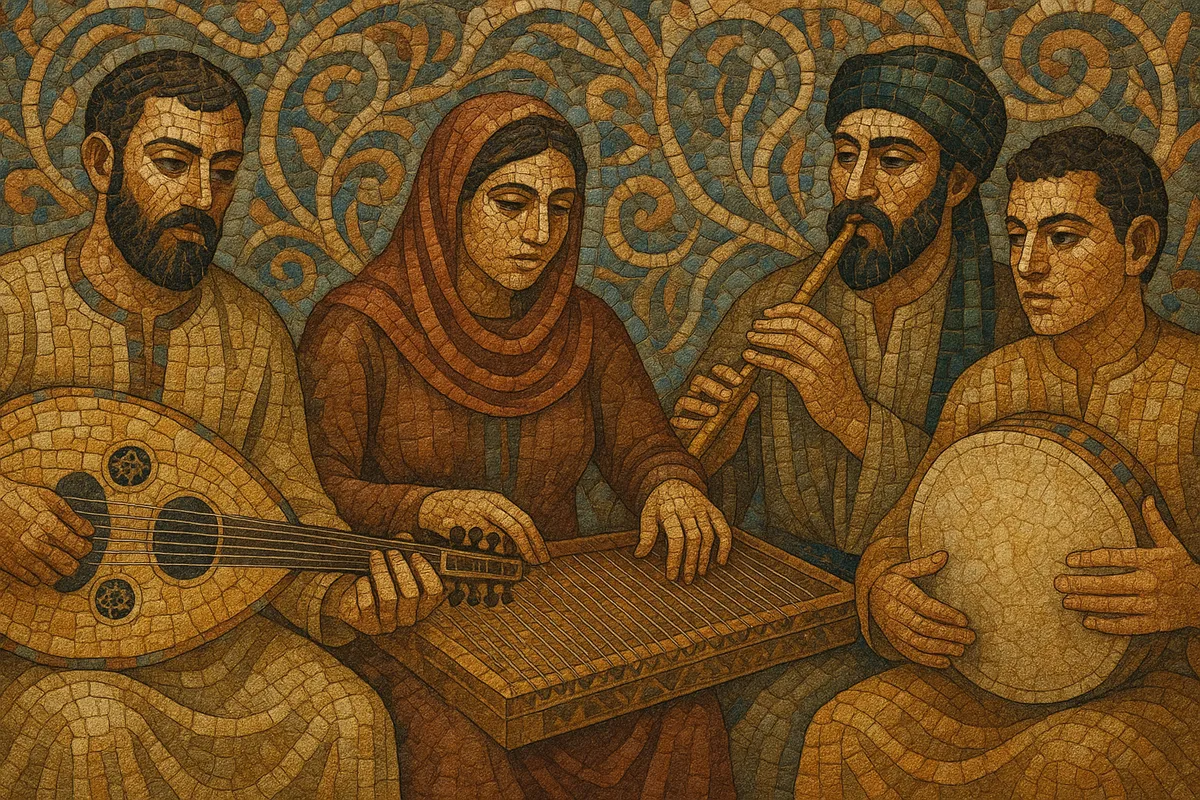
Its sound world is defined by modal systems (maqām in the Arab world, dastgāh in Iran, makam in Turkey, mugham in Azerbaijan), cyclical rhythms (iqaʿ/uşûl), microtonal inflections, extensive ornamentation, and a primarily monophonic or heterophonic ensemble texture. Signature instruments include the ʿūd, qanun, ney, kamancheh, santur, tar, saz/bağlama, duduk, zurna, riqq, daf, and darbuka. Improvised preludes (taqsīm/taksim), composed instrumental forms (samaʿi, peşrev, longa), and vocal arts that set classical or folk poetry are central performance practices.
Across centuries, West Asian music has shaped and been shaped by courtly, sacred, and folk contexts—Sufi ritual and dhikr, urban salon and café cultures, seasonal festivals, and modern concert stages—while continuing to adapt in dialogue with recording technologies, broadcasting, and global popular genres.
History
The oldest antecedents of West Asian music are traced to ancient Mesopotamian, Levantine, and Anatolian cultures, evidenced by cuneiform hymns, iconography of harps and lyres, and early theoretic hints. Liturgical traditions such as Syriac and other Near Eastern Christian chants, as well as Jewish Levantine practices, transmitted melodic formulas and modal thinking across centuries.
Between the 800s and 1200s, theorists active around Abbasid Baghdad and Persian courts—al-Kindī, al-Fārābī, Ibn Sīnā (Avicenna), and later Ṣafī al-Dīn al-Urmawī—systematized scale organization, rhythmic cycles, and melodic procedure. This era consolidated frameworks that underlie Arab maqām, Persian dastgāh, Ottoman makam, and Caucasian mugham. Court patronage, urban performance, and scholarly treatises formed a shared intellectual-musical sphere spanning Arabic-, Persian-, and Turkic-speaking regions.
From the 15th to 19th centuries, musical life in Istanbul, Isfahan/Tehran, Aleppo, Damascus, Baghdad, and the Caucasus saw intense exchange. Sufi orders (Mevlevi, Qadiri, Naqshbandi) cultivated distinct repertoires; instrumental genres like peşrev, semai/samaʿi, and longas circulated widely. Local styles—such as the Iraqi maqam suite, Persian radif, Ottoman fasıl, and Azerbaijani mugham—crystallized, each articulating regional modal flavors and performance etiquette.
Radio, gramophone, and conservatories professionalized musicianship and standardized pedagogy. National projects reframed court and folk genres into modern concert formats, while cosmopolitan cities fostered orchestral arrangements and new songwriting. Political upheavals and diasporas carried West Asian idioms to Europe and the Americas, catalyzing hybridizations with jazz, rock, and later electronic music.
Today, virtuosi maintain classical lineages (radif, maqam, makam, mugham) alongside thriving popular and indie scenes. Cross-border collaborations, film and television soundtracks, and global festivals have amplified West Asian timbres and modal sensibilities in world, electronic, and art music. Digital platforms sustain local traditions, archival revivals, and bold fusions that keep the region’s musical languages vibrant.