Your digging level

For this genre
0/8
🏆
Sign in, then listen to this genre to level up

Description

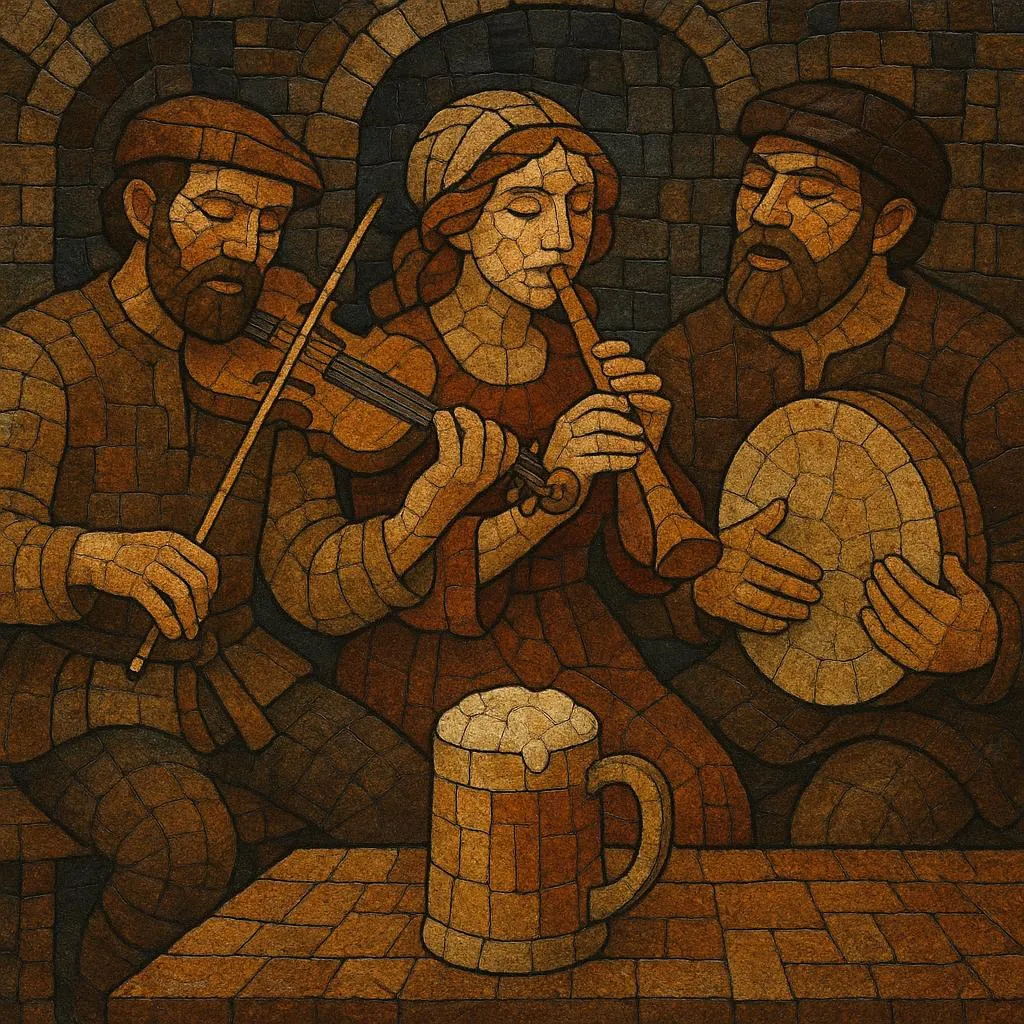
Tavern music refers to the lively, communal songs and dance tunes historically heard in inns, alehouses, and taverns across Britain and continental Europe. It blends rustic dance forms with sing‑along choruses, drinking toasts, bawdy humor, and ballad storytelling.

Musically, the style favors acoustic, portable instruments—fiddles, flutes and whistles, lutes/citterns, hurdy‑gurdy, hand drums (frame drum, tabor, bodhrán), small pipes, and simple bass drones. Rhythms often follow folk dance meters (reels in 4/4, jigs in 6/8, hornpipes with dotted swing), melodies sit in modal keys (Dorian, Mixolydian, Aeolian), and harmonies stay uncomplicated with open fifths and triads to keep the energy focused on participation.

In the modern imagination—fueled by folk revivals, historical reenactment, LARP, and fantasy media—“tavern” evokes clinking mugs, stomping floors, call‑and‑response refrains, and boisterous camaraderie. Sessions can also include gentler airs and narrative ballads between the rowdy sets.


Sources: Spotify, Wikipedia, Discogs, RYM, MB, user feedback and other online sources

History

Origins (late Medieval to Renaissance)

Tavern music grew from the everyday soundscape of medieval and early modern public houses where travelers, artisans, and locals gathered. While courtly and sacred repertoires dominated manuscripts, secular dance tunes, catches, and simple ballads circulated orally. As urban taverns blossomed in the 16th–17th centuries, convivial singing—rounds, catches, and drinking songs—became a social ritual, with portable instruments accompanying dances and toasts.

Early Modern Pub Culture and Balladry

In England and across the Isles, broadside ballads and strophic story‑songs thrived in alehouses, while rustic dance forms (jigs, reels, hornpipes) animated floors. Continental inns echoed similar strains—fiddles, pipes, and drums supporting communal refrains and improvised harmonies. The music emphasized participation over polish, reinforcing taverns as sites of community memory, humor, and social release.

19th–20th Century Transmission and Revival

Industrialization and changing leisure habits shifted music‑making into more formal venues, yet tavern repertoire lived on in local folk traditions and pub sessions. The 20th‑century folk revival documented and re‑energized session culture, normalizing the set‑based dance tune medley (AABB forms) and chorus‑led songs in bars and folk clubs.

Contemporary Reimagining

From the late 20th century onward, historical reenactment, Renaissance fairs, and a surge of Celtic/medieval folk acts reframed “tavern” as a vivid performance aesthetic. In the 2010s–2020s, tabletop games, RPGs, and fantasy media popularized “medieval tavern” playlists, merging older pub‑session practices with modal folk, rustic percussion, and sing‑along hooks for an immersive, communal sound.

How to make a track in this genre

Core Instrumentation
•   Melody: fiddle, wooden flute/whistle (D/C), small pipes, hurdy‑gurdy, recorder. •   Harmony/texture: lute/cittern/guitar, accordion/concertina, droning instruments (bagpipe/organetto), occasional bass viol. •   Rhythm: frame drum (bodhrán), tabor, stomps/claps; keep percussion earthy and unpolished.
Rhythm & Forms
•   Alternate lively dance sets (reels in 4/4 straight; jigs in 6/8; hornpipes with dotted swing) with slower airs/ballads. •   Use simple binary tune structures (AABB), chaining 2–3 tunes in related keys for a rousing “set.” •   Tempi: reels ~100–120 BPM (half‑note feel), jigs ~110–130 BPM (dotted‑quarter feel), adjusting for sing‑along comfort.
Harmony, Modes & Texture
•   Favor modal colors (Dorian for rugged grit, Mixolydian for bright lift, Aeolian for laments). •   Keep chords rustic: i–VII–VI or i–VII progressions (in Dorian), I–bVII–IV (in Mixolydian); frequent pedal drones and open fifths. •   Use parallel 3rds/6ths sparingly; let melody/drone lead, with strummed accompaniment and occasional bourdon.
Melody & Ornamentation
•   Fiddle/pipe ornaments: cuts, rolls, mordents, slides; short pick‑ups into phrases. •   Write memorable, vocally comfortable choruses with limited range so groups can join easily.
Lyrics & Delivery
•   Themes: ale and camaraderie, mischief, travel, roguish romance, local legends, mock‑heroics. •   Forms: strophic verses with a strong refrain; encourage call‑and‑response (“leader” lines answered by crowd/ensemble). •   Keep diction clear and cadences obvious so a room can latch on by verse two.
Ensemble Practice & Production
•   Arrange dynamics: start with solo melody or hand‑drum pulse, layer instruments, then drop to voices for refrains. •   Capture room energy: minimal processing, close mics plus a bit of warm room reverb; leave foot‑stomps and crowd claps in. •   Invite breaks: whistle/fiddle solos between verses; modulate up a step for a final chorus if voices can follow.

Top tracks

Locked
Share your favorite track to unlock other users’ top tracks

Upcoming concerts

in this genre
Influenced by
Has influenced

Download our mobile app

Get the Melodigging app and start digging for new genres on the go
© 2026 Melodigging
Melodding was created as a tribute to Every Noise at Once, which inspired us to help curious minds keep digging into music's ever-evolving genres.
Buy me a coffee for Melodigging