Your digging level
Description
Celtic folk music is the modern umbrella for living folk traditions that grew from the Celtic-speaking regions of Ireland, Scotland, Wales, Cornwall, the Isle of Man, Brittany (France), and the northwestern Iberian areas of Galicia, Asturias, and Cantabria, as well as Trás-os-Montes in Portugal.
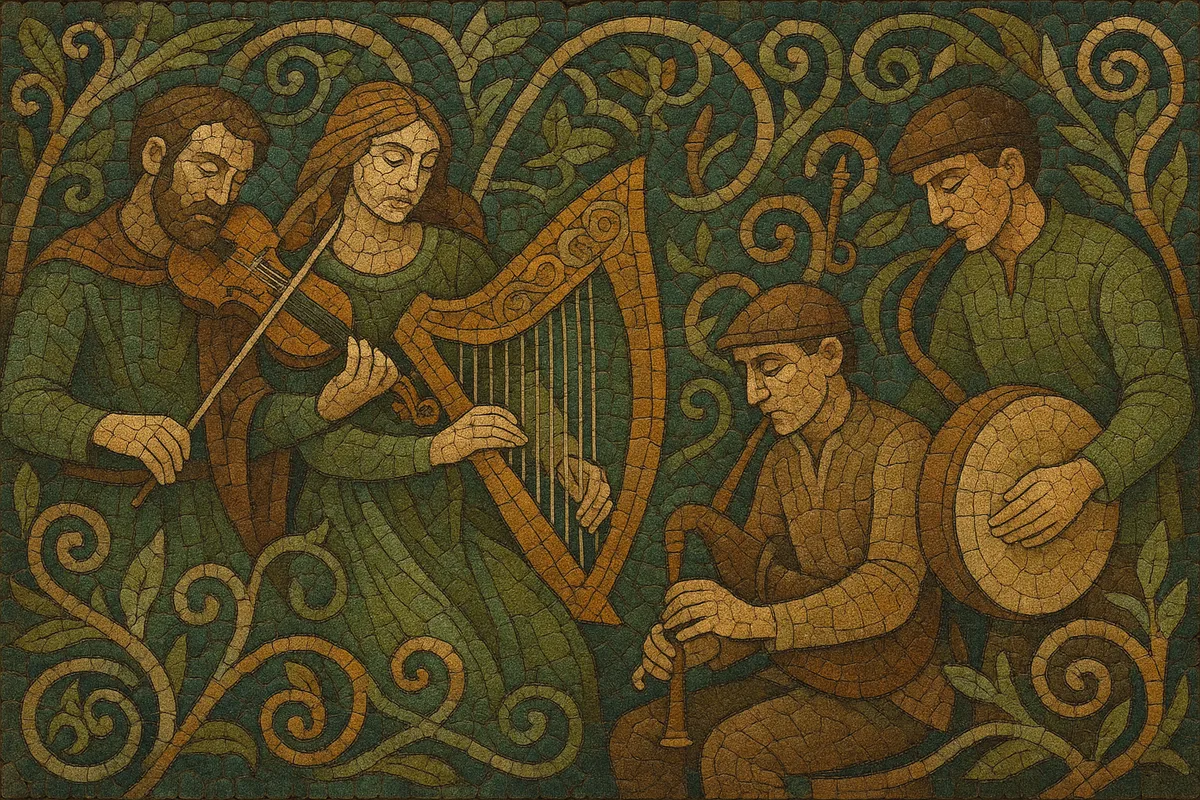
It centers on modal melodies (often Dorian and Mixolydian), strong dance rhythms (reels, jigs, hornpipes, polkas, strathspeys), and richly ornamented tune-playing on fiddle, flutes and whistles, bagpipes (Uilleann and Highland), harp, accordion/concertina, and increasingly the Irish bouzouki and guitar. Vocal styles range from unaccompanied sean-nós and Gaelic ballads to chorus-led pub songs, with themes of landscape, seafaring, migration, love, labor, resistance, and communal memory.
Arrangements frequently present sets of tunes—several related dance airs played back-to-back at rising intensity—supported by drone textures, syncopated bodhrán patterns, and modal pedal points, creating a propulsive, earthy, and often celebratory sound.
History
Celtic folk music descends from centuries-old rural and maritime traditions across the Celtic world. Dance-airs (jigs, reels, hornpipes, strathspeys), work songs, laments, and narrative ballads evolved within Irish- and Gaelic-speaking communities, Breton fest-noz circles, and Galician-Asturian romerías. Instruments such as harp, pipes, and fiddle were central to courtly, clan, and village life, while unaccompanied singing (e.g., Irish sean-nós and Scottish Gaelic song) maintained highly ornamented, free-rhythm styles.
From the 18th–19th centuries, collectors (e.g., Edward Bunting in Ireland, Francis James Child in the Anglo-Celtic tradition) notated repertoires that had previously been taught orally. Diaspora to North America transmitted Scots-Irish dance tunes and balladry to Appalachia and the Maritimes, foreshadowing American old-time, bluegrass, and country lineages.
A pan-Celtic awareness coalesced during the postwar folk revival. In Ireland, The Dubliners, The Chieftains, Planxty, and The Bothy Band modernized ensemble craft, introduced guitar/bouzouki backlines, and popularized tune sets. In Scotland, innovators such as The Tannahill Weavers and Capercaillie elevated Gaelic song and Highland piping within contemporary arrangements. In Brittany, Alan Stivell’s electric harp and fest-noz revivals reframed Breton music for international audiences. This period standardized the now-familiar session culture and studio aesthetics of “Celtic folk.”
From the 1990s, Celtic folk informed a spectrum of crossovers: Celtic rock and punk, Celtic new age, and electronic fusions, while traditional scenes deepened virtuosity (e.g., Lúnasa, Altan). Diasporic artists and media broadened the audience, and sessions spread worldwide. Today, regional styles remain distinct yet dialogic—Irish reels, Scottish strathspeys, Breton an dro and hanter dro, Galician muñeiras—within a shared, modern pan-Celtic identity.
Celtic folk continues to animate social dance, language revitalization, and community ritual, while serving as a foundational influence on British/Irish folk-rock and American roots idioms.