Your digging level
Description
Shabad is the Sikh devotional hymn repertoire drawn from the Guru Granth Sahib and related canonical sources (Dasam Granth, Rehatnamas, etc.), sung as kirtan in congregational settings (sangat) and at home.
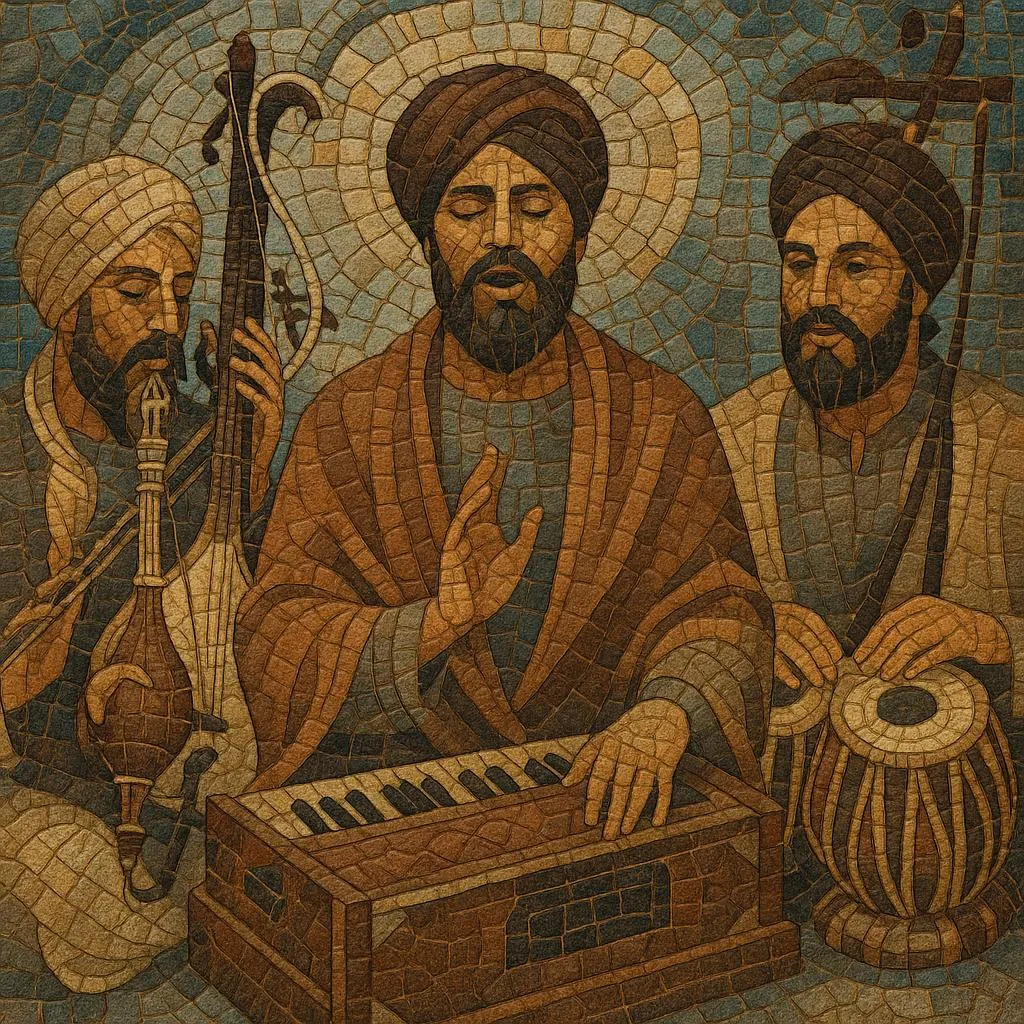
Musically, it is fundamentally raga-based: each hymn (shabad) is prefaced in the scripture by a specific raga (and often a rhythmic ghar indication), guiding the melodic framework, time-of-day association, and mood. Traditional instruments include rabab (associated with Bhai Mardana), saranda, taus, dilruba, sarangi, jori/pakhawaj, and later tabla; since the late 19th–20th centuries the harmonium became widespread. Performances typically employ a drone (tanpura or electronic shruti), meend (glides), and subtle gamak/murki ornamentation borrowed from Hindustani practice.
Linguistically, shabads are primarily in Punjabi and Sant Bhasha (Braj/Hindavi), with occurrences of Persian and Sanskrit. The texts center on Naam (Divine Name), ethical conduct, remembrance (simran), and liberation, structured with a refrain marker (rahāu) that functions as the chorus or thematic line.
History
Sikh shabad practice begins with Guru Nanak (1469–1539), who traveled with the rabab player Bhai Mardana, singing revelatory hymns within ragas familiar to North Indian art-music culture. Successive Gurus formalized performance as congregational kirtan. In 1604, Guru Arjan compiled the Ādi Granth (later Guru Granth Sahib), explicitly organizing hymns under raga headings and, in places, indicating rhythmic/structural cues (ghar), anchoring a uniquely scriptural musicology.
From the 17th century onward, hereditary and trained ragis (kirtan singers) served in Sikh courts and gurdwaras across Punjab. The repertoire included dhrupad-informed delivery (pakhawaj/jori accompaniment) and stringed bowed instruments (saranda, dilruba), with improvised alap preceding verse-based renditions. The presence of the rahāu line as a refrain shaped congregational participation and thematic focus.
Under colonial modernity and the Singh Sabha movement, harmonium and tabla became common. Print culture and early recordings disseminated shabad renditions beyond Punjab. Institutional training (e.g., at historic gurdwaras and later music academies) preserved raga adherence while accommodating evolving tastes and diasporic contexts.
Global Sikh communities fostered new jathas (ensembles), youth camps, and conservatory-style programs, catalyzing both traditional puratan (old) raga revival and contemporary settings. Broadcasts, streaming, and educational projects documented rare ragas and older instruments (taus, rabab). Today, shabad sustains a living classical-devotional continuum, from historically informed renditions to accessible hymn tunes, while remaining anchored to the Guru Granth Sahib’s raga rubric.