Your digging level
Description
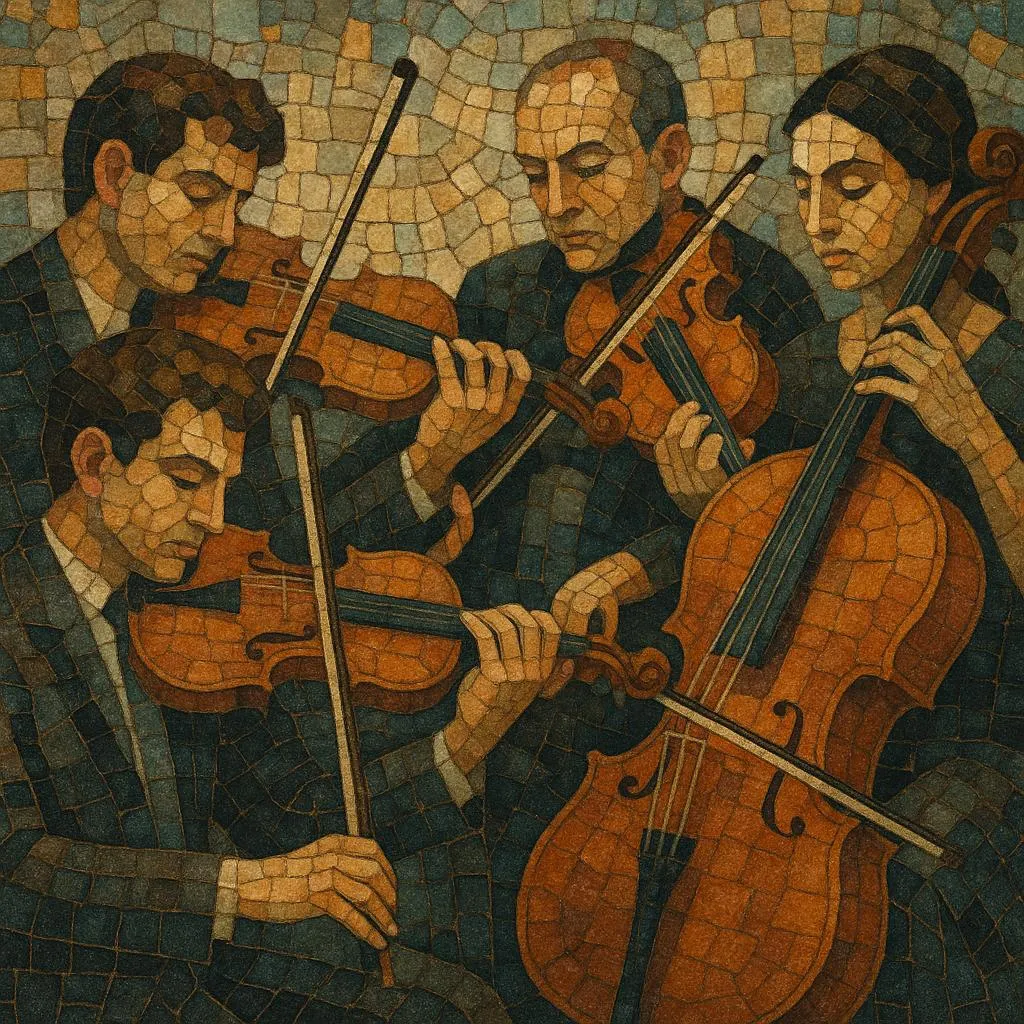
Quartetto d'archi (string quartet) denotes both a chamber ensemble of two violins, viola, and cello, and the repertoire written for that group.
It is prized for its conversational balance: four distinct voices sharing themes, trading countermelodies, and creating transparent polyphony. Classical-era quartets typically follow a four‑movement plan (fast sonata form; slow lyrical movement; minuet/scherzo; lively finale), while Romantic and modern works expand, compress, or transform the pattern.
Because the timbres are closely related yet individually characterful, the quartet is a laboratory for motivic development, harmonic subtlety, and rhythmic interplay. From its mid‑18th‑century codification to contemporary practice, it has remained the benchmark medium for intimate, architecturally rigorous musical thought.
History
The string quartet coalesced in the 1750s–1760s within the Habsburg domains, especially around Vienna and Esterháza. Informal divertimenti and serenades for mixed forces gave way to works crafted explicitly for two violins, viola, and cello. Joseph Haydn systematized the ensemble’s rhetoric—dialogue among equals, motivic economy, and a four‑movement cycle—creating a model that defined the genre’s voice.
Haydn’s mature sets established the quartet’s expressive and formal toolkit; Mozart enriched its harmonic palette and textural sophistication (often in homage to Haydn); and Beethoven both perfected and exploded the template, from the bold Op. 18 to the visionary late quartets, which expanded form, technique, and emotional scope.
Composers such as Schubert, Mendelssohn, Schumann, Brahms, Smetana, and Dvořák preserved the quartet’s intellectual rigor while deepening lyricism and national color. The ensemble moved from salons to concert halls, and professional touring quartets emerged, elevating performance standards.
The quartet became a crucible for new languages: Debussy and Ravel’s coloristic modernism; Bartók’s rhythmic and modal innovations; Schoenberg and the Second Viennese School’s atonality and serialism; Shostakovich’s personal narratives under political shadows; and postwar experiments in texture, silence, and extended technique (Lutosławski, Ligeti, Carter).
Late 20th‑ and 21st‑century composers extend the idiom with spectral harmony, microtonality, electronics, and cross‑genre collaboration. Commissioning culture, competitions, and a global network of elite ensembles have kept the quartetto d’archi central to chamber music while opening it to multimedia, improvisation, and popular idioms.
Respect ranges and speaking registers:
• Vln: G3–E7; Vla: C3–A6; Vc: C2–E5 (practical sweet spots matter). •Balance technical demands so all players contribute character without overtaxing a single part.