

Your digging level
Description
“String music” is a broad umbrella for music written primarily for bowed and/or plucked string instruments.
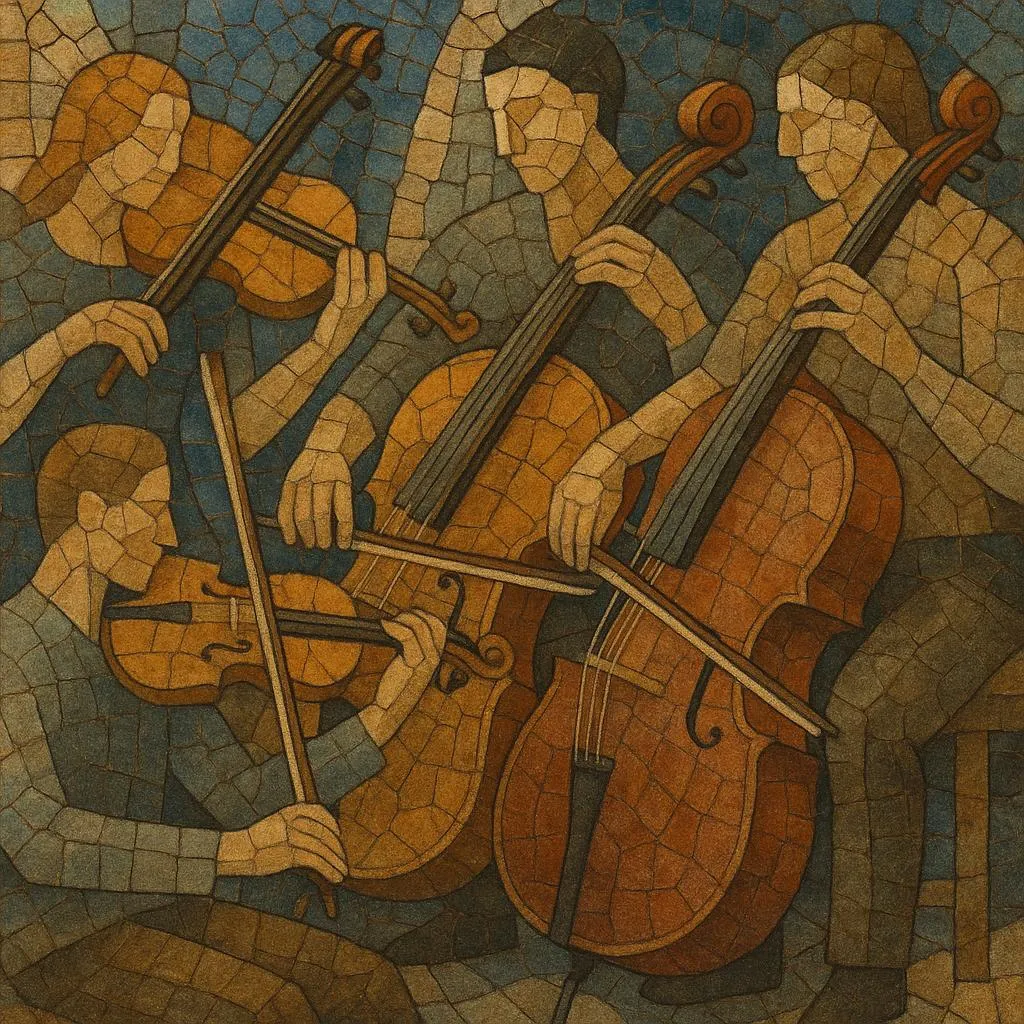
In practice it most often refers to Western art-music traditions centered on the violin family (violin, viola, cello, double bass) in settings such as string quartets, string orchestras, and larger orchestras.
The genre emphasizes sustained tone, expressive phrasing, and detailed articulation (bowing, vibrato, dynamics), and it commonly features contrapuntal writing, rich harmonic voice-leading, and idiomatic textures like tremolo, pizzicato, and double-stops.
History
String-centered writing grows out of Renaissance consort practices and dance music, with early bowed-string families and ensemble polyphony.
In the late 1500s and 1600s, the modern violin family becomes standardized and dominant in Italy. Composers develop idioms like sequential passages, basso continuo frameworks, and concerto forms that foreground strings.
By the 1700s, the string quartet and related chamber forms become central laboratories for thematic development, balanced phrasing, and harmonic clarity.
In the 1800s, string writing expands in range, dynamic extremes, lyrical intensity, and symphonic scale, with virtuosic techniques and larger ensembles.
String music diversifies into modernist timbres (extended techniques), new rhythmic languages, minimalist repetition, film scoring, and cross-genre collaborations while remaining a core classical medium.
Core bowed strings: violin(s), viola, cello; optionally double bass for depth.
•Common formats:
•String quartet (2 violins, viola, cello): tight counterpoint and conversational writing.
•String orchestra: wider, more cinematic massed sonority.
•Solo + accompaniment: lyrical spotlight with supportive texture.
Use clear phrasing (often 2-, 4-, or 8-bar units in classical-style writing), but vary with extensions and elisions.
•Exploit bow-driven articulation:
•Legato for long melodic arcs.
•Spiccato/staccato for rhythmic clarity.
•Tremolo for tension and shimmer.
•Pizzicato for percussive, lighter grooves.
Prioritize smooth voice-leading: stepwise inner motion, prepared dissonances, and resolved suspensions.
•Use divisi or double-stops sparingly to thicken harmony without losing clarity.
•For modern approaches, explore:
•Modal harmony (Dorian, Aeolian) for openness.
•Quartal/quintal sonorities for brightness.
•Pedal tones in cello/bass for grounding.
Keep fast passages in comfortable keys and positions when possible; write violin-friendly figurations (scales, arpeggios, sequences).
•Respect range and stamina:
•High violin writing is brilliant but fatiguing; balance with mid-register relief.
•Cellos sing warmly in tenor range; very low passages can lose definition at speed.




