Your digging level
Description
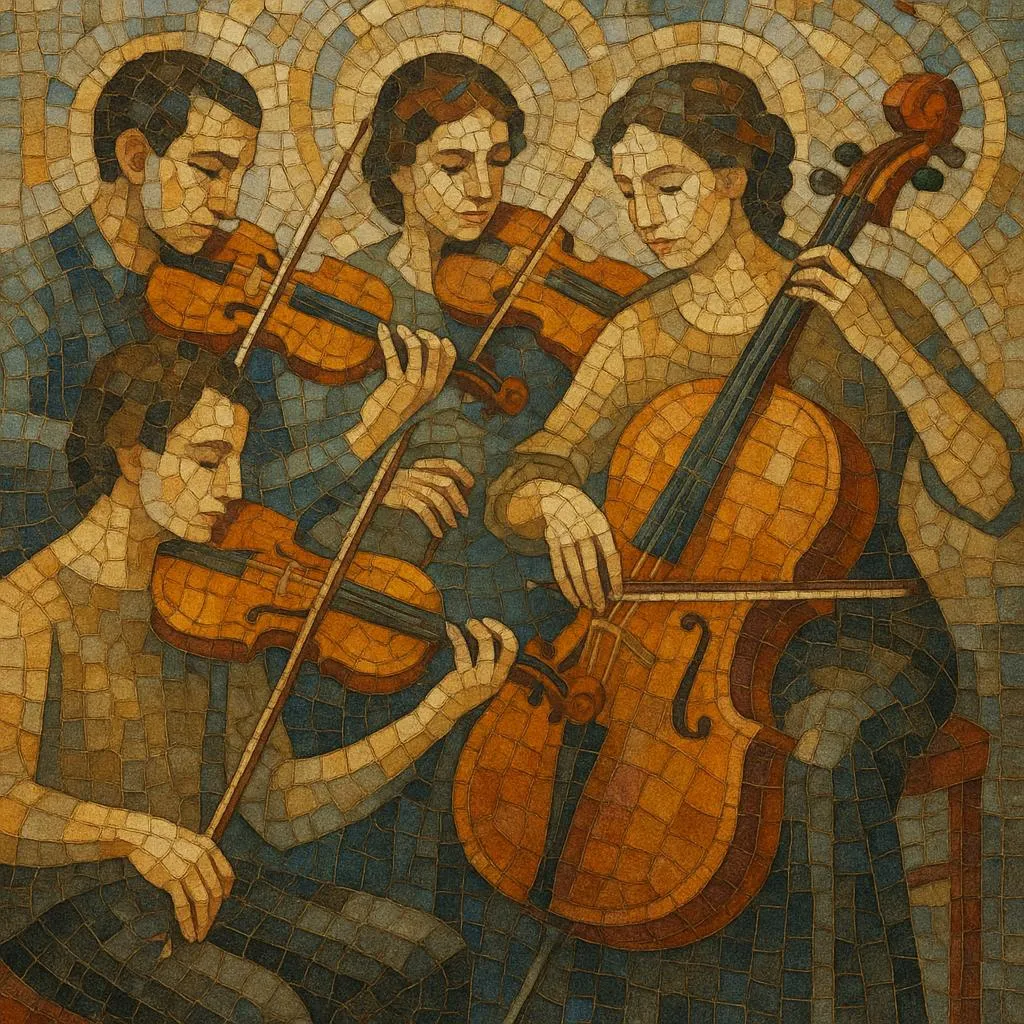
“Quatuor à cordes” (string quartet) is the cornerstone chamber ensemble of the Classical tradition, scored for two violins, viola, and cello.
It balances four independent voices in a conversational texture, making it an ideal vehicle for counterpoint, motivic development, and structural clarity. From the refinement of the Classical style to the expressive innovations of the 20th century and beyond, the string quartet has served as a laboratory for compositional ideas, intimate expression, and formal experimentation.
History
The modern string quartet coalesced in the 1760s in the Habsburg lands, where Joseph Haydn refined convivial multi-movement string ensembles into a serious, balanced form. Rooted in the social rise of chamber music among aristocratic patrons, the quartet quickly became the ideal medium for Classical poise and dialogue among four equal parts.
Haydn’s mature quartets established the four-movement model (often fast–slow–minuet/scherzo–fast), motivic economy, and witty discourse. Mozart deepened the idiom’s lyricism and harmonic sophistication, while early Beethoven pushed form, rhetoric, and instrumental technique, culminating in late quartets that reimagined structure, continuity, and expressive depth.
Schubert’s quartets fused songful melody with rich harmony and long-breathed forms; later, Brahms and Dvořák broadened texture and contrapuntal density without losing Classical balance. The ensemble’s portability made it central to 19th‑century concert life and domestic music-making alike.
Debussy and Ravel introduced timbral color, modal inflection, and cyclic form. Bartók redefined quartet writing through rhythmic asymmetry, folk materials, arch forms, and extended techniques. Shostakovich turned the medium into a personal diary across 15 quartets, blending irony, intimacy, and stark drama.
Post‑1945 composers use the quartet as a laboratory for spectral harmony, microtonality, live electronics, and extended techniques (sul ponticello, col legno, harmonics). Today the genre spans historically informed performance to genre-crossing collaborations, yet retains its core identity: intricate dialogue among four strings.