Your digging level
Description
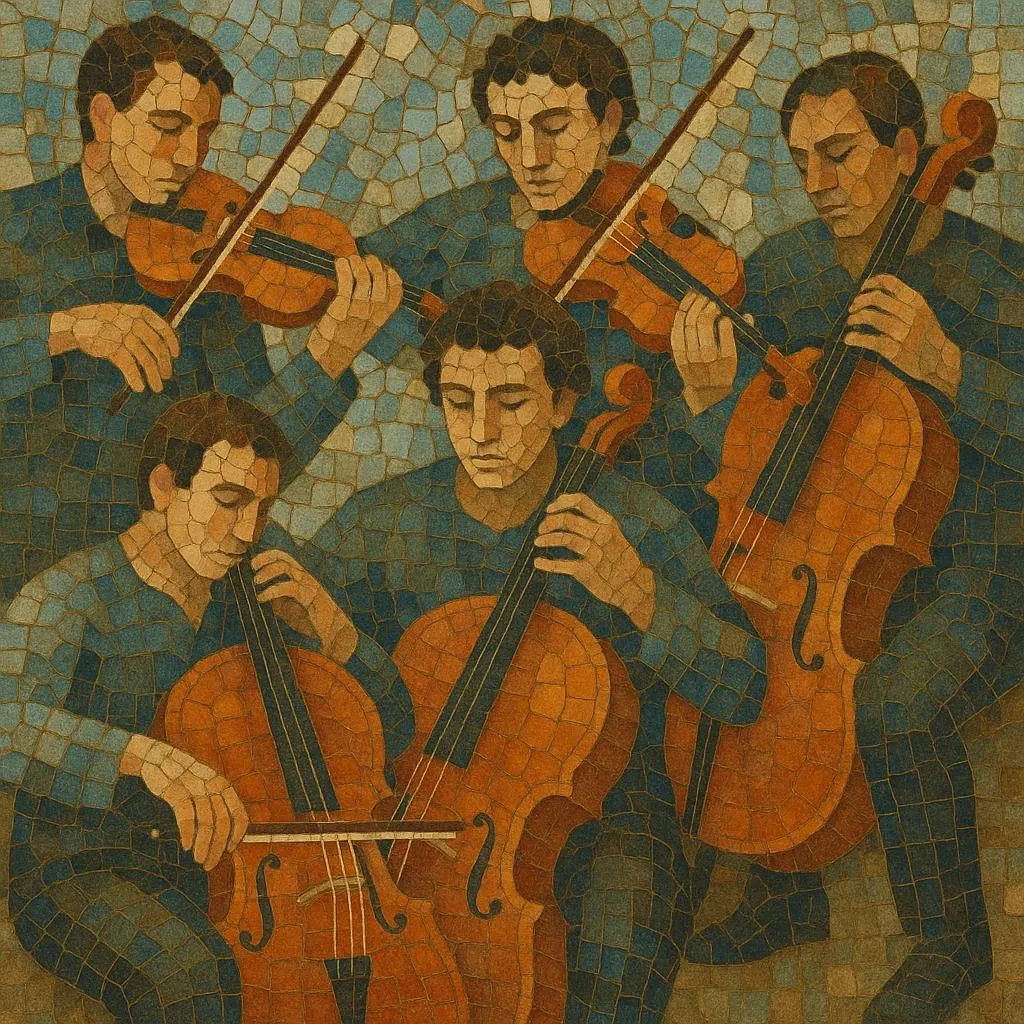
The string quintet is a chamber-music genre written for five bowed string instruments. Its most common instrumentations are either two violins, two violas, and cello (the "Mozart" configuration) or two violins, viola, and two cellos (the "Boccherini/Schubert" configuration). Less common are variants that add double bass to a string quartet, or other historic mixtures.
Musically, string quintets extend the quartet’s contrapuntal clarity and conversational balance with an extra middle or low voice, enabling thicker harmony, broader registral span, and richer color. Composers typically adopt four-movement classical forms (fast–slow–minuet/scherzo–fast), but the quintet’s added sonority invites expansive slow movements, rustic or dance-like inner movements, and highly symphonic finales.
History
The string quintet emerged in the later 18th century as an outgrowth of the Classical string quartet and broader chamber-music practices. Luigi Boccherini pioneered quintets—often with two cellos—exploiting his virtuosity as a cellist to deepen bass resonance and lyrical writing. Almost simultaneously, Viennese classicism shaped the genre through works that favored two violas (enhancing inner-part dialogue and warmth).
Wolfgang Amadeus Mozart established the two-viola model as a high classical ideal, crafting large, symphonic-scale movements with intricate counterpoint and luminous inner textures. Michael Haydn and others contributed to solidifying the quintet as a prestigious chamber format parallel to the quartet.
Romantic composers broadened the quintet’s expressive range. Franz Schubert’s C-major Quintet (with two cellos) exemplifies lyrical breadth, harmonic adventure, and orchestral imagination within chamber forces. Felix Mendelssohn refined classical balance with buoyant scherzi; Johannes Brahms deepened motivic development and autumnal color; George Onslow and Antonín Dvořák cultivated both two-viola and double-bass variants, the latter echoing salon and orchestral bass sonorities.
Anton Bruckner’s quintet transposed his cathedral-like harmony into chamber textures. Into the 20th and 21st centuries, the genre remained a laboratory for advanced harmony, texture, and form. Composers such as Sofia Gubaidulina reimagined timbre, spacing, and silence, while historically informed performance revived Classical/Romantic practice on period instruments. Today, the quintet endures in concert life, recordings, and new commissions, valued for its unique blend of clarity and symphonic depth.
Decide between the two classic layouts:
•2 violins, 2 violas, cello (warm inner voices; flexible counterpoint).
•2 violins, viola, 2 cellos (deeper sonority; expansive bass lines; lyrical cello writing).
•Alternative: quartet + double bass for broader low-end and rustic weight.
Treat each instrument as an independent voice—avoid perpetual doubling. Use the extra viola or cello to:
•Enrich inner counterpoint (two-viola model) or
•Create antiphonal dialogues and pedal points (two-cello model).
•Craft varied textures: chorale-like homophony, fugal or imitative passages, and transparent solo–accompaniment contrasts.