Your digging level
Description
A psalm is a sacred song or hymn whose lyrics come from the biblical Book of Psalms (the Psalter), part of the Hebrew Bible (Tanakh, Ketuvim) and the Christian Old Testament.
Across Jewish and Christian traditions, psalms have been sung, chanted, or set polyphonically for over two millennia, ranging from ancient Temple cantillation and synagogue modes to Gregorian psalm tones, Anglican chant, metrical congregational psalmody, and modern concert works. Because the Psalter contains laments, thanksgivings, royal hymns, and songs of praise, psalm music spans a wide expressive range—from contemplative and penitential to triumphant and ceremonial.
History
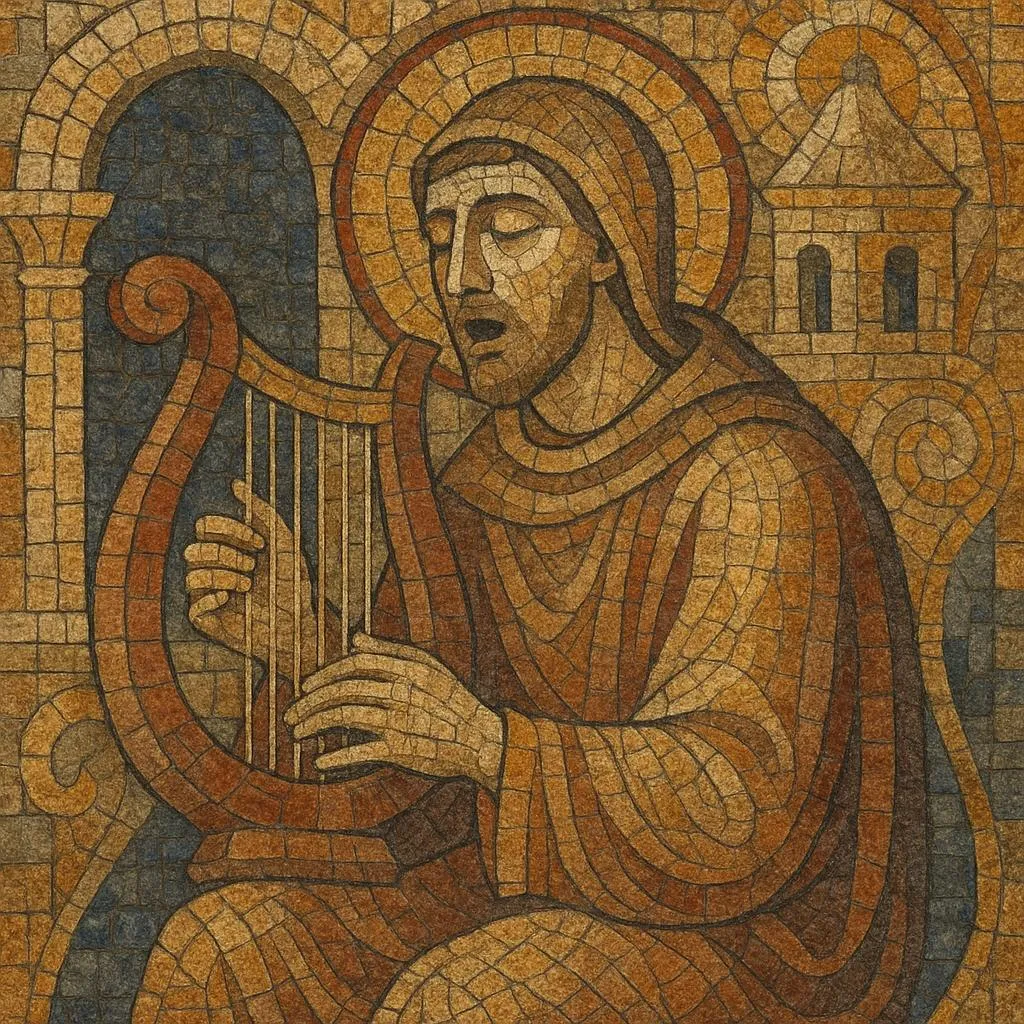
Psalms originated as Hebrew religious poems associated with worship in ancient Israel (traditionally linked to King David and later temple musicians). They were performed with vocal recitation and instrumental support (e.g., lyre, harp), shaped by priestly/Levitical musical practice. Over centuries, synagogue cantillation systems evolved to guide pitch, contour, and phrasing when chanting psalm texts.
As Christianity spread, psalm singing became central to monastic offices and public worship. In the Western Church, psalm recitation standardized around psalm tones within plainchant/Gregorian chant, using modal formulas (intonation, tenor, mediation, termination) that matched the psalm’s prose accentuation. Antiphonal and responsorial patterns (alternating choirs or soloist–choir) structured much of this practice.
From the 15th–17th centuries, composers set psalms polyphonically in Latin and in vernaculars. In Jewish art music, Salomone Rossi produced landmark Hebrew psalm settings for synagogue use. In the Christian sphere, Palestrina, Victoria, and Lassus wrote motets and vesper psalms; later, Schütz and Monteverdi expanded ceremonial and concerted styles with cori spezzati and instrumental forces.
The Protestant Reformation emphasized congregational singing. The Genevan Psalter (texts by Marot and de Bèze; tunes by Louis Bourgeois and others) provided rhymed, metrical psalms in French (and later many languages), harmonized by Claude Goudimel. In the English tradition, psalm tunes and chant developed alongside Anglican chant (pointed prose psalms sung over harmonized reciting formulas). Shape-note traditions (e.g., Sacred Harp in North America) preserved robust congregational psalmody.
The 19th–21st centuries saw continued synagogue composition (e.g., Lewandowski) and major concert works, such as Stravinsky’s Symphony of Psalms and Bernstein’s Chichester Psalms, alongside liturgical Anglican chant by Stanford and Howells. Today, psalms continue to inspire works across classical, choral, and popular sacred styles, with performances in Hebrew and countless vernacular translations.