Your digging level
Description
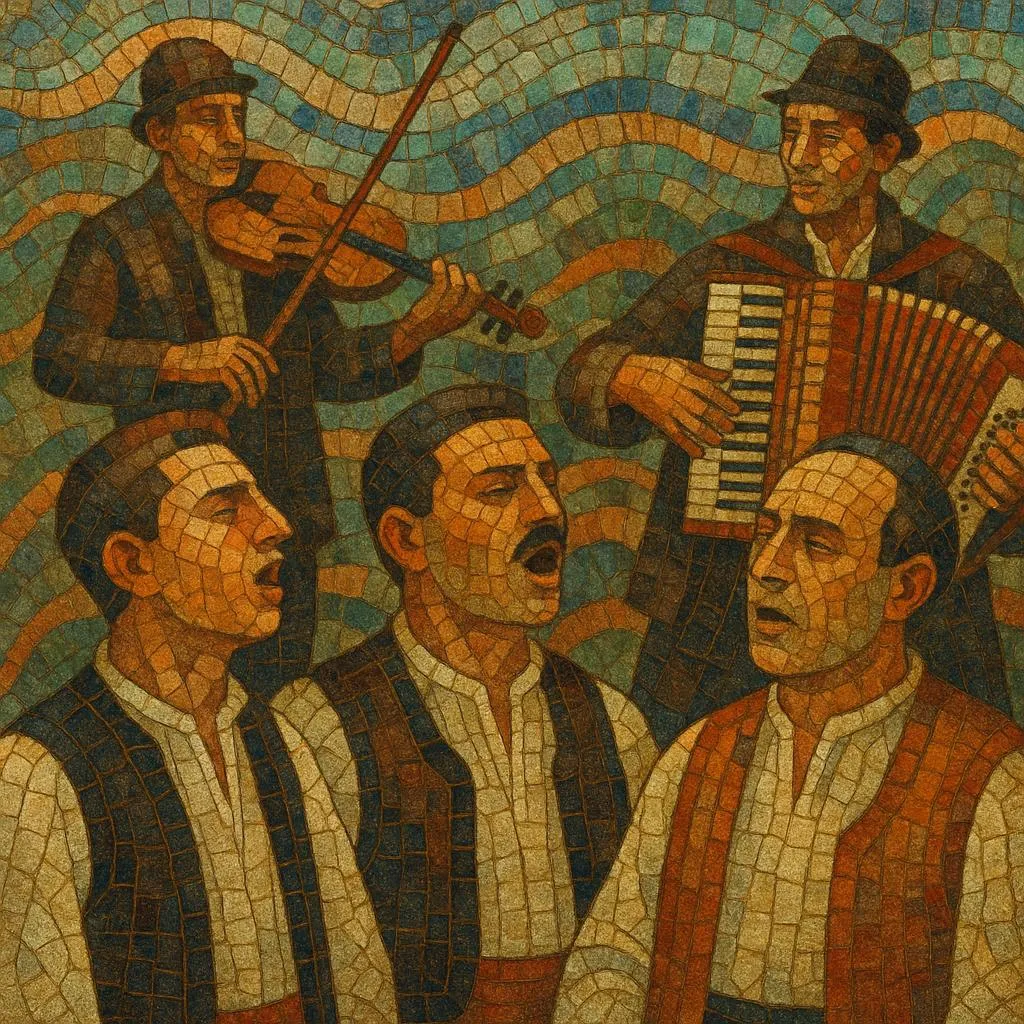
Popullore jugu refers to the traditional folk music of southern Albania, especially the regions of Labëria and Toskëria. Its core sound is the famed Albanian iso‑polyphony—multi‑part a cappella singing built around a sustained drone (iso) under lead and response voices.
The style ranges from powerful, chest‑voiced, rugged Lab ensembles to more lyrical Tosk variants, and it also includes southern urban "qytetare" songs (serenata) and dance tunes accompanied by clarinet, violin, laouto/lute, accordion, and frame drum. Modal melodies, narrow ambitus lines, ornamented phrases, and free or asymmetrical meters (2/4, 7/8, 9/8, 12/8) are common. Themes move between love, pastoral life, migration and exile, heroic memory, and communal ritual—performed at weddings, seasonal feasts, and regional festivals.
History
Southern Albanian folk practice has deep pre‑modern roots, with village song traditions taking shape over centuries. In Labëria and adjacent Tosk areas, multi‑part singing crystallized into iso‑polyphony: a lead (marrës), a responding/turning voice (kthyes), and a drone group (iso). The aesthetic shares traits with Byzantine ecclesiastical chant and broader Balkan modal practices while remaining distinct in timbre and structure.
By the 1800s, the repertoire coalesced into recognizable song families—epic commemorations, laments, love songs, and shepherds’ calls—alongside urban southern "qytetare" serenades (notably in Korçë), where clarinet and violin (“saze” ensembles) supported refined, salon‑inflected melodies.
After WWII, Albania’s cultural policy promoted staged folklore. Regional polyphonic groups from Gjirokastër, Vlorë, Tepelenë, Himarë, Pilur, and Lunxhëri became emblematic, and the National Folk Festival in Gjirokastër (from 1968) canonized styles and repertoires. Archival recordings and radio broadcasts helped standardize performance formats while keeping regional colors.
UNESCO inscribed Albanian iso‑polyphony on the Representative List of the Intangible Cultural Heritage of Humanity (2005), spotlighting the southern tradition internationally. In the 21st century, projects and ensembles (including cross‑border collaborations) have revived village textures, sometimes blending traditional a cappella with saze instruments or subtle contemporary production for global stages.
Popullore jugu thrives both in community contexts (weddings, saints’ days, local festivals) and on concert stages. Younger artists and diaspora groups continue the practice, while recordists present historically informed and modern treatments—keeping the communal, participatory ethos central.