Your digging level
Description
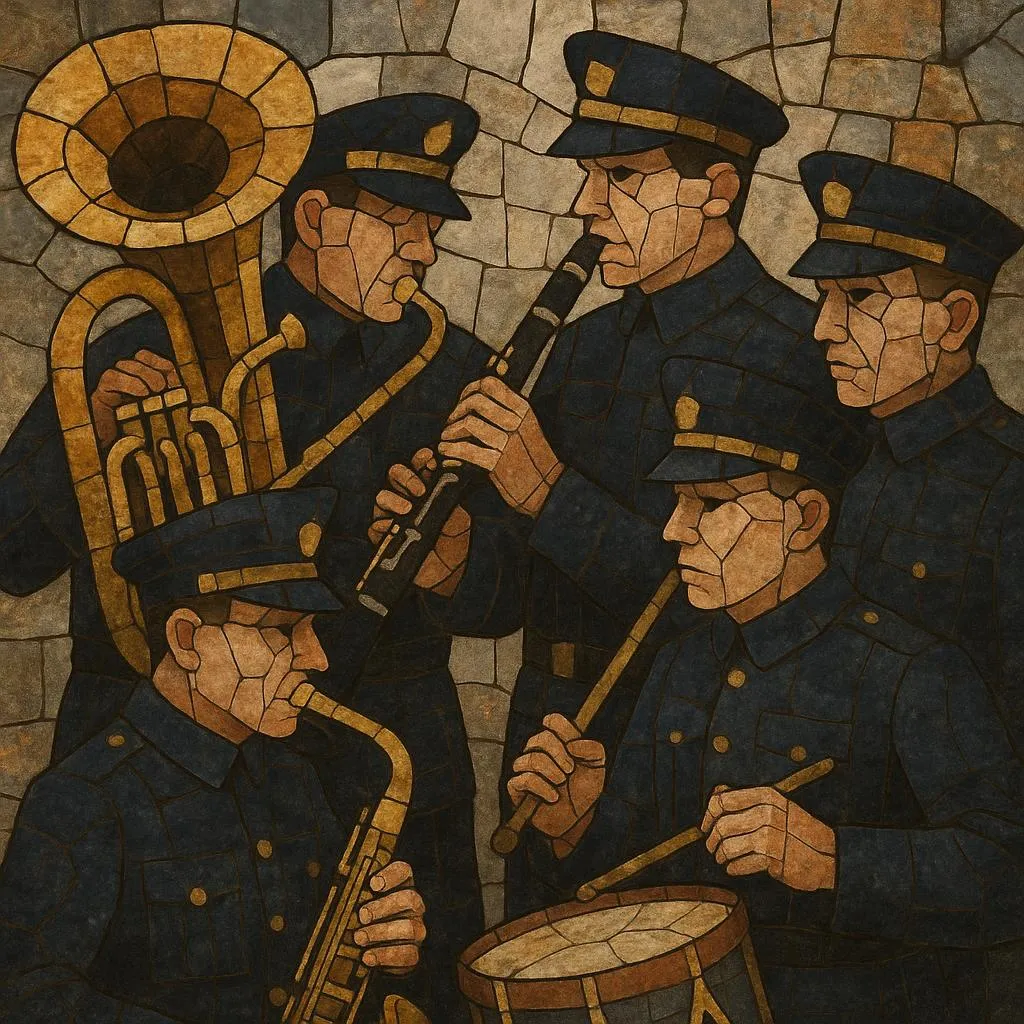
Police band is a tradition of state-sponsored wind and percussion ensembles maintained by police forces for ceremonial duties, public relations, and community concerts.
Typically configured as brass bands, concert bands, or pipe-and-drum corps, these groups perform marches, fanfares, national anthems, hymn tunes, and arrangements of classical and popular repertoire. Their role spans parades, honors ceremonies, academy graduations, funerals, state visits, and park or school concerts, acting as a sonic emblem of civic authority while also serving as a bridge between law enforcement and the public.
Instrumentation usually mirrors military and civic wind ensembles (brass, woodwinds, and battery/percussion), with regional variants that include pipes and drums in Anglophone contexts or fanfare instruments in continental fanfare traditions.
History
Police bands emerged out of the broader 19th‑century European military and civic band movements. As urban police forces professionalized, many established permanent musical units modeled on military bands to serve ceremonial needs and public events. Early exemplars include bands attached to British and Irish forces (e.g., the Royal Irish Constabulary Band in the 1860s), which helped institutionalize the format across the British Isles and colonial administrations.
By the interwar period, police bands were common throughout Europe and the wider British Empire/ Commonwealth. Notable formations such as the Malta Police Band (1920), the Singapore Police Force Band (1925), and later the Tokyo Metropolitan Police Band (1948) formalized concert and parade duties. After World War II, police pipe-and-drum traditions grew significantly in North America (e.g., NYPD Emerald Society Pipes and Drums, founded 1962), partly as a public-ceremony counterpart to fire-service pipe bands.
In the late 20th century, police bands diversified their repertoires beyond marches and anthems to include light classics, film medleys, and popular arrangements to serve community-outreach goals. Regions such as East Asia (Hong Kong/Singapore/Japan), the Middle East (notably the Royal Oman Police Band), and Latin America (Carabineros de Chile) developed distinctive ceremonial styles that integrated local musical elements.
Today, police bands remain fixtures of state protocol (funerals, national days, diplomatic welcomes), but they also function as public-facing ambassadors. Many maintain concert seasons, commission new works for wind ensemble, and collaborate with schools. Their standardization of ceremony and parade repertoire has, in turn, reinforced the global canon of marches, fanfares, and patriotic music performed by civic wind groups.