Your digging level

For this genre
0/8
🏆
Sign in, then listen to this genre to level up

Description

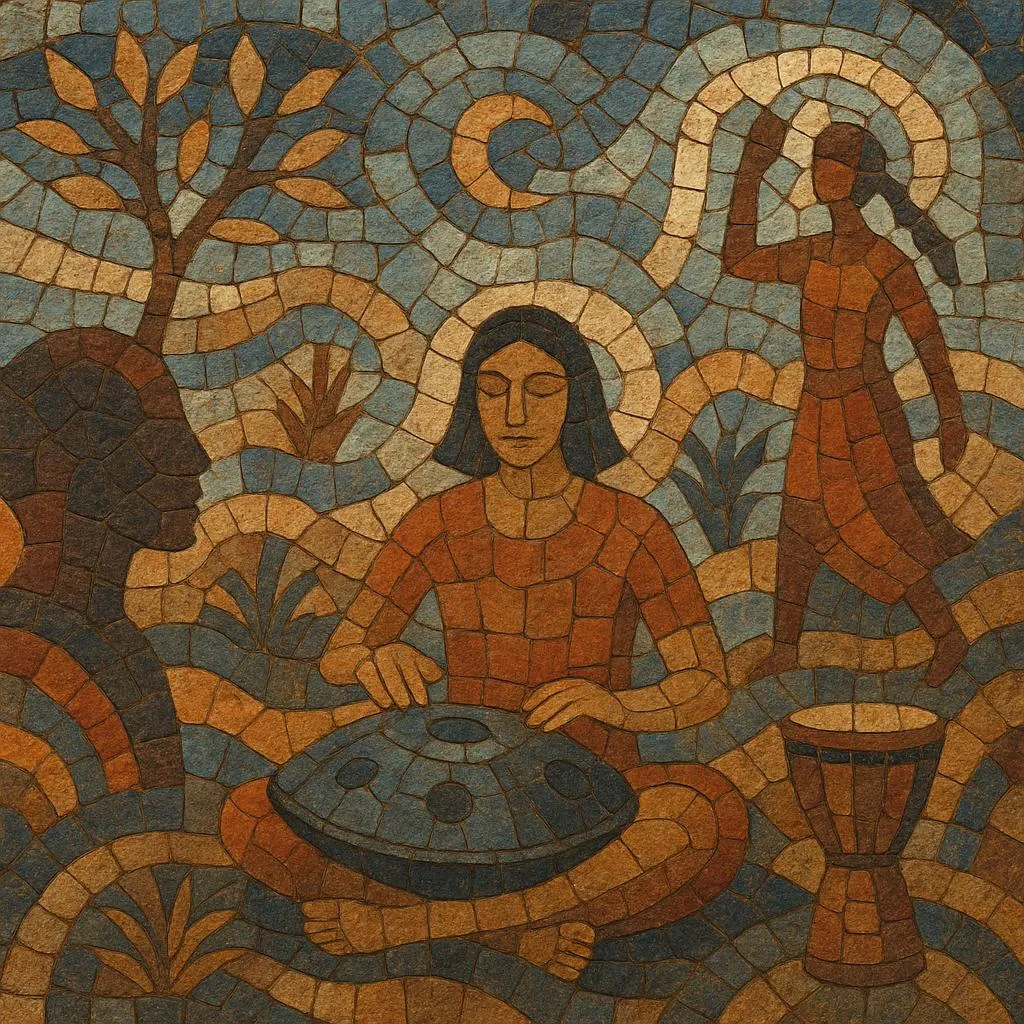
New tribe is a contemporary, spiritually tinged world-fusion microgenre centered on the handpan (a.k.a. hang) and related resonant idiophones, often framed by ambient textures and gentle world percussion.

Its sound emphasizes spaciousness, organic resonance, and meditative pulse over harmonic complexity, drawing on New Age, world devotional practices, and chillout aesthetics. Typical pieces unfold slowly with evolving ostinatos, shimmering overtones, and breathy pads, invoking nature, ritual, and communal togetherness.

Although global in reach, the aesthetic coalesced around the early 2000s handpan movement, then flourished online through live-looping performance culture, yoga and wellness spaces, and intimate concerts where the handpan’s bell-like tone became a symbol of modern, portable mindfulness.


Sources: Spotify, Wikipedia, Discogs, RYM, MB, user feedback and other online sources

History

Origins (early 2000s)

The "new tribe" sound emerges alongside the invention of the Hang/handpan in the early 2000s in Switzerland. Players quickly discovered its uniquely sustained, bell-like tone, ideal for meditative grooves and modal improvisation. Early adopters performed in parks, small venues, and spiritual spaces, developing a vocabulary of flowing ostinatos, harmonic slaps, and lyrical, pentatonic-leaning melodies.

Diffusion and community (late 2000s–2010s)

As handpans spread globally, a cottage industry of builders and a community of players grew. The music found natural homes in yoga studios, wellness retreats, world-music festivals, street performances, and intimate house concerts. Live-loopers fused the handpan with frame drums, udu, tanpura/shruti drones, and subtle electronics. Online video platforms amplified the scene, helping establish a recognizable aesthetic: slow-blooming tempos, generous reverb, and ritualistic pacing.

Aesthetic consolidation (2010s–present)

By the 2010s, "new tribe" cohered as a microgenre: handpan-led instrumental pieces (sometimes with mantra-like vocals) set within ambient and chillout frameworks. Production values improved—lush pads, soft sub-bass, field recordings—yet the ethos stayed intimate and communal. The style’s repertoire now includes concert works, collaborative ensembles, and crossovers with jazz, contemporary classical, and cinematic ambient.

Themes and practices

The genre foregrounds presence, breath, and togetherness—music as a shared ritual. Performances often encourage close listening and somatic engagement, using cyclical forms and modes that invite trance-like attention. This emphasis on communal, mindful listening underpins the “tribe” metaphor in the name.

How to make a track in this genre

Core instruments and timbre
•   Center the handpan (or similar resonant idiophones). Supplement with frame drum, udu, shakers, shruti box/tanpura, soft pads, and sparse bass. •   Favor natural, breathy, and bell-like timbres. Use spacious reverb and gentle delays to enhance overtones without washing out articulation.
Scales, harmony, and melody
•   Common handpan sound models: D Kurd, D Celtic Minor, D Hijaz, and other modal palettes (minor, dorian, aeolian, phrygian-dominant). •   Keep harmony modal and static; let color tones and overtones carry interest. Melodies should be lyrical, singable, and repetitive with subtle variation.
Rhythm and groove
•   Tempos typically 60–90 BPM (or rubato). Grooves emerge from layered ostinatos and interlocking patterns rather than heavy backbeats. •   Use handpan techniques—thumbs, slaps, taps, harmonics—to create polyrhythmic nuance. 4/4 and 6/8 are common; try cyclical phrasing (e.g., 8- or 16-beat cycles).
Arrangement and form
•   Build from a simple ostinato + drone, then add melodic fragments, counter-lines, and light percussion. Introduce texture in waves rather than verse/chorus contrasts. •   Employ dynamics as narrative: start intimate, bloom to a gentle peak, then return to stillness.
Production tips
•   Capture close detail and room resonance; blend a clean close mic with a stereo room image. Use high-pass filtering to preserve clarity. •   Add field recordings (water, wind, leaves) sparingly to deepen the nature-centric atmosphere.
Vocal and spiritual elements (optional)
•   If using voice, favor mantra-like phrases, open vowels, and soft harmonies. Lyrics may reference nature, breath, or compassion. •   Keep text minimal; let repetition and timbral evolution guide the listener’s focus.

Top tracks

Locked
Share your favorite track to unlock other users’ top tracks

Upcoming concerts

in this genre
Influenced by
Has influenced

Download our mobile app

Get the Melodigging app and start digging for new genres on the go
© 2026 Melodigging
Melodding was created as a tribute to Every Noise at Once, which inspired us to help curious minds keep digging into music's ever-evolving genres.
Buy me a coffee for Melodigging