Your digging level

For this genre
0/8
🏆
Sign in, then listen to this genre to level up

Description

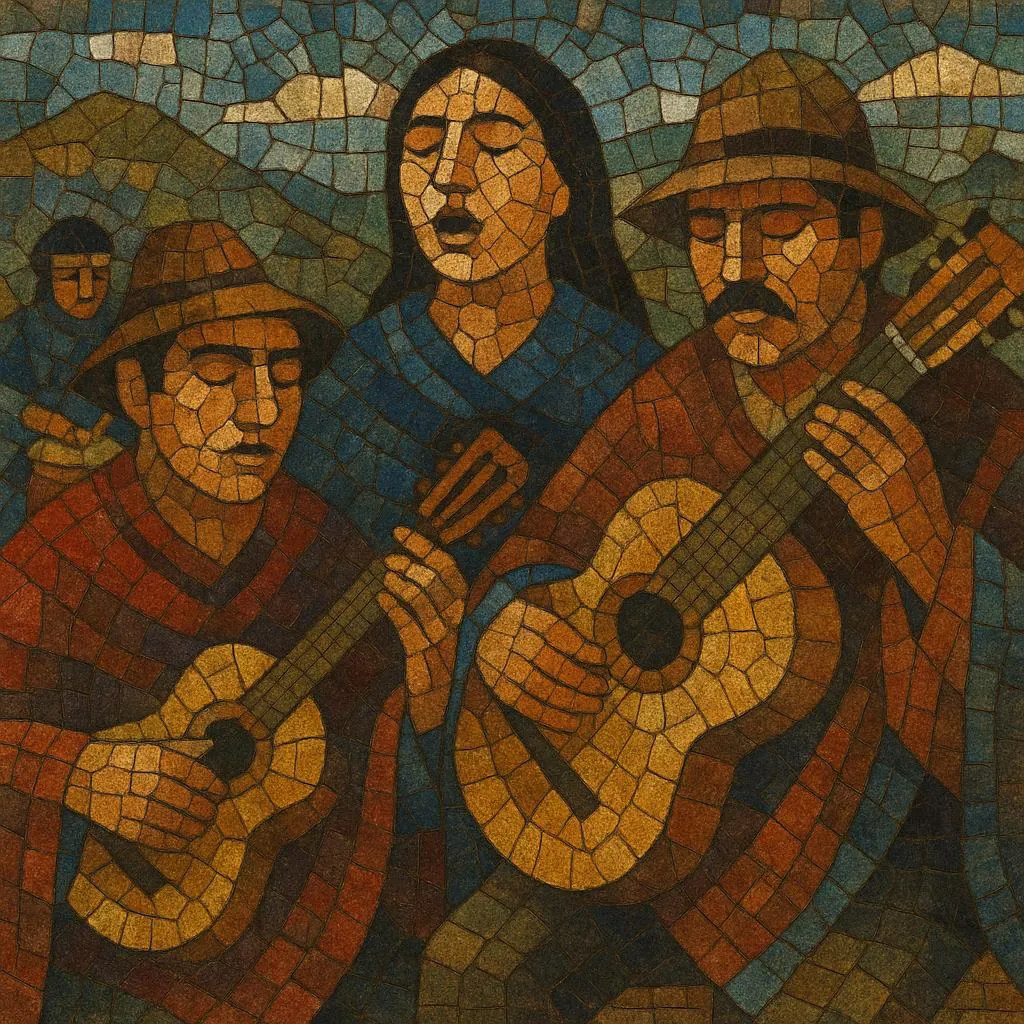
Música ayacuchana is the regional Andean music tradition associated with the department of Ayacucho in south‑central Peru. It blends indigenous Quechua song forms (yaraví/harawi) and the lively regional huayno with a distinctive, refined guitar school known for counterpoint between two nylon‑string guitars (primera and segunda), delicate arpeggios, and vocal duets in close harmony.

Unlike brass‑driven highland styles, the Ayacucho sound is intimate and lyrical: serenades, laments, and pastorals alternate with festive carnavales ayacuchanos. Core instruments include two guitars (sometimes joined by a third for bordón bass), charango, violin, harp, quena, and small drums (tinya). Lyrics—often in Quechua and Spanish—evoke love, longing for the tierra, religious devotion, and the Andean landscape.

The result is a bittersweet aesthetic: tender and melancholic in slow yaraví/harawi pieces, and bright, communal, and dancing in carnival repertoires.


Sources: Spotify, Wikipedia, Discogs, RYM, MB, user feedback and other online sources

History

Roots and early formation

Ayacucho has been a historical crossroads of Quechua cultures. Pre‑colonial song types such as harawi and later yaraví (a poetic, slow lament) provided the expressive core of the local repertoire. During the colonial and republican eras, these forms intertwined with guitars, violins, and harps introduced from Europe, giving rise to a chamber‑like Andean sound distinct from brass‑band highland music.

The guitar school (1940s–1970s)

In the mid‑20th century, an urban "escuela ayacuchana" of guitar flourished. Duos and trios refined counter‑melodic accompaniment—primera (melody) and segunda (inner voice/bass movement)—supporting solo or duo vocals in thirds and sixths. Slow yaraví and harawi highlighted micro‑ornamentation, portamenti, and melismas; huaynos carried the dancing pulse of local fiestas. Radio, 78s, and later LPs disseminated the style from Ayacucho to Lima.

Diffusion, resilience, and revival (1980s–2000s)

Even amid social upheaval in the region, música ayacuchana persisted in peñas (folk venues), community festivals, and religious celebrations. Conservatory‑trained guitarists codified techniques; folkloric ensembles carried the carnival comparsa tradition (violin/harp/guitar/percussion) onto concert stages. Recordings and national broadcasts helped establish the style as a pillar of Peruvian Andean identity.

Contemporary directions (2000s–present)

Today, the Ayacucho idiom thrives in two complementary streams: (1) traditionalists who maintain the intimate guitar‑voice format, and (2) innovators who fuse ayacuchano melodies and Quechua lyrics with urban genres, singer‑songwriter idioms, or electronic textures. Carnival repertoires remain central to civic identity, while the refined guitarra ayacuchana continues to be taught, arranged, and performed internationally.

How to make a track in this genre

Core formats and instruments
•   Build around two nylon‑string guitars: a primera (melody/lead) and a segunda (counter‑melody/inner voices) with alternating bass (bordón). Add charango for sparkle, violin for lyrical lines, and harp or quena in festive/carnival pieces. A small drum (tinya) and hand percussion can support dance tunes.
Modes, scales, and harmony
•   Favor Aeolian (natural minor) and Dorian colors, often with pentatonic inflections inherited from harawi/yaraví. Cadences commonly avoid dominant‑function brightness; modal shifts (i–VII–VI or i–bVII–IV) preserve a wistful hue. •   In the guitarra ayacuchana, write a singing top line with inner‑voice counterpoint. The segunda answers or weaves around the melody in thirds, sixths, or contrary motion rather than block‑chord strums.
Rhythm and grooves
•   Yaraví/harawi: very slow 3/4 (or rubato), free phrasing, sustained tones and vocal portamenti. Keep accompaniment transparent (arpeggios and long bass notes). •   Huayno ayacuchano: moderate 2/4 with a bouncy, forward lilting feel; use alternating bass and light rasgueos, syncopating into beat 2. Carnival tunes may add hemiolic accents and call‑and‑response refrains.
Vocal style and text
•   Use close vocal duets (thirds/sixths) with gentle vibrato and occasional falsetto touches. Ornament with short appoggiaturas and sighing figures. •   Write in Quechua and/or Spanish about love, distance from home, devotion to local saints/fiestas, Andean nature, and communal celebration. In carnival songs, craft participatory choruses that invite group singing.
Arrangement tips
•   Keep textures intimate: guitars foregrounded, violin/charango as filigree. Reserve percussion for dance numbers. •   Introduce brief instrumental interludes where the segunda takes the melody and the primera answers, showcasing contrapuntal dialogue. •   For modern fusions, layer traditional guitar counterpoint over subtle pads or cajón/bombo legüero while preserving modal harmony and the characteristic melodic sighs.

Top tracks

Locked
Share your favorite track to unlock other users’ top tracks

Upcoming concerts

in this genre
Influenced by
Has influenced

Download our mobile app

Get the Melodigging app and start digging for new genres on the go
© 2026 Melodigging
Melodding was created as a tribute to Every Noise at Once, which inspired us to help curious minds keep digging into music's ever-evolving genres.
Buy me a coffee for Melodigging