Your digging level
Description
The music of Guadeloupe refers to the island’s traditional and popular musics, from ancestral drum-and-song practices to globally successful dance-pop.
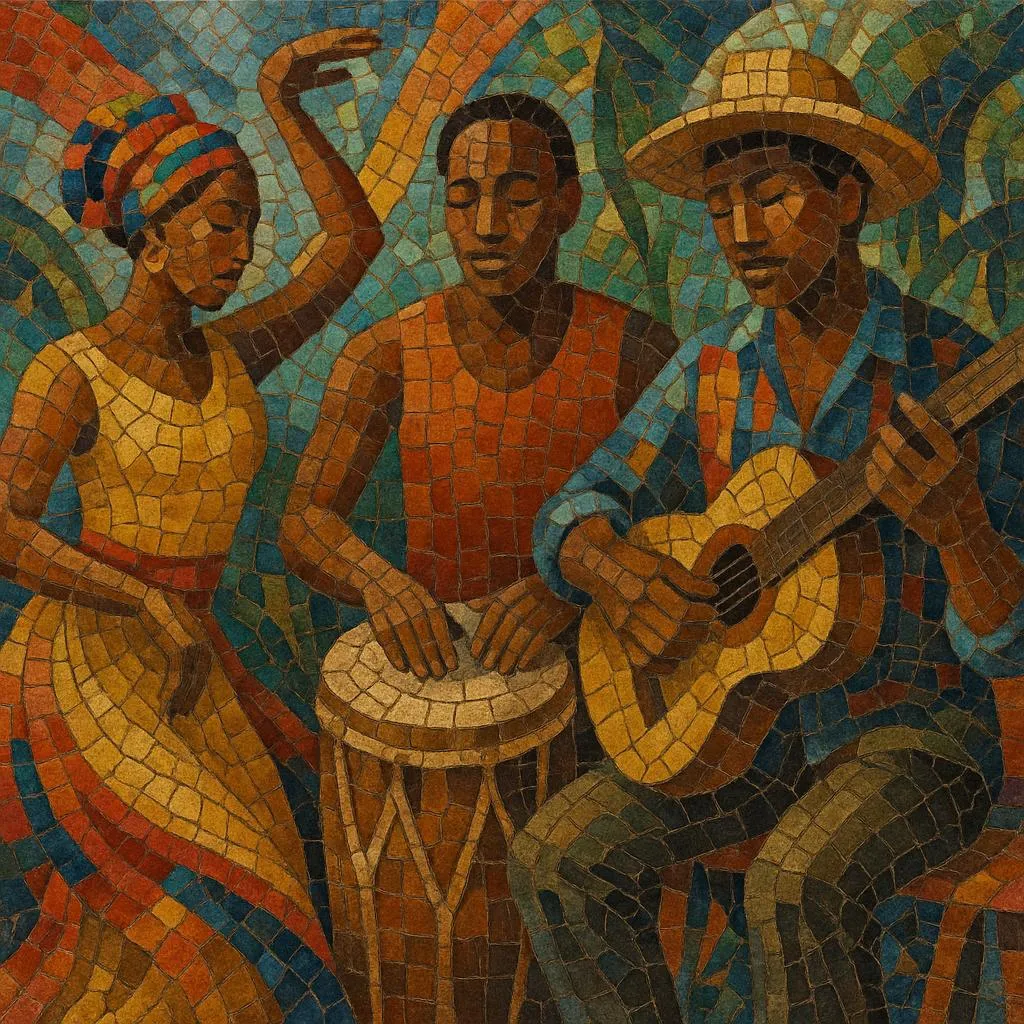
At its core is gwo ka, a family of Creole Afro-Caribbean drumming, song, and dance traditions forged by enslaved Africans and sustained in communal léwòz gatherings. Alongside gwo ka, 19th–early 20th century Creole ballroom styles such as biguine and local quadrille-derived dances blended European forms (polka, mazurka, waltz) with Caribbean syncopation.
From the late 20th century, Guadeloupe became internationally known through zouk—a studio-driven dance music crystallized by Kassav’—which drew on Guadeloupan gwo ka, Martinican chouval bwa, Haitian kadans/compas, and the pan-Caribbean calypso tradition. Today the island’s soundworld spans deep-rooted acoustic forms, jazz fusions, and modern electronic zouk and dancehall-leaning productions.
History
Gwo ka emerged during the slavery era as a vital community practice centered on ka drums, call-and-response singing, and dance. Its seven core rhythms (woulé, toumblak/toumblak, kaladja, graj, mendé, padjanbel, and léwòz) map social occasions and expressive moods. In parallel, Creole ballroom musics (biguine, local quadrille variants) fused European dance-forms—polka, mazurka, and waltz—with Caribbean syncopation and instrumentation.
Biguine bands and Antillean dance orchestras established a presence in Paris, while island ensembles modernized with horns and guitar. Regional currents—Haitian kadans/compas, Dominican cadence-lypso (from Dominica), and Trinidadian calypso—circulated widely and were absorbed by Guadeloupean musicians. Local groups (e.g., Les Vikings de la Guadeloupe) blended soul, funk, and cadence, foreshadowing later studio styles.
By the early 1980s, Kassav’ synthesized a new studio-driven dance music, zouk, whose DNA combined Guadeloupan gwo ka and Martinican chouval bwa with kadans/compas and calypso. Zouk’s energetic, tightly produced groove and Creole vocals surged in France and across the Afro-diaspora, becoming a powerful symbol of Antillean identity. Softer mid-tempo variants (“zouk love”) broadened its reach throughout the 1990s.
Gwo ka remains a living tradition (inscribed by UNESCO as Intangible Cultural Heritage in 2014), while artists have created jazz fusions (often called “gwo ka jazz”), contemporary zouk, and crossovers with dancehall and EDM. Community drum circles (léwòz), carnival musics, and Creole songwriting continue to nourish Guadeloupe’s evolving musical life.
Because “music of Guadeloupe” spans roots and popular idioms, a practical approach is to learn both a traditional gwo ka setting and a modern zouk production.
Whether acoustic or electronic, center the Creole language, participatory call-and-response, and dance-led phrasing. Even in the DAW, let rhythmic interaction—not just grid quantization—drive the feel.