Your digging level
Description
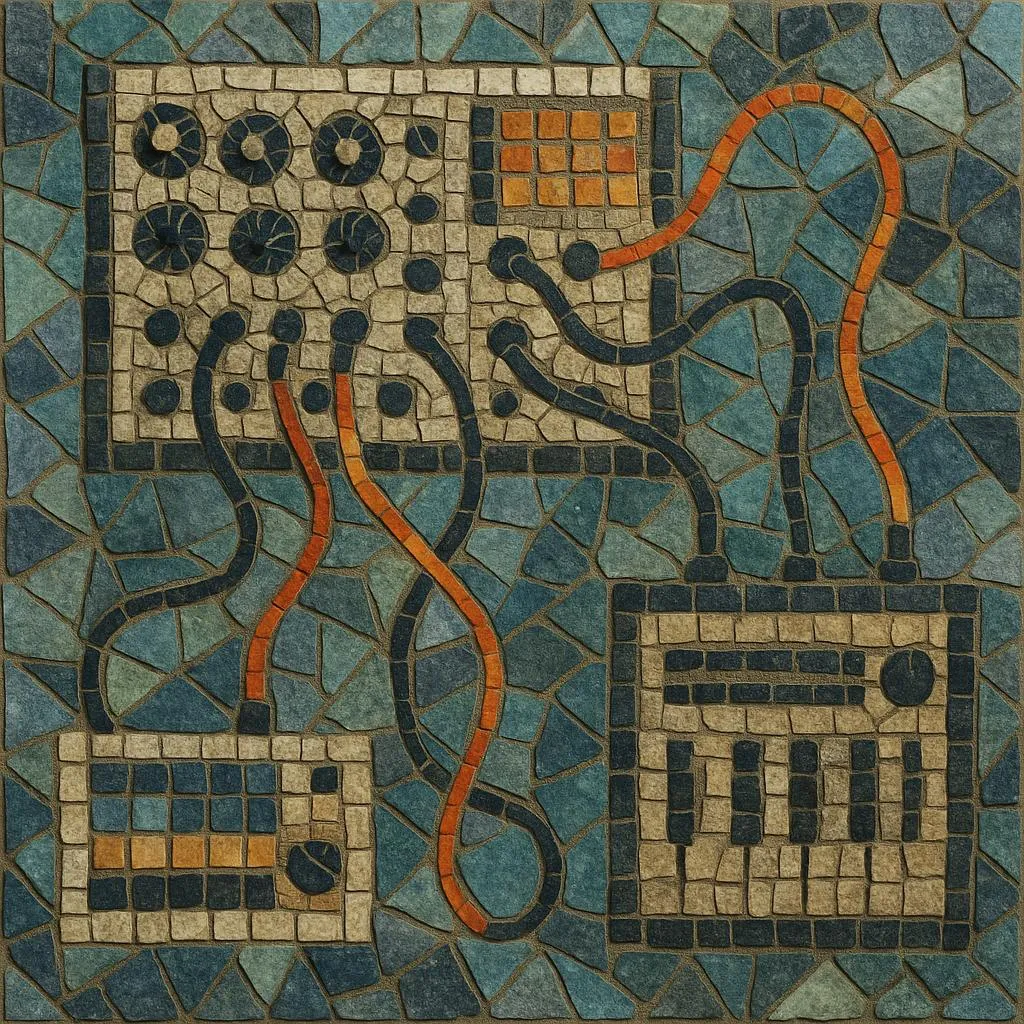
Modular synth (or modular synthesizer) music is created on systems composed of separate sound‑generating and sound‑shaping modules that are interconnected with patch cables. Instead of presets, the musician builds each sound by designing a signal path—an approach that encourages exploration, generative processes, and real‑time performance.
The idiom spans contemplative ambient and minimalism, Berlin‑school style sequencer music, and more beat‑driven modular techno. Signature timbres include rich analog oscillators, voltage‑controlled filters (e.g., Moog ladder) and low‑pass gates (in Buchla‑style systems), randomized modulation sources, and hypnotic step‑sequenced patterns.
History
Early modular systems crystallized in the mid‑1960s with Robert Moog’s modular synthesizer (presented in 1964) and Don Buchla’s modular electronic music systems (first released in 1965). These instruments formalized voltage control of oscillators, filters, envelopes, and sequencers, letting composers design sounds as patchable circuits rather than fixed instruments.
In 1967, Morton Subotnick’s “Silver Apples of the Moon” showcased the possibilities of the Buchla system for long‑form, studio‑sculpted electronic music. Wendy Carlos’s 1968 “Switched‑On Bach” demonstrated the Moog modular’s musicality to a mass audience, bringing synthesizers into popular awareness and accelerating their adoption by composers and bands.
Throughout the 1970s, modular systems appeared on progressive rock stages and in electronic studios, fueling sequencer‑driven textures associated with the Berlin School and the broader rise of synthesizer‑centered music.
While compact polysynths and digital instruments eclipsed large modulars in the 1980s, modular synthesis later rebounded as musicians sought hands‑on, exploratory workflows. In the 21st century, a flourishing ecosystem of module makers and artists reignited interest in generative patches, complex modulation, and live, cable‑based performance.
Contemporary modular artists combine minimalism, electro‑acoustic thinking, and algorithmic/generative techniques, extending modular synth music from meditative drones to kinetic club contexts.