Your digging level

For this genre
0/8
🏆
Sign in, then listen to this genre to level up

Description

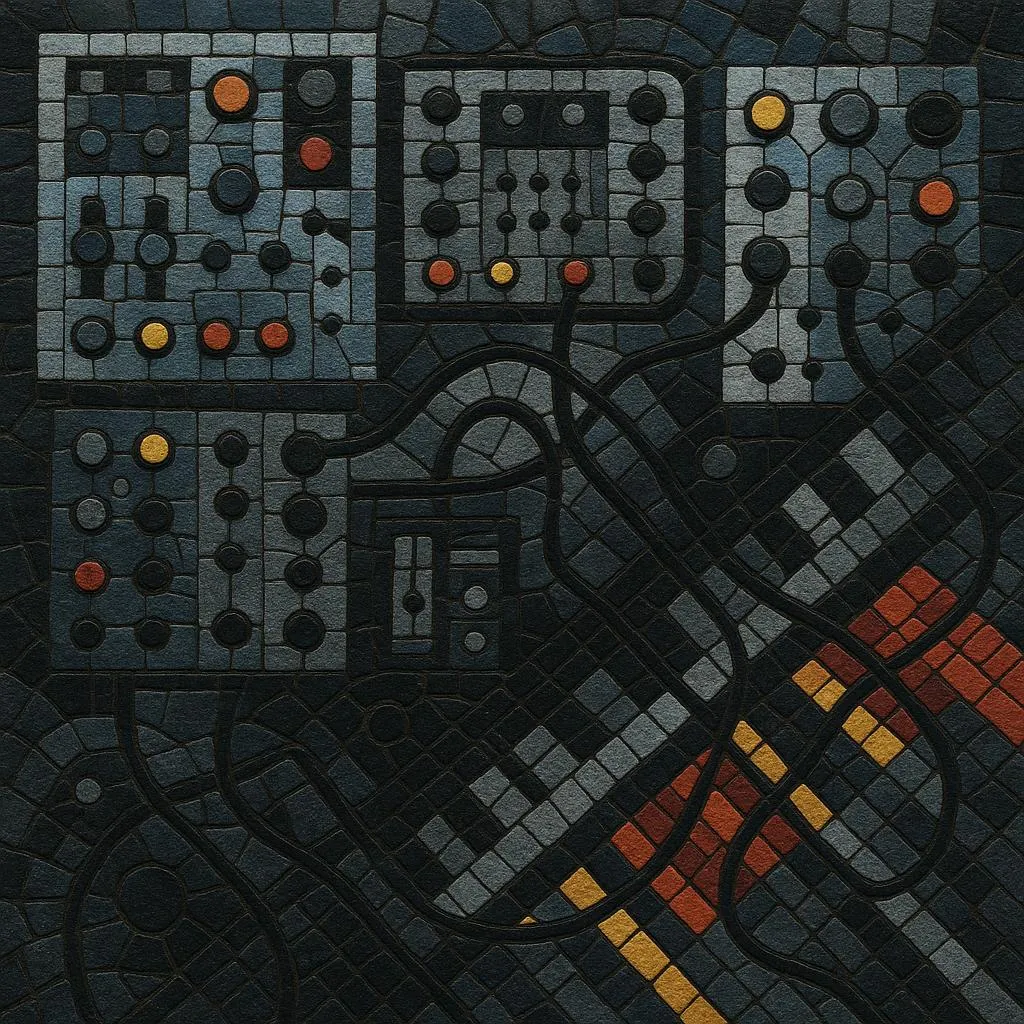
Modular techno is a branch of techno centered on composing and performing primarily with modular synthesizers (most commonly Eurorack). Rather than arranging in a DAW, artists patch oscillators, filters, sequencers, clock dividers and utility modules into evolving signal chains, then sculpt rhythm and timbre in real time.

The approach privileges improvisation, polyrhythms, and continuously shifting textures over fixed song structures. Early, visible champions included UK/Wales-based artist Steevio—who explicitly framed his 2012 release as "Modular Techno" and recorded it live in single takes—followed by a broader wave of adopters in the mid‑to‑late 2010s as modular systems spread across European techno scenes.


Sources: Spotify, Wikipedia, Discogs, Rate Your Music, MusicBrainz, and other online sources

History

Origins (late 2000s–early 2010s)
•   The Eurorack boom made modular systems more affordable and portable, and a cadre of techno artists began building live rigs. A foundational signpost is Steevio’s Modular Techno Vol. 1, released in February 2012, documented as live, computer‑free, one‑take recordings prepared for his Freerotation sets in Wales.
Mid‑2010s expansion
•   By the mid‑2010s, modular workflows were reshaping the sound and process of several headline techno producers. Blawan publicly pivoted toward sculpting percussion and textures from modular patches rather than relying on standard drum machines, a shift heard across his TERNESC releases (e.g., the 2015 EP Hanging Out the Birds). •   Interviews and scene reporting around Freerotation and related circles highlighted an ethos of real‑time pattern interaction, polyrhythm, and performance‑first recording, helping solidify a recognizable "modular techno" practice.
Late 2010s–2020s consolidation
•   Blawan’s 2018 debut album, Wet Will Always Dry, further broadcast the modular sound design aesthetic to a global techno audience, with press noting the role of modular synthesis in his evolving palette. •   The 2020s saw continuing output from key practitioners (e.g., Steevio’s 2025 BH009 release) and a widening live circuit where improvised modular sets coexist with DJ culture, underscoring modular techno as both a production method and a performance vernacular.

How to make a track in this genre

Core setup
•   Sound sources: at least two VCOs (or digital voices) for kick/bass and mid/upper percussion; noise and sample players optional. •   Shaping: multimode VCFs, wavefolders/drive, VCAs, envelopes/LFOs, and dynamics (compressor/side‑chain or VCA ducking). •   Control: clock, clock dividers/multipliers, two or more sequencers (one can be Euclidean or Cartesian), quantizer, logic and random/chaos for variation.
Patch recipe (a starting point)
    •   

    Master clock → dividers feed: a) kick sequencer (straight 4/4 or polymetric), b) bassline sequencer (odd step length for phase play), c) hats/percussion (Euclidean fills). 125–140 BPM is common.

    •   

    Kick: sine/triangle VCO → fast envelope → VCA, plus pitch envelope for thump; optionally parallel distortion.

    •   

    Bass: second VCO → VCF (mod frequency and resonance subtly) → VCA. Use probability/gates to drop notes and create negative space.

    •   

    Hats/perc: noise → VCA with short envelopes; add band‑pass filtering, FM pings or resonant filter self‑oscillation for metallic hits.

    •   

    Movement: route clocked random or S&H to filter cutoff, wavefolder amount, decay times; use logic (AND/OR/XOR) to combine triggers for emergent grooves.

    •   

    Mix & dynamics: patch a side‑chain envelope (or VCA ducking) from the kick to glue the groove; keep headroom for live gain‑riding.

Performance method
•   Treat the rack like an instrument: pre‑patch scenes, assign macro knobs (attenuverters) to musically significant parameters, and practice muting/adding voices to shape sections. •   Record or perform in long, evolving takes rather than arranging on a timeline—an approach explicitly documented by early modular‑techno releases (e.g., Steevio’s one‑take, computer‑free recordings).

Related labels

Top tracks

Locked
Share your favorite track to unlock other users’ top tracks
Influenced by
Challenges
Digger Battle
Let's see who can find the best track in this genre

Download our mobile app

Get the Melodigging app and start digging for new genres on the go
© 2026 Melodigging
Melodding was created as a tribute to Every Noise at Once, which inspired us to help curious minds keep digging into music's ever-evolving genres.
Buy me a coffee for Melodigging