Your digging level for this genre
Description
Minyue (民乐) refers to modern Chinese traditional instrumental music built on regional folk and court traditions but standardized for concert performance.
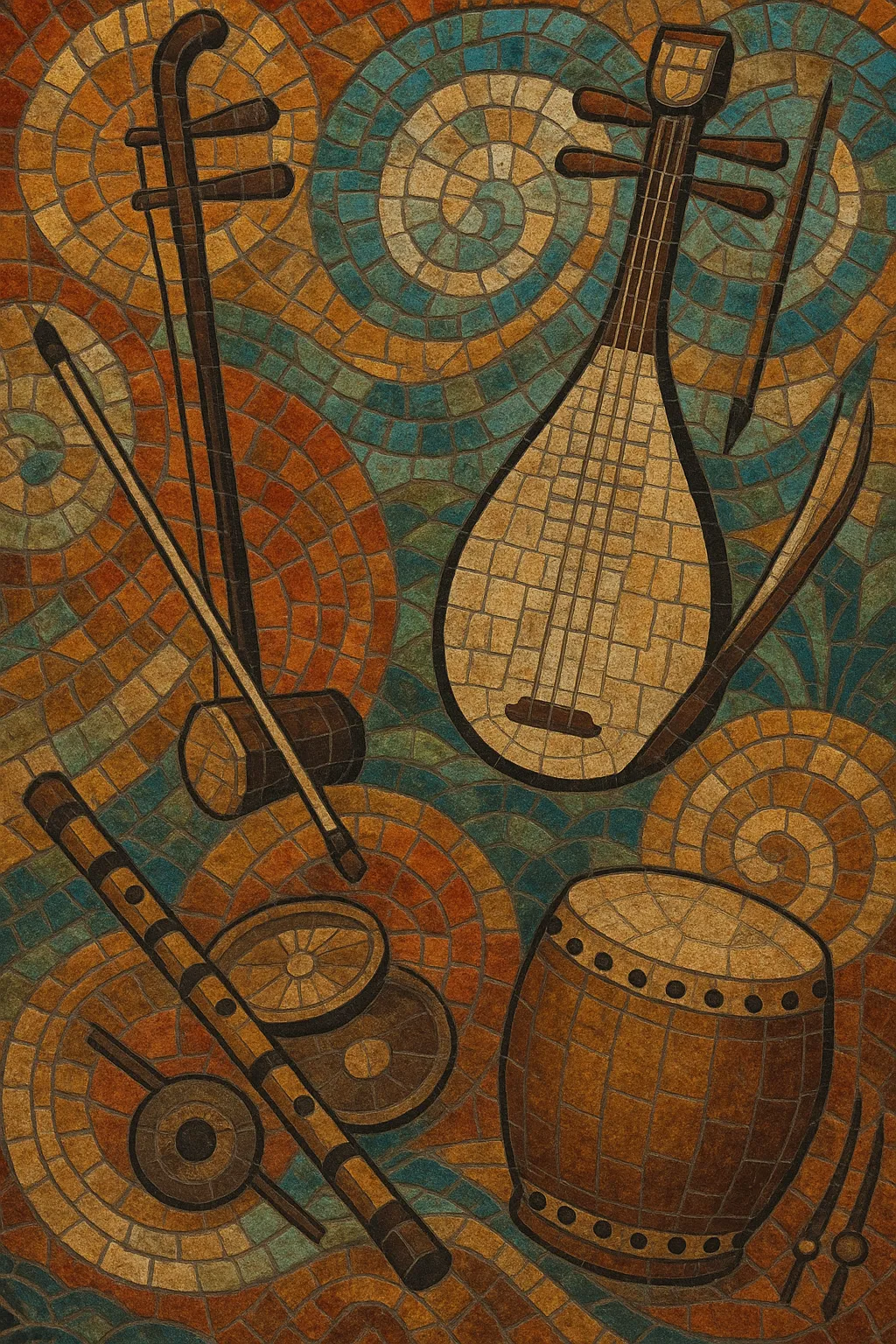
It typically features Chinese orchestra or chamber ensembles consisting of bowed strings (erhu family), plucked strings (pipa, guzheng, ruan family, yangqin), winds (dizi, xiao, sheng, suona), and percussion (paigu, luo, bo, tanggu). The idiom favors pentatonic modes, ornamented melodies, heterophonic textures, and programmatic titles that depict landscapes, folklore, and historical scenes.
While its roots are ancient, the concert-oriented, conservatory-trained practice of minyue took shape in the mid-20th century, aligning traditional timbres with modern ensemble techniques, notational practices, and staged presentation.
History
Chinese ritual and court repertoires (yayue) and a vast body of regional folk idioms formed the premodern foundation for the instruments, modes, and performance practices later heard in minyue. Silk-and-bamboo (sizhu) ensembles, narrative opera traditions, and solo literati genres established the core timbres and melodic languages.
After 1949, state ensembles and conservatories systematized instruments, pedagogy, and notation. Builders expanded ranges (e.g., erhu, sheng families), standardized pitch, and created orchestral sections analogous to Western orchestras. Arrangers adapted regional melodies and qupai into concert suites and overtures, while composers wrote new showcase pieces for solo instruments and Chinese orchestra. Broadcast and cultural troupes popularized the sound across the country.
Conservatory-trained virtuosi and composers broadened the repertory, integrating extended techniques, larger forms, and selective Western harmonic devices while retaining pentatonic/modal centers and heterophony. National and provincial Chinese orchestras flourished, competitions emerged, and landmark soloists (pipa, erhu, dizi) established canonical concert works and recordings.
International tours, collaborations, and media broadened minyue’s reach. Ensembles and soloists crossed into film, world, and pop markets, while crossover acts popularized the timbres for new audiences. Parallel pop movements such as Zhongguo Feng and GuFeng borrowed minyue’s scales, instruments, and imagery, further embedding its sound in contemporary Chinese and global music.
How to make a track in this genre
Top albums
%2C%20Cover%20art.webp)
%2C%20Cover%20art.webp)