Your digging level

For this genre
0/8
🏆
Sign in, then listen to this genre to level up

Description

Indonesian jazz is the practice of jazz developed in Indonesia that fuses the idioms of American jazz (swing, bebop, cool, fusion) with local musical languages such as keroncong, gamelan (slendro/pelog), Sundanese/Minangkabau rhythmic feels, and, in later decades, elements from dangdut and pop.

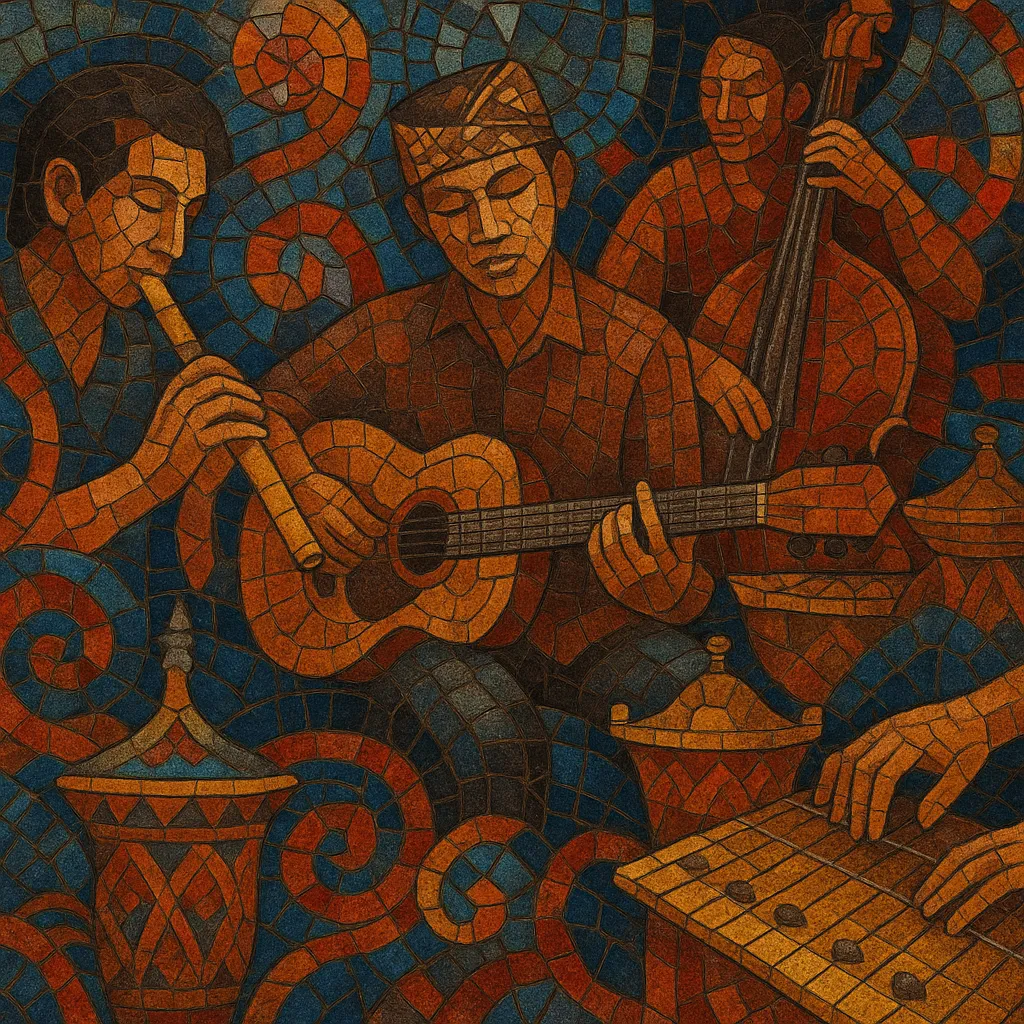
It typically features the harmonic richness and improvisation of jazz—extended chords, ii–V–I cadences, head–solo–head forms—while incorporating Indonesian timbres (suling bamboo flute, kendang hand drums, kacapi zither, metallophones) and modal colors. The result ranges from intimate acoustic small‑combo jazz to electric jazz‑fusion with indigenous percussion and scales.


Sources: Spotify, Wikipedia, Discogs, Rate Your Music, MusicBrainz, and other online sources

History

Early contacts (1930s–1950s)

Jazz entered the Dutch East Indies via colonial dance bands, radio, and records in the 1930s. Local musicians absorbed swing and early modern jazz alongside homegrown popular styles like keroncong. After independence (1945), post‑war urban hubs such as Jakarta, Bandung, and Surabaya nurtured nightclub and hotel band circuits where American jazz repertoire mingled with Indonesian songs.

Nation‑building and pioneers (1960s–1980s)

By the 1960s, a distinctive Indonesian jazz community was visible, led by figures like Jack Lesmana, Bubi Chen, Ireng Maulana, and (later) Benny Likumahuwa. Bebop and cool‑school harmony were adapted to Indonesian melodies, while recordings and broadcasts spread the style beyond elite venues. In the late 1970s–80s, university and city festivals—most notably Jazz Goes To Campus (founded 1977)—helped form audiences and networks.

Fusion and festival era (1990s–2000s)

The 1990s catalyzed jazz‑fusion with traditional instruments and scales: groups such as Krakatau blended Sundanese modal systems, kendang, and kacapi with synths and electric rhythm sections. A generation including Indra Lesmana, Dwiki Dharmawan, Tohpati, and Dewa Budjana expanded touring and international collaborations. Major festivals like JakJazz (from 1988) and Java Jazz Festival (from 2005) established Indonesia as a regional jazz hub.

2010s–present: Cross‑genre and global reach

Contemporary Indonesian jazz spans acoustic small‑group modern jazz, progressive fusion, and pop‑jazz that feeds mainstream charts. Community festivals (Ngayogjazz, Ubud Village Jazz Festival) and music schools sustain talent pipelines, while digital platforms enable collaborations with global jazz and world‑fusion scenes. The language continues to evolve by reimagining folk material and experimenting with pelog/slendro in contemporary jazz forms.

How to make a track in this genre

Core vocabulary
•   Harmony: Use mainstream jazz harmony (extended tertian chords, altered dominants, modal interchange) and standard progressions (ii–V–I, turnarounds). Reharmonize Indonesian folk or pop melodies to highlight modal colors. •   Form: Typical head–solo–head structures with space for improvised solos; intersperse short interludes that reference gamelan cycles or keroncong vamps.
Indonesian color
•   Scales/Modes: Integrate slendro and pelog modal flavors. If instruments are not retunable, approximate via pitch collections and characteristic intervals; emphasize pedal notes and parallel motion to evoke gamelan texture. •   Rhythm: Layer syncopated swing or straight‑8th fusion grooves with Indonesian patterns—e.g., kendang phrases, Sundanese jaipongan‑inspired accents, or keroncong‑style off‑beat strumming.
Instrumentation and timbre
•   Core rhythm section: piano/keys, guitar, bass (upright or electric), drum set. •   Indigenous timbres: add suling (bamboo flute), kendang, kacapi, metallophones, or rebab for color and call‑and‑response with the horn/lead. •   Texture: Create “gamelan‑like” shimmer by layered arpeggios, bell‑like keyboard patches, or interlocking guitar/piano figures.
Improvisation and arrangement
•   Solo language: Combine bebop phrasing with pentatonic and pelog/slendro motifs; quote folk themes within solos. •   Arrangement: Use unison horn lines for folkloric melodies, then open to modal vamps for solos. Employ dynamic builds (soft suling/kacapi intros to full ensemble climaxes).
Production tips
•   Keep percussion crisp and mid‑forward to honor hand‑drum articulations. •   If fusing electronics, favor warm analog‑style synths that blend with acoustic instruments rather than dominate them.

Top tracks

Locked
Share your favorite track to unlock other users’ top tracks
Influenced by
Has influenced
Challenges
Digger Battle
Let's see who can find the best track in this genre
© 2026 Melodigging
Melodding was created as a tribute to Every Noise at Once, which inspired us to help curious minds keep digging into music's ever-evolving genres.
Buy me a coffee for Melodigging