Your digging level
Description
Indigenous music is an umbrella term for the traditional and contemporary music of Indigenous (original) peoples across the world. It centers the music of communities whose presence in a territory predates later settler or immigrant populations, and whose cultural continuity is rooted in place, kinship, and customary law.
The label describes a social and political relationship rather than a single musical sound: what counts as "indigenous" is defined less by musical traits and more by a people’s historical and political status in their homelands. As a result, Indigenous music comprises an immense diversity of styles—from powwow and Inuit throat singing to Sámi joik, Yolngu manikay, Tuvan khoomii, Andean siku panpipe ensembles, West African griot traditions, Polynesian mele, and thousands more.
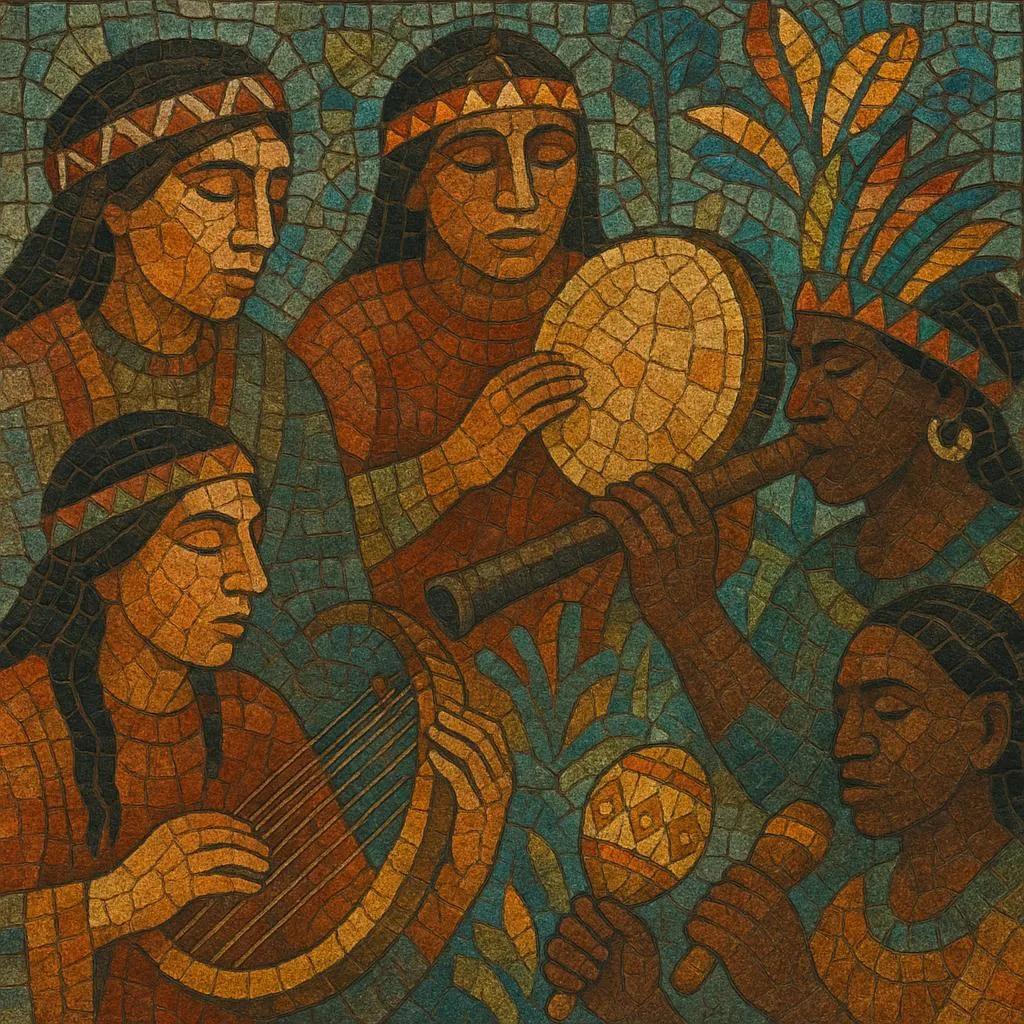
Common through-lines include the primacy of voice and community participation; close ties between music, dance, and ceremony; cyclical or additive rhythms; place-based timbres and instruments (rattles, frame drums, flutes, zithers, jaw harps, didgeridoo, etc.); and languages, stories, and cosmologies that encode ecological and historical knowledge.
History
Music in Indigenous societies long predates the idea of “genres.” It functions as ceremony, law, archive, social glue, pedagogy, and environmental knowledge. Oral/aural systems—songs, chants, dances, and instrumental signals—encode genealogies, land stewardship, seasonal cycles, and spiritual relationships. Instruments range from skin drums, rattles, bone or cane flutes, jaw harps, and shell trumpets to string instruments like the ngoni, kora, and various lutes and zithers, as well as idiophones fashioned from local materials.
Colonization, missionization, forced assimilation, and dispossession attempted to suppress Indigenous musics and the lifeways they sustain. Yet communities adapted, hid, hybridized, or revitalized practices. Early collectors (often missionaries or colonial officials) produced fragmentary or biased notations and recordings; by the early 20th century, comparative musicology and later ethnomusicology began documenting with increasing methodological care, though still within power imbalances.
After World War II and especially from the 1960s, Indigenous cultural and political movements fostered revitalization: powwow circuits grew; Sámi joik entered public stages; Aboriginal Australian songlines were documented and taught; Andean ensembles popularized siku and charango worldwide. Portable recorders, cassette culture, radio, and later the internet enabled community-controlled archiving and distribution.
Today, Indigenous artists work across the spectrum—from ceremonial contexts maintained within communities to public-facing genres (folk, rock, hip hop, metal, EDM) grounded in Indigenous languages, rhythms, and perspectives. The focus has shifted toward Indigenous sovereignty in storytelling, consent-based research, community archives, and benefits returning to knowledge holders. Global collaborations now occur on Indigenous terms, with precision around protocols, representation, and data ownership (e.g., Traditional Knowledge labels, community-run labels and festivals).