Your digging level
Description
Abakuá music is the ritual and ceremonial music of the Abakuá religious fraternity in Cuba.
It descends from the Ékpè (Ekpe) tradition of the Cross River region of West Africa and is practiced primarily in Havana and Matanzas.
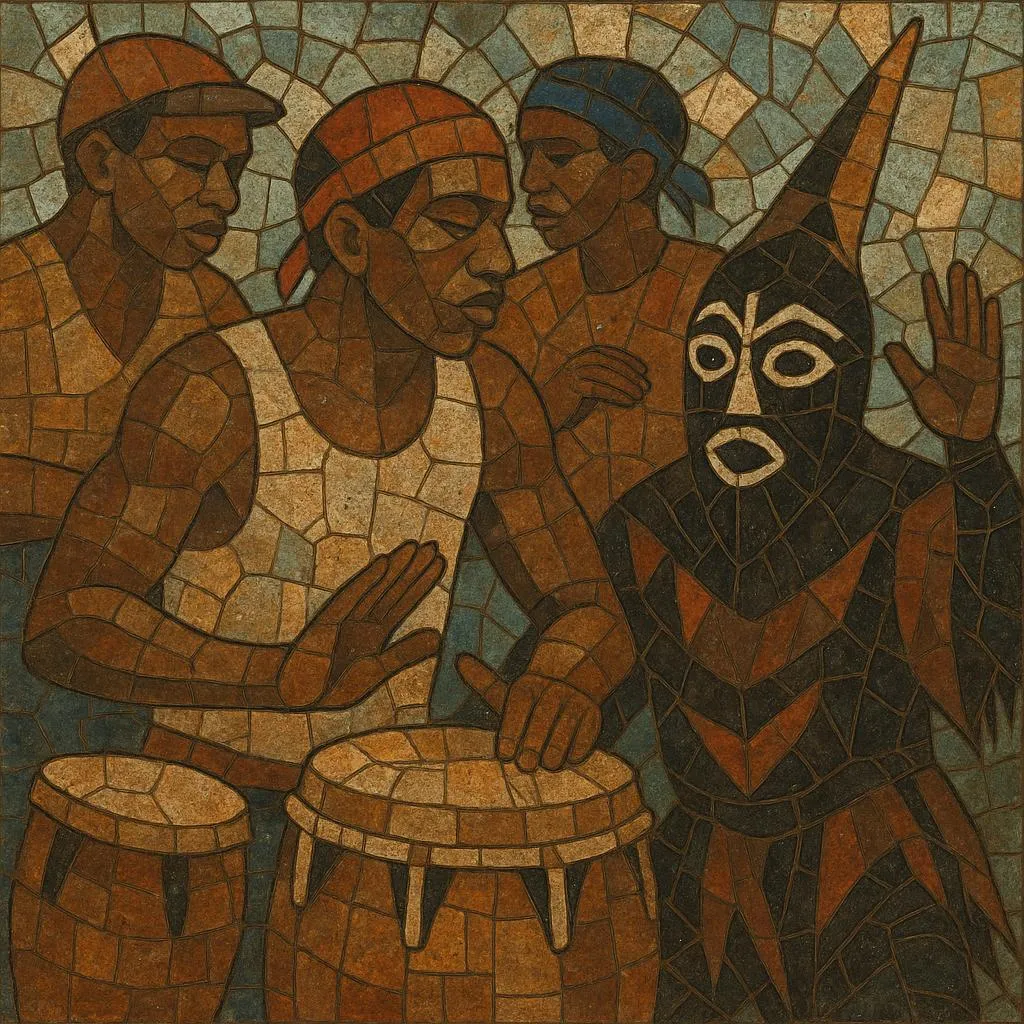
The style is centered on consecrated drums, dense interlocking rhythms, call-and-response singing in Abakuá-lexicon languages, and strict performance rules tied to initiation, secrecy, and specific rites.
Abakuá music strongly emphasizes collective groove, coded vocal texts, and the dramatic presence of masked/embodied figures in certain ceremonies, making it both devotional and highly percussive.
History
Abakuá music originates in Cuba as a diasporic continuation of Ékpè/Ekpe society practices from the Cross River region of West Africa.
During the 1800s, Abakuá lodges (potencias) formed in Havana and Matanzas, developing local repertoires of chants and drum languages while maintaining links to Ékpè-derived ritual structures.
Although Abakuá music is primarily ritual rather than entertainment music, Abakuá rhythmic ideas, vocabulary, and ceremonial prestige circulated outward through Afro-Cuban communities and influenced secular popular forms.
In the 20th century, elements associated with Abakuá identity became more publicly audible through Afro-Cuban folkloric ensembles and through references within rumba and related Afro-Cuban genres, even as core ceremonial practice remained restricted to the fraternity.
Abakuá music is sacred and often restricted; do not reproduce consecrated chants, ceremonial sequences, or society-specific drum patterns as “authentic ritual” without permission and guidance.
For composition, you can respectfully draw from general Afro-Cuban percussion principles and from publicly documented Abakuá-influenced folklore approaches.
Use a percussion-forward ensemble.
Commonly associated timbres include deep lead drums, supporting drums, and hand percussion that can create layered ostinatos.
If you are working in an Abakuá-influenced (non-ritual) context, combine Afro-Cuban drum textures with clave-aware phrasing.
Build the feel from interlocking rhythmic cells rather than from chord changes.
Write at least three layers: a steady time-keeping pattern, a mid-layer that “answers” it with syncopation, and a lead part that converses with the singers.
Aim for a dense, forward-driving groove suitable for procession or ceremony, with clear cue points for breaks and re-entry.
Favor call-and-response structure, where a lead voice states a short phrase and a chorus answers with a repeated refrain.
Keep melodic ranges narrow and rhythmically precise so the text rides the drum grid.
Arrange the piece in sections: invocation/entry, development with intensified drum conversation, and a closing cadence or cut.
Traditional Abakuá ceremony is not harmony-driven.
If you add harmony in an Abakuá-influenced contemporary arrangement, keep it minimal (static vamps) and prioritize the rhythmic pocket.
Rehearse cues as if the lead drummer is the conductor.
Dynamics should be purposeful: softer for entry/recitation-like moments, louder and more complex for climactic passages.
Prioritize ensemble precision, because the impact comes from tight interlock rather than individual virtuosity alone.