Your digging level
Description
Hare Krishna is a devotional music tradition centered on congregational chanting (kīrtan) and hymn singing (bhajan) from the Gauḍīya Vaiṣṇava lineage founded by Śrī Caitanya in 16th‑century Bengal.
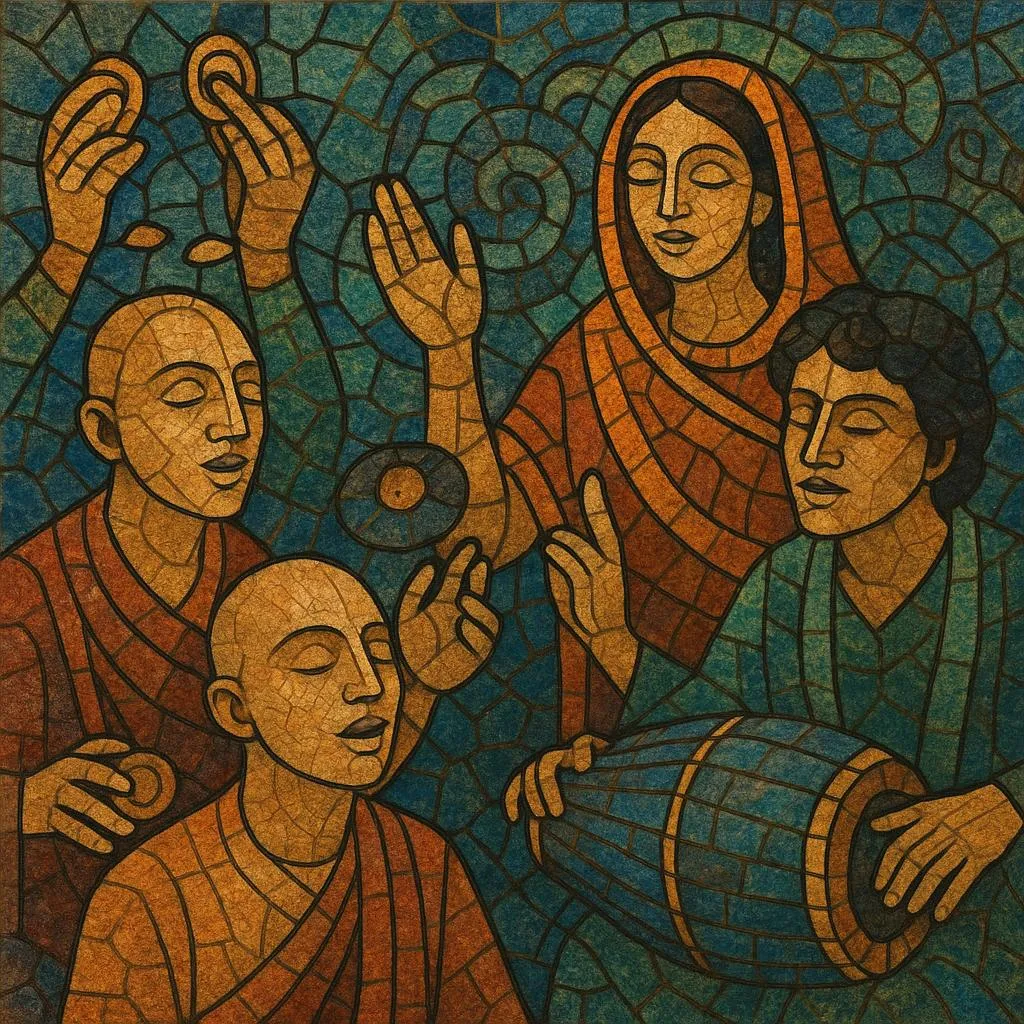
At its core is call‑and‑response singing of the mahā‑mantra (the "Hare Krishna" mantra) accompanied by hand cymbals (karatāls), double‑headed drum (mṛdaṅga), and often harmonium. Melodies typically draw on rāga‑like modal patterns, with cyclic tāla (rhythmic cycles) such as kahervā (8 beats), bhajani (8), or tintāl (16), and tempos that gradually accelerate to collective ecstasy. Lyrics invoke names and qualities of Rādhā and Krishna in Sanskrit and Bengali; performances can be intimate bhajans or long, high‑energy street/processional kīrtans.
In the late 1960s the International Society for Krishna Consciousness (ISKCON) globalized the form, weaving traditional instrumentation with guitars, bass, and later electronic textures. Today "Hare Krishna" encompasses temple liturgy, public sankīrtana, and a wide range of studio and stage interpretations that keep the mantra and participatory spirit at the center.
History
Hare Krishna music arises from Gauḍīya Vaiṣṇavism in Bengal and Odisha, where Śrī Caitanya (1486–1534) popularized sankīrtana—public, congregational chanting of the holy names. Poet‑saints such as Narottama Dāsa Ṭhākura and later Bhaktivinoda Ṭhākura codified vast repertoires of Bengali and Sanskrit bhajans that shaped the melodic and poetic language of the tradition. The core ensemble of mṛdaṅga and karatāls, with clapping and antiphonal responses, became the idiomatic sound.
The revivalist efforts of Bhaktisiddhānta Sarasvatī (1874–1937) modernized outreach while retaining musical centrality of kīrtan and daily ārati songs. Gramophone recordings and printed songbooks began to stabilize versions of key hymns and performance practice.
A. C. Bhaktivedanta Swami Prabhupāda founded ISKCON in New York (1966), bringing Bengali kīrtan and bhajan to Western audiences. Street sankīrtana, temple programs, and commercial recordings quickly spread through North America and Europe. The London‑based Radha Krishna Temple, supported by sympathetic rock figures, introduced the mantra to pop listeners while retaining mṛdaṅga/karatāls/harmonium texture.
24‑hour kīrtans, festivals, and pilgrimages fostered a global scene across India, Europe, the Americas, and Oceania. Studio productions expanded instrumentation—adding acoustic guitars, strings, bansuri, bass, and light percussion—while some artists integrated folk, soft rock, and ambient aesthetics, yet preserved the participatory call‑and‑response structure and mantra focus.
Today "Hare Krishna" denotes both liturgical temple music (ārati songs, bhajans, and sankīrtana) and concert/recording contexts. Yoga and mindfulness circles often feature mantra‑centric sets influenced by this repertoire, while devotees maintain traditional rāga‑inflected melodies, cyclical tāla, and the ecstatic crescendo that defines sankīrtana.