Your digging level for this genre

0/8
🏆
Sign in, then listen to this genre to level up

Description

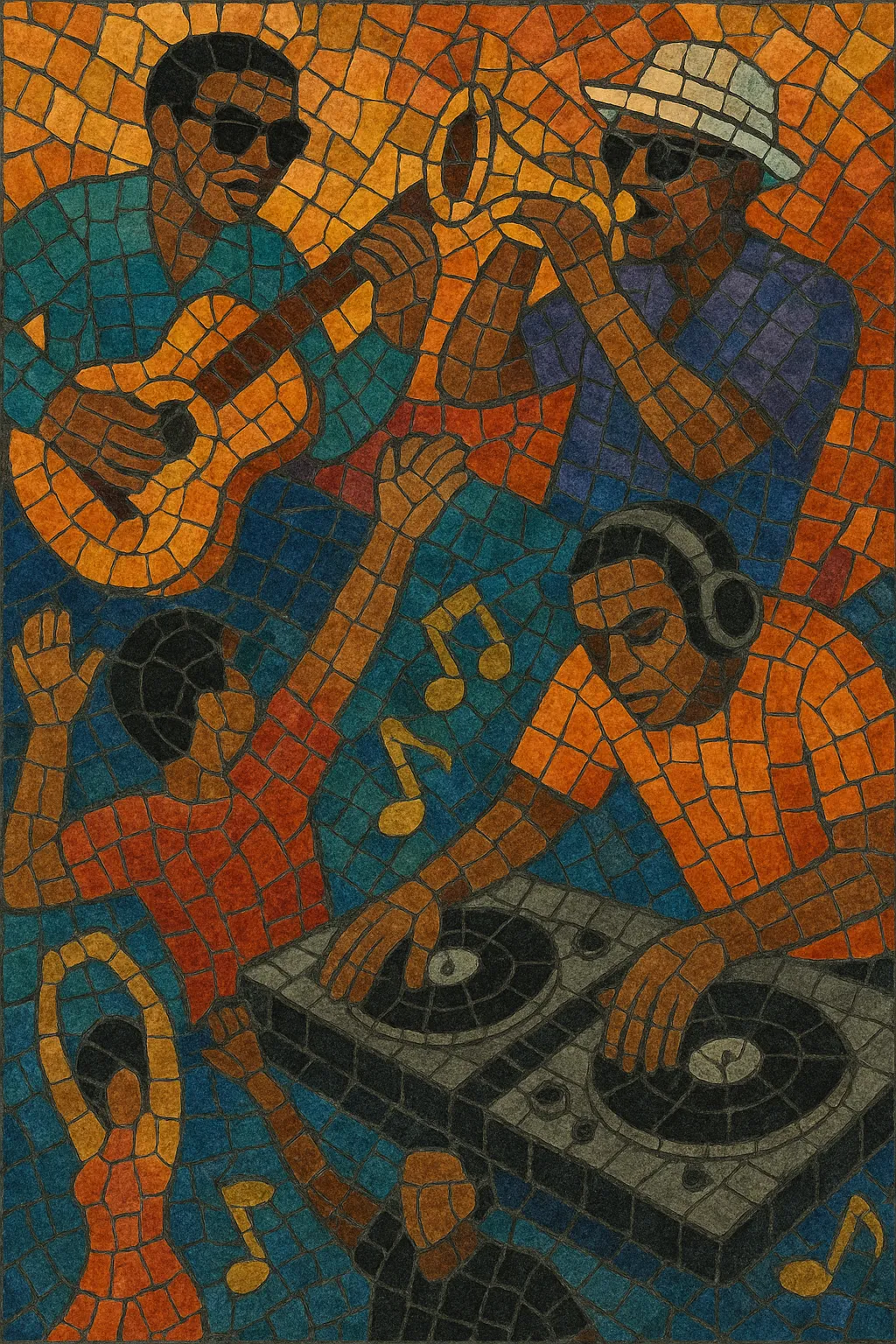
Funky breaks is a breakbeat subgenre that blends the syncopated drum programming of breakbeat with the groove, horn stabs, and basslines of classic funk and disco. It is typically sample-driven, leaning on chopped drum breaks, rhythmic guitar licks, and soulful vocal snippets.

The style favors bouncy, swung rhythms over four-on-the-floor patterns, with tempos most often between 110–130 BPM. DJs and producers emphasize party-friendly arrangements, gritty vinyl textures, and turntablist techniques like cutting and scratching to create a lively, feel-good, dancefloor energy.

History

Roots (1970s–early 1990s)

Funky breaks traces its DNA to 1970s funk and disco rhythm sections and the breakbeat-centered practices of early hip hop DJs who isolated drum breaks from records. As sampling technology matured, producers began to recontextualize funk drum breaks with modern electronic production.

Emergence in the UK breaks/big beat era (mid–late 1990s)

In the mid-1990s United Kingdom club culture, a wave of big beat and breaks artists popularized heavier, funk-laden breakbeats and sample collages. This environment catalyzed a distinct, party-forward strand—later tagged "funky breaks"—that foregrounded funk instrumentation, horn riffs, and hip hop turntablism over chunky, syncopated drums.

2000s consolidation and global spread

Through the 2000s, independent labels and DJ-led club nights helped codify the sound. UK crews and allied scenes in the US (including Florida’s breaks community) pushed a bassy, groove-first approach while keeping the tempo sweet spot around 110–130 BPM. Digital production and the rise of sample-clearable packs expanded access to authentic funk textures.

Influence and modern crossovers (2010s–present)

Funky breaks fed into adjacent styles like glitch hop, electro swing, and mashup culture, all of which rely on breakbeats, funk sampling, and crowd-pleasing arrangements. Contemporary producers still draw on the genre’s core recipe—classic funk flavors over modern breakbeat engineering—to deliver high-energy, DJ-friendly tracks.

How to make a track in this genre

Tempo and rhythm
•   Aim for 110–130 BPM with a noticeable swing/groove. Use syncopation and ghost notes to keep the drums lively.
Drums and percussion
•   Start with a classic funk break (e.g., chopped drum loops) and reinforce with layered one-shots (kicks, snares, hi-hats) to modernize punch. •   Apply gentle saturation and transient shaping to keep breaks punchy and warm. Add percussion (congas, shakers, claps) for shuffle and forward motion.
Bass and groove
•   Write a funky, syncopated bassline (electric-bass emulation or synth bass). Emphasize off-beat accents and octave jumps. •   Sidechain subtly to the kick for clarity, and glue bass and drums with bus compression.
Sampling and musical elements
•   Sample horn stabs, guitar licks, Rhodes/piano chords, and soulful vocal snippets. Chop and re-sequence to form call-and-response hooks. •   Use tasteful scratching, backspins, and tape-stop effects for DJ flavor.
Harmony and melody
•   Keep harmonic progressions simple (I–IV–V or minor i–VII–VI patterns). The groove and arrangement carry the track. •   Deploy short, memorable melodic riffs (horns, synth leads, or guitar) that punctuate the rhythm.
Arrangement and structure
•   DJ-friendly 8/16-bar phrasing. Build from an intro groove to a primary drop, then alternate between breakdowns and returns. •   Introduce new fills, edits, and variations every 4–8 bars to maintain dancefloor energy.
Sound design and mixing
•   Aim for warm, vintage-leaning tones (light tape/console saturation). Preserve transients on drums while keeping midrange clear for samples. •   Parallel compression on drums and careful high-pass filtering on non-bass elements help maintain a tight low end.
Performance and tools
•   Drum machines/samplers (e.g., MPC-style workflows), turntables for scratches, and DAWs with time-stretching for break editing. •   Focus on crate-digging or high-quality royalty-free packs to source authentic funk textures.

Top tracks

Locked
Share your favorite track to unlock other users’ top tracks
Influenced by
Has influenced
Challenges
Digger Battle
Let's see who can find the best track in this genre
© 2025 Melodigging
Melodding was created as a tribute to Every Noise at Once, which inspired us to help curious minds keep digging into music's ever-evolving genres.
Buy me a coffee for Melodigging