Your digging level
Description
Folclore extremeño is the traditional folk music and dance of Extremadura, a western region of Spain bordering Portugal. It gathers village repertoires tied to the agricultural calendar, religious feasts, and rites of passage.
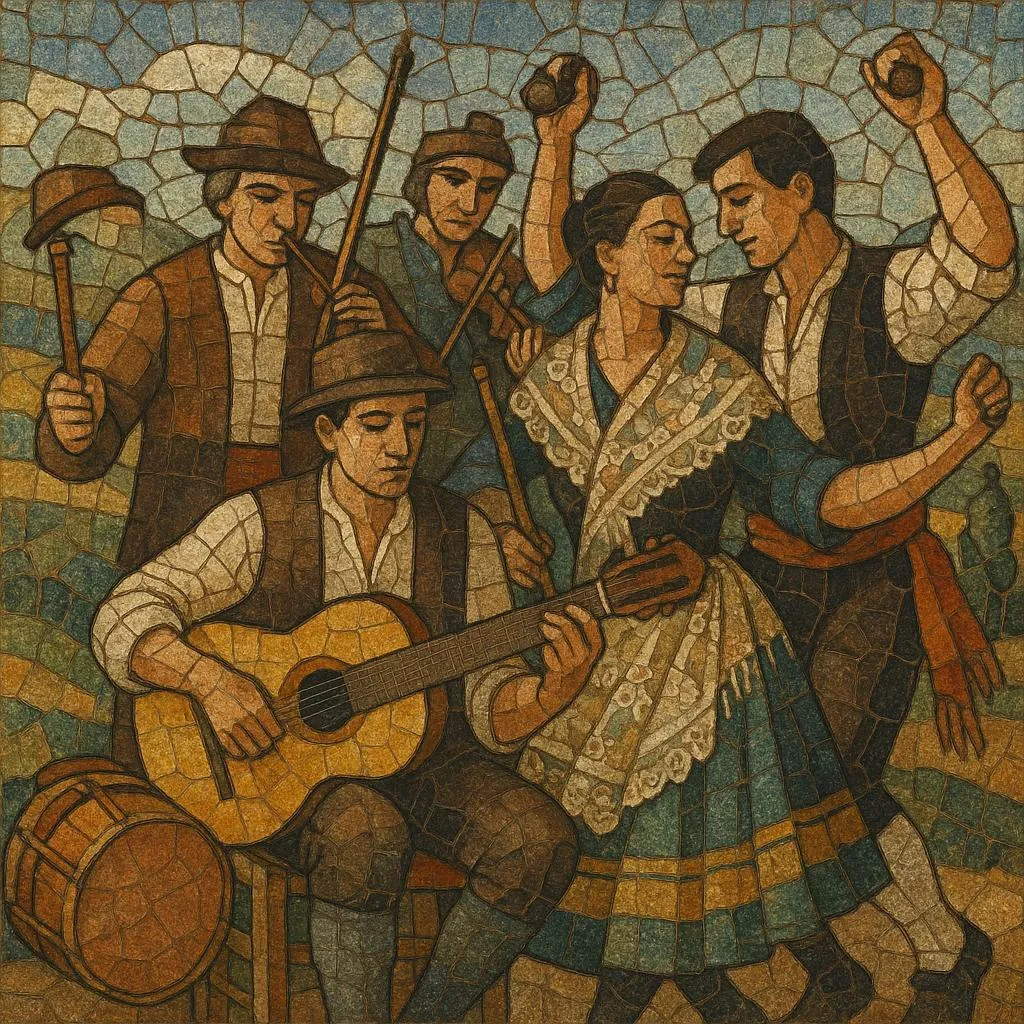
Typical forms include lively jotas (often in 3/4 or 6/8), rondas (serenading or circulating songs), and narrative romances (ballads). Ensembles are commonly led by the tamborilero, who plays the three‑holed flute (gaita de tres agujeros) with one hand while striking a small side drum (tamboril) with the other—a hallmark sound of the western Iberian interior. Voices are supported by guitar, bandurria, lute, violin or rabel, accordion, hand percussion (pandereta, adufe in border areas, almirez), zambomba at Christmas, and castanets.
Melodies are strophic and catchy, often in major or modal (Mixolydian/Dorian) flavors with call‑and‑response refrains. Lyrics speak in local speech of courtship, harvests, conscription “quintos,” saints’ days, and communal celebration, preserving the memory and identity of Extremadura’s towns and comarcas.
History
The roots of folclore extremeño lie in communal singing and dance practices shaped by farm work, transhumance, and parish life from at least the 18th–19th centuries. The iconic tamborilero tradition (three‑holed flute and small drum) anchored outdoor dances and processions, while strophic romances carried news, legends, and morality tales across villages.
In the early–mid 20th century, schoolteachers, priests, and local musicians began notating and recording local repertoires. During the 1940s–1960s, “Coros y Danzas” ensembles systematized costumes, choreographies, and song suites for the stage, helping to disseminate Extremadura’s jotas and rondas beyond their original towns while also standardizing versions.
From the 1970s onward, Spain’s folk revival encouraged fieldwork and new performance projects in Extremadura. Groups blended archival material with modern arrangements, expanded instrumentation (e.g., violin, accordion, guitar‑bandurria sections), and revived repertories for festivals and recordings. This movement professionalized the tamborilero’s role and diversified local dance groups tied to cultural associations across the region.
Folclore extremeño now lives both in community rituals (patron‑saint fiestas, Christmas rounds, May songs) and on stage. Ensembles balance historical fidelity (dialect verses, region‑specific steps and costumes) with contemporary presentation. Cross‑border exchange with Portugal remains palpable in frame‑drum practice (adufe) and melodic turns, reflecting a broader western‑Iberian soundscape.