Your digging level
Description
Comptine africaine refers to African nursery rhymes and children’s songs that are transmitted orally and, in many regions, sung in French alongside local languages. They blend the simplicity of children’s verse with the rich call-and-response, handclap games, and small percussion textures found across African musical traditions.
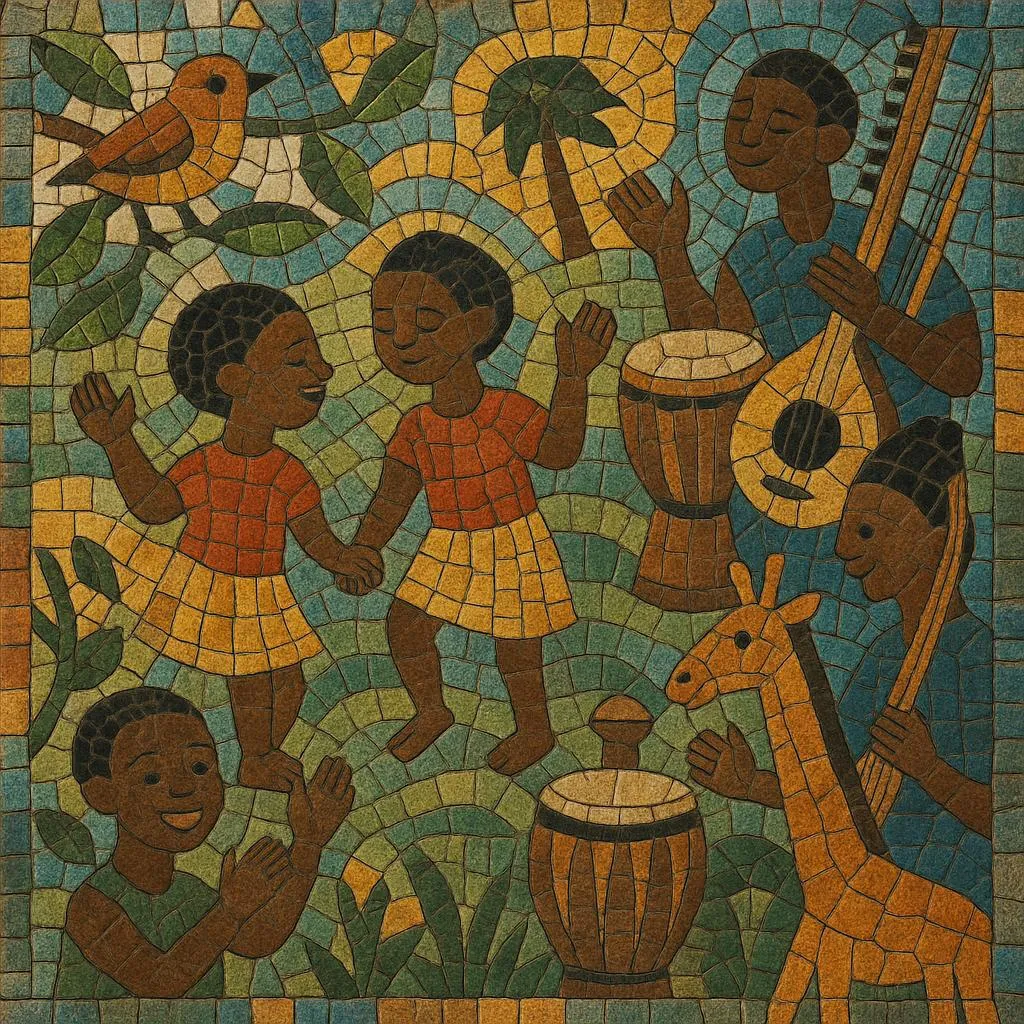
Typically concise, repetitive, and melodically narrow to enable group participation, these pieces accompany circle games, counting, naming of animals, and life-skills themes. Their rhythms often sit in a lilting 6/8 or a gently swinging 4/4, supported by claps, shakers, and sometimes small drums or kora/mbira accompaniments. The result is playful and educational music that is immediately singable by young voices while preserving regional folklore and proverbs.
History
Long before recordings, children’s songs formed part of daily life across African societies. Simple refrains embedded in play (handclap and circle games) and caregiving (lullabies) taught language, coordination, and social rules. In francophone regions, contact with French colonial schooling introduced the French word "comptine" (nursery rhyme) into local vocabularies and, over time, some French lyrics and forms mingled with indigenous game-songs.
With the rise of radio across West and Central Africa, children’s programming began to feature short songs, riddles, and call-and-response jingles. Teachers and community educators gathered and adapted rhymes for classroom use, frequently translating between French and local languages. From the 1970s to the 1990s, the spread of affordable cassettes allowed families and schools to circulate home-made and semi-professional recordings of comptines, preserving local variants and game instructions.
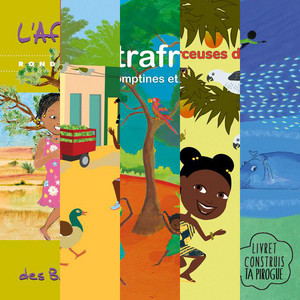
Ethnomusicologists, educators, and labels issued curated anthologies of comptines africaine, often pairing field recordings with illustrated lyric books. These compilations showcased the breadth of regional styles (Wolof, Bambara, Lingala, Malagasy, and others) and emphasized their educational value—counting, naming, manners, nature, and moral tales—while preserving play rules and gestures.
Video platforms and classroom resources accelerated circulation: teachers share lesson-ready versions; diaspora communities revive songs in bilingual formats; and animation studios produce lyric videos that retain the essential traits—repetition, call-and-response, onomatopoeia, and body percussion. Even as arrangements modernize, the core remains participatory children’s singing that connects play with memory, identity, and language.