Your digging level

For this genre
0/8
🏆
Sign in, then listen to this genre to level up

Description

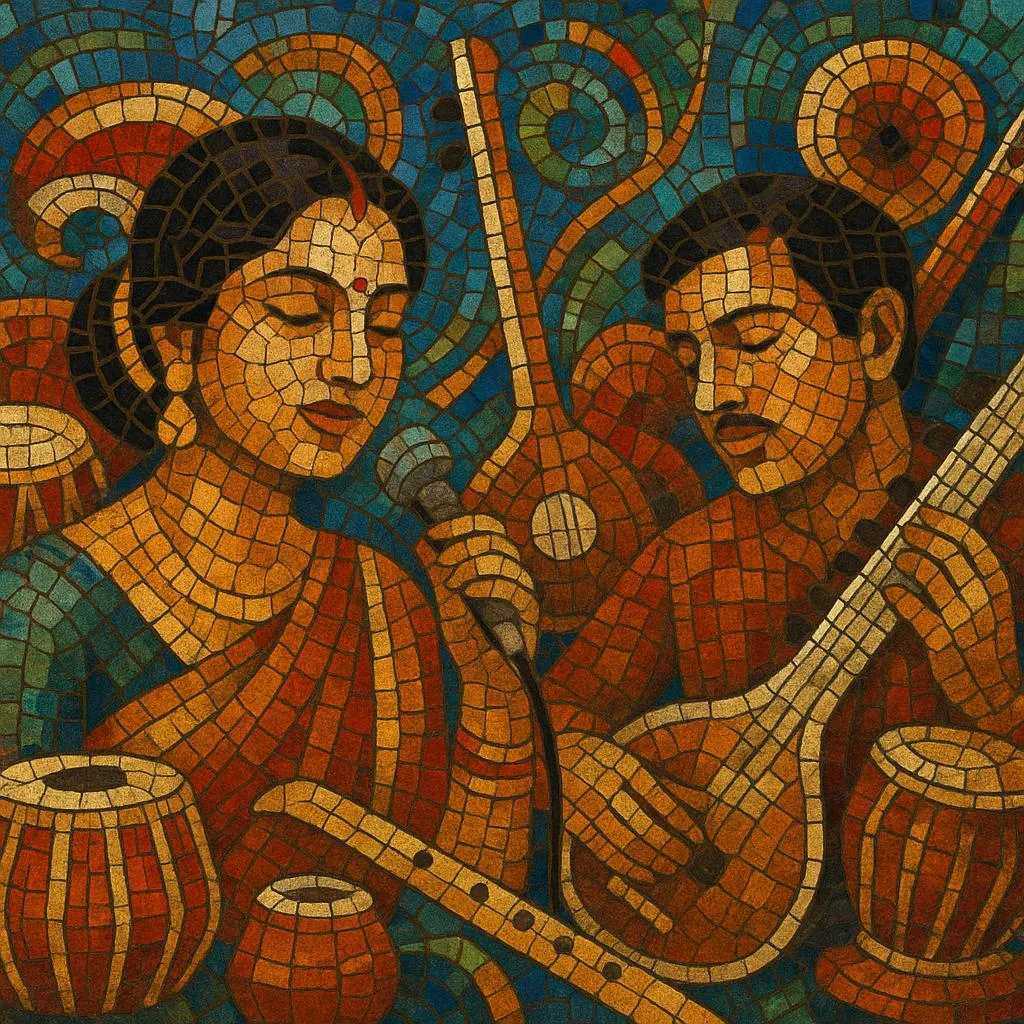
Classic Bollywood refers to the golden-age style of Hindi film songs that crystallized between the 1950s and late 1970s in India.

It blends raga-informed melodies and Hindustani vocal aesthetics with Western orchestration and cosmopolitan dance rhythms. Hallmarks include richly arranged string sections, woodwinds (bansuri), harmonium, sitar and sarangi colors, and a rhythm section of tabla, dholak, and Western drums or percussion. Songs are typically picturized on screen, carried by playback singers, and written in poetic Hindi/Urdu that draws on ghazal, nazm, and folk idioms.

Stylistically, classic Bollywood balanced romance, pathos, devotion, and spectacle, crafting memorable refrains and sweeping interludes that became the emotional core of Indian cinema.

Sources: Spotify, Wikipedia, Discogs, RYM, MB, user feedback and other online sources

History

Early formation (1930s–1940s)
•   Indian talkies began in 1931 (Alam Ara), establishing the music-forward grammar of Hindi cinema. Early film songs drew from Hindustani classical and Indian folk, devotional traditions, and Urdu poetry. Studio systems and radio (All India Radio, later Vividh Bharati) seeded a pan-Indian song culture.
Golden age codification (1950s–1960s)
•   The post-Independence boom of studios in Bombay ("Bollywood") standardized the song format: a memorable mukhda (refrain) with one or more antara (verses), lush interludes, and dance-friendly rhythms (keherva/8-beat, dadra/6-beat, foxtrot, waltz, tango, rumba). •   Music directors such as Naushad, Shankar–Jaikishan, S. D. Burman, Madan Mohan, O. P. Nayyar, and Salil Chowdhury fused raga-based melody with Western harmony and orchestration, often employing full string sections, choir, and jazz-derived arrangements. •   The era of iconic playback voices—Lata Mangeshkar, Mohammed Rafi, Asha Bhosle, Mukesh, Manna Dey, Talat Mahmood—defined the timbral identity of classic Bollywood.
Stylistic expansion (late 1960s–1970s)
•   Kishore Kumar’s rise and innovative composers like R. D. Burman introduced rock, funk, Latin, and psychedelic colors while retaining raga/modal sensitivities. •   Recording technology improved (multi-track, larger orchestras), and the picturization of songs evolved with more elaborate choreography and location shoots.
Legacy and transition (1980s onward)
•   Synth-pop, disco, and electronic instrumentation transformed film music, but the melodic craft, poetic lyricism, and orchestral sweep of the classic era continued to influence modern Bollywood and pan-Indian film industries. •   Revivals, remasters, and sampling in indie, pop ghazal, and Indian fusion have kept classic Bollywood’s repertoire central to South Asian musical memory.

How to make a track in this genre

Core form and melody
•   Use the classic song structure: a strong mukhda (hook/refrain) and 1–3 antara (verses), with instrumental interludes that modulate energy and set up picturization. •   Build melodies from accessible ragas (e.g., Yaman, Khamaj, Kafi, Bhimpalasi, Pahadi), favoring stepwise motion, graceful meends (glides), and clear cadences back to the tonic.
Rhythm and groove
•   Favor common talas and ballroom dances used in films: Keherva (8 beats), Dadra (6 beats), and occasional Teentaal (16) for semi-classical pieces; Western foxtrot, waltz, and tango for urban scenes. •   Layer Indian percussion (tabla, dholak, duggi) with Western drums and auxiliary percussion (shakers, bongos, castanets) to create hybrid feels.
Harmony and arrangement
•   Keep harmony supportive, not dominant: mostly diatonic progressions (I–IV–V, ii–V–I) with modal inflections from the raga; use secondary dominants sparingly. •   Orchestrate with strings (violins/violas/celli) carrying lush pads and counter-melodies; add bansuri, shehnai, sitar, sarangi as color instruments; use piano/accordion/guitar/mandolin and occasional brass/woodwinds for Western sheen. •   Write memorable instrumental leitmotifs to introduce characters or themes; employ call-and-response between voice and instruments in interludes.
Vocal style and lyrics
•   Compose for a clear, expressive playback voice with impeccable diction and emotive ghazal-influenced phrasing (ornaments like murki, khatka, gentle gamaks). •   Lyrics in Hindi/Urdu draw on shayari (metaphor, nature imagery, romance, viraha/longing, devotion). Maintain singable prosody that supports the melodic contour.
Production tips
•   Use dynamic, scene-aware arrangements: begin intimately, expand to full orchestra at the hook, and taper for narrative moments. •   Keep tempo moderate (roughly 68–120 BPM) to preserve lyrical clarity; use modulation or key lifts for climactic repeats. •   Reference classic mic techniques (warm vocal capture, natural reverb/echo) and panoramic orchestral spacing to evoke period authenticity.

Top tracks

Locked
Share your favorite track to unlock other users’ top tracks

Upcoming concerts

in this genre
Influenced by
Has influenced

Download our mobile app

Get the Melodigging app and start digging for new genres on the go
© 2026 Melodigging
Melodding was created as a tribute to Every Noise at Once, which inspired us to help curious minds keep digging into music's ever-evolving genres.
Buy me a coffee for Melodigging