

Your digging level
Description
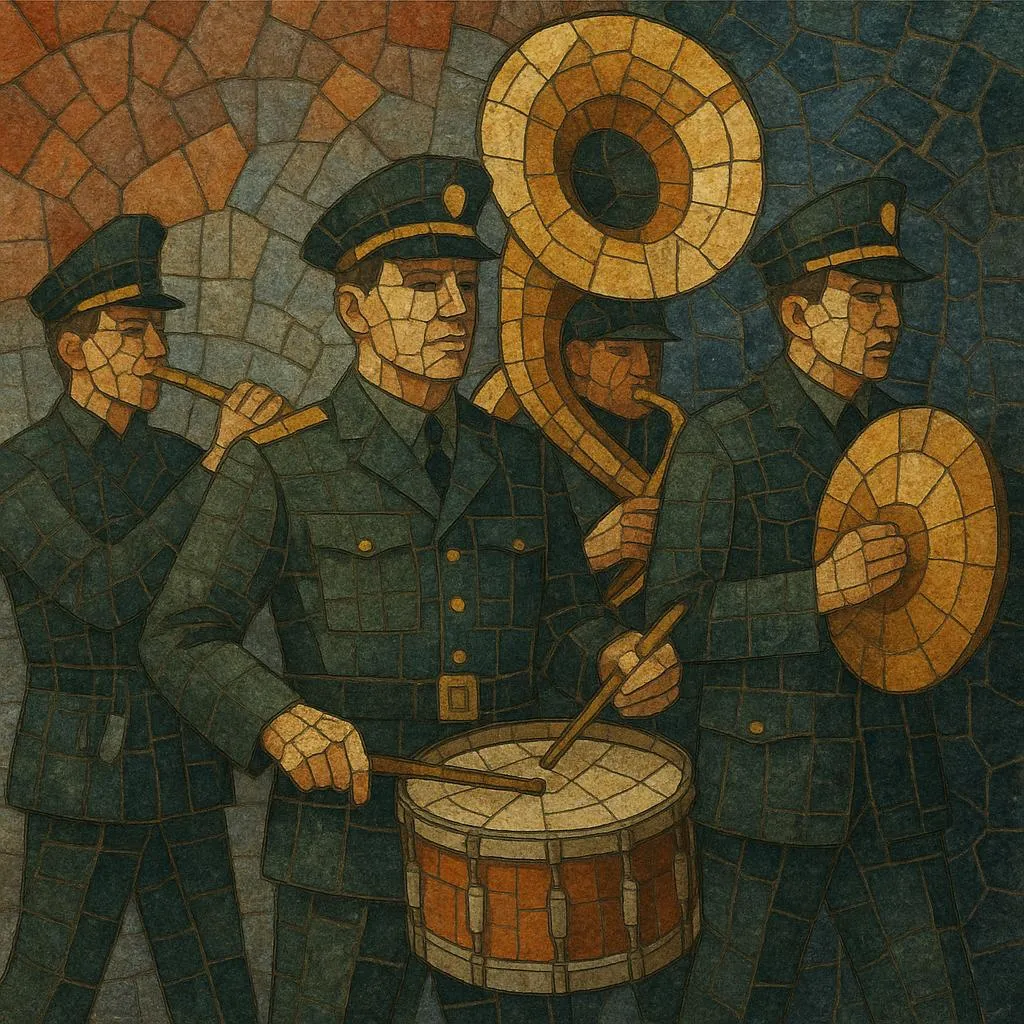
Banda militar (military band) is a wind-and-percussion ensemble designed to support military ceremony, pageantry, and public morale through processional music, fanfares, and concert selections.
Typical instrumentation mixes brass (cornets/trumpets, horns, trombones, euphoniums/baritones, tubas), woodwinds (piccolo, flutes, oboes, clarinets, saxophones), and a battery of percussion (snare, bass drum, cymbals, tenor drums, glockenspiel, and sometimes timpani for static ceremonies). In certain traditions, bagpipes or bugles also appear.
The core repertoire centers on marches, fanfares, patriotic songs, hymn settings, and arrangements of overtures and popular tunes. Stylistically, military bands emphasize clear rhythmic articulation, bright timbral blend, and balanced, antiphonal voicings that project effectively outdoors and on the move.
History
Modern military bands coalesced in 18th‑century Europe as armies formalized musical units to regulate troop movement, communicate commands, and project ceremonial prestige. While brass and percussion had long accompanied troops, the Western military band’s standardized wind ensemble—mixing woodwinds and brass—was shaped by court and regimental traditions in Britain, Prussia, and France, and by the example of Ottoman mehter (Janissary) music with its prominent percussion and martial rhythms.
Across the 1800s, military bands professionalized, adopted keyed brass and improved woodwinds, and codified the march as a central form (intro–strains–trio–breakstrain–stinger). Britain’s Guards bands and the Royal Marines Band Service became widely emulated, while composers such as John Philip Sousa (U.S.), Kenneth J. Alford (U.K.), Karl L. King, and Henry Fillmore expanded the repertoire. As nation‑states formed in the Americas and beyond, military bands spread globally, becoming emblems of civic identity at parades, state visits, and national celebrations.
In the 20th century, military bands increasingly served as public concert ensembles, commissioning original wind works (e.g., Holst, Vaughan Williams, Grainger) and broadcasting on radio. Their training standards and instrumentation strongly influenced civilian concert bands, school marching bands, and wind symphonies, while their ceremonial roles remained central to state protocol, remembrance rites, and military ceremonies.
Contemporary military bands continue to perform ceremonial duties, concerts, tours, and educational outreach. They preserve historic repertoire (marches, fanfares, national songs) while premiering new wind ensemble music, collaborating with choirs and orchestras, and representing national cultural diplomacy worldwide.



