Your digging level

For this genre
0/8
🏆
Sign in, then listen to this genre to level up

Description

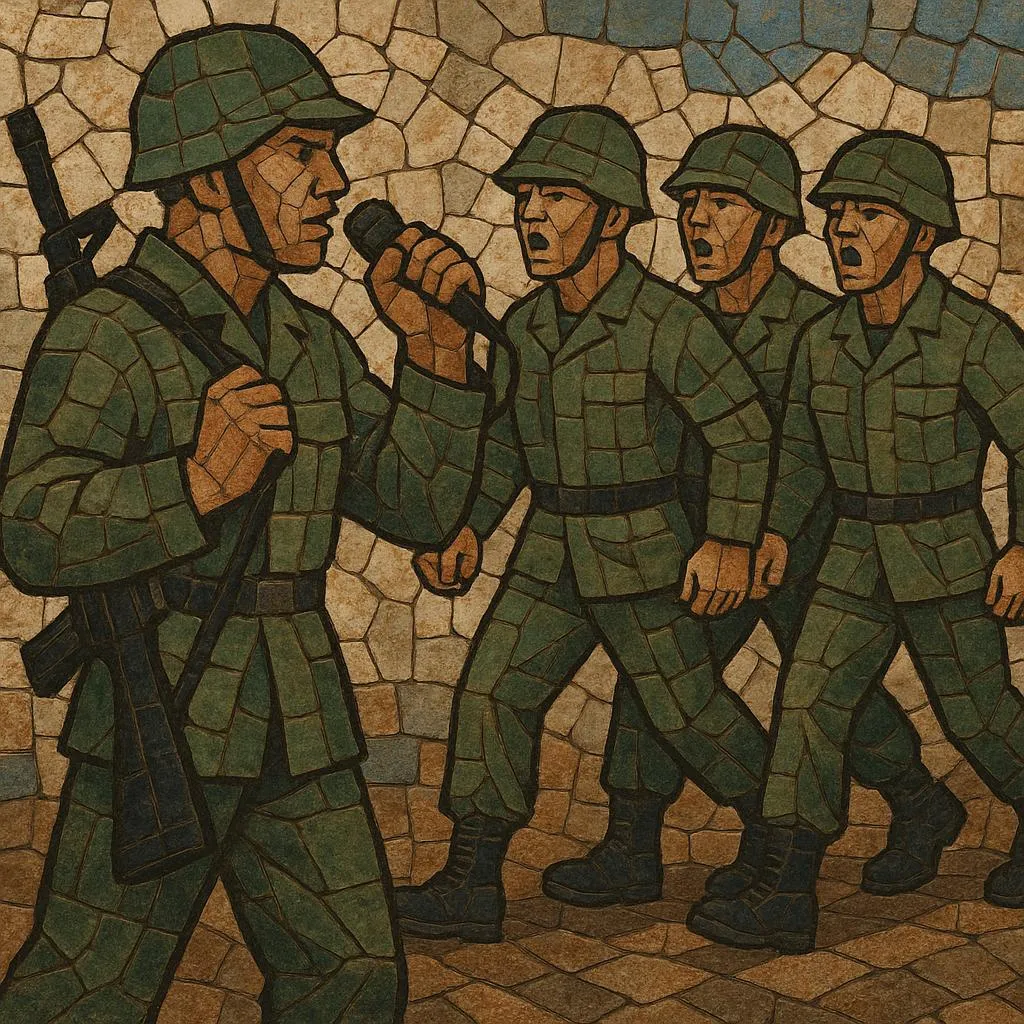
Military cadence (also called a cadence call or “jody call”) is a traditional call-and-response work song used by military personnel while marching or running.

It is designed to synchronize footfalls and breathing, reinforce unit cohesion, and maintain a steady training pace.

Cadences typically feature a single leader (caller) who improvises or selects verses, with the group responding in a fixed refrain or echoed phrase, often over a simple, repetitive rhythmic pattern aligned to the movement.


Sources: Spotify, Wikipedia, Discogs, Rate Your Music, MusicBrainz, and other online sources

History

Functional roots

Military cadence grows from older work-song traditions where rhythm coordinates collective labor.

Its structure resembles other call-and-response traditions and serves a similar purpose: timing, endurance, and morale.

Modern U.S. development

While armies long used marching songs and drill chants, the modern “running cadence” format became especially prominent in the mid-to-late 20th century with expanded physical training culture.

Cadences became a standard tool in basic training and unit PT, with recognizable refrains (including “jody” themes) circulating widely between units.

Standardization and recording culture

Over time, commonly shared verses and refrains became semi-standard, while leaders continued to adapt lyrics to unit identity, current events, and training context.

Commercial and institutional recordings helped spread particular versions, but the tradition remains primarily oral and situational.

Contemporary use and controversy

Cadences persist as a training practice, though many organizations periodically revise or restrict lyric content due to concerns about offensiveness or harmful messaging.

As a result, there is an ongoing tension between informal tradition and modern professional standards.

How to make a track in this genre

Core structure (call-and-response)
•   Write (or select) a short, repeatable response line that the group can memorize quickly. •   Create lead lines that fit the same phrase length so the group can answer without breaking stride. •   Keep the form modular: multiple verses can be swapped in without changing the refrain.
Rhythm and tempo
•   Use a strong, steady pulse aligned to marching or running footfalls. •   Common feel is in duple meter (e.g., 2/4 or 4/4) with accents that match steps. •   For running, the cadence should support breathing; avoid overly dense syllable clusters on every beat.
Melody and vocal delivery
•   Melodies are often limited-range, chant-like, and easy to project outdoors. •   Prioritize clarity and volume over ornamentation. •   The leader may use slight pitch inflection for command and memorability, but the group response is typically simpler and more uniform.
Lyrics and themes
•   

Favor short lines with strong consonants and clear vowel sounds for projection.

•   

Typical lyrical functions include:

•   

motivating effort and endurance

•   

reinforcing unit identity and pride

•   

humor, storytelling, or light taunting to build camaraderie

•   

Keep language appropriate to the intended context and current regulations.

Arrangement and instrumentation
•   Traditionally a cappella. •   If arranging for recording, minimal reinforcement can work (e.g., snare-like pulse, claps, or stomps), but it should not overpower the call-and-response.
Performance practice
•   The leader must maintain consistent timing and cue responses clearly. •   Rotate leaders to sustain energy. •   Adjust intensity (volume, density of lines, and verse length) to the group’s fatigue level and training goals.

Top tracks

Locked
Share your favorite track to unlock other users’ top tracks
Influenced by
Has influenced
Challenges
Digger Battle
Let's see who can find the best track in this genre

Download our mobile app

Get the Melodigging app and start digging for new genres on the go
© 2026 Melodigging
Melodding was created as a tribute to Every Noise at Once, which inspired us to help curious minds keep digging into music's ever-evolving genres.
Buy me a coffee for Melodigging