Genres
Artists
Albums
Make Music
Sign in
Sign in
Artists
Chamber Music
Artists
Chamber Music
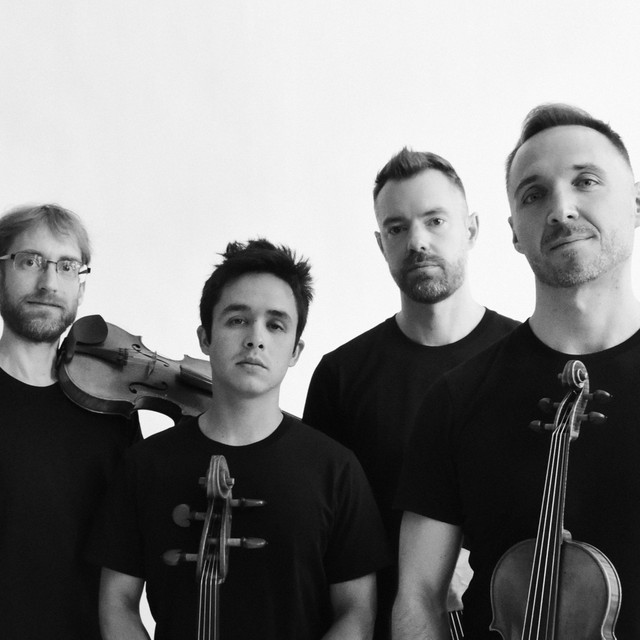
JACK Quartet
2009–2023
·
4 albums
Listen
1
/5
Genres
Reductionism
Reductionism is a strand of experimental, improvised music that emerged in the late 1990s, coalescing in scenes around Berlin, London, Tokyo, and Vienna. It focuses on extremely quiet dynamics, the creative use of silence, and the cultivation of subtle, unconventional timbres. Hallmarks include microtonality, extended and non-standard techniques, high amplification at very low volumes, and attention to minute sonic events such as friction, breath, electrical hum, and resonant artifacts. Rather than narrative arcs or traditional rhythm/harmony, the music prioritizes space, texture, and the act of listening itself.
Discover
Listen
Minimalism
Minimalism is a style of Western art music that emerged in the United States during the 1960s, characterized by the use of very limited musical materials, steady pulse, and extensive repetition. Composers often build pieces from short cells or motifs that are repeated and slowly transformed through additive or subtractive processes, phase shifting, and gradual changes in harmony, texture, or register. Harmony is typically consonant (often modal or diatonic), though just intonation and extended drones are also common. The result is music that foregrounds process, clarity, audibility of structure, and a hypnotic sense of stasis and flow. Typical ensembles include keyboards, mallet percussion, strings, winds, voices, and electronics or tape. Minimalism influenced a wide array of later styles, from ambient and new age to post-minimalism and minimal techno.
Discover
Listen
American Gamelan
American gamelan is a movement within contemporary classical and experimental music in the United States that creates new repertoire for gamelan-style ensembles built or adapted outside Indonesia. It draws on the cyclical, layered textures of Javanese and Balinese gamelan while embracing American instrument-building, just-intonation tunings, and minimalist process techniques. Ensembles often use homemade metallophones, gongs, and resonators fabricated from aluminum, steel, and other materials, producing a shimmering, bell-like sonority that is at once Indonesian-inspired and distinctively American. Unlike traditional Indonesian genres tied to court, ritual, or theatre, American gamelan typically serves the concert stage and educational settings, favoring newly composed works, cross-cultural collaborations, and experiments that combine gamelan with Western instruments, voice, or electronics.
Discover
Listen
Musique Concrète Instrumentale
Musique concrète instrumentale is a compositional approach that transfers the ideas of musique concrète to the realm of purely acoustic instruments. Instead of manipulating recorded sound objects on tape or digitally, composers write for traditional instruments played with unconventional, extended techniques so that the instruments produce "concrete" sound-objects: breaths, frictions, scratches, resonances, and mechanical noises. Pitch and regular meter are de-centered in favor of the morphology of sounds—how they begin, sustain, and decay; their grain, spectrum, and energy; and the dramaturgy created by their transformation over time. The result is a highly tactile, timbre-driven music that treats the instrument as a source of material rather than as a vehicle for themes or harmonic progressions.
Discover
Listen
Stochastic Music
Stochastic music is a 20th‑century avant‑garde approach in which musical parameters are governed by probability theory and random processes rather than fixed, note‑by‑note determination. Instead of traditional melody and harmony, composers shape "sound masses" by controlling statistical features like density, event rate, pitch distributions, durations, and dynamics. Typical tools include Gaussian, Poisson, and Markov processes, which create evolving textures, swarms, and clouds of sound—often realized in both orchestral and electroacoustic settings. The term is most closely associated with Iannis Xenakis, who formalized the method and demonstrated it in landmark works and writings, but it has deeply influenced computer music, experimental electronic practices, and later microsound/granular approaches.
Discover
Listen
Avant-Garde
Avant-garde music is an umbrella term for boundary-pushing practices that challenge prevailing norms of harmony, rhythm, timbre, form, and performance. It privileges experimentation, conceptual rigor, and a willingness to reframe what counts as music at all. Historically tied to early 20th‑century artistic modernism, avant-garde music introduced atonality, the emancipation of noise, and new forms of notation and process. It embraces indeterminacy, extended techniques, electronics, spatialization, and multimedia performance, treating sound as material to be sculpted, questioned, and reinvented.
Discover
Listen
Microtonal Classical
Microtonal classical is a stream of Western art music that organizes pitch using intervals smaller than the conventional 12-tone equal temperament. Composers employ alternative equal temperaments (such as 19, 24, 31, or 72 tones per octave), just intonation, and other tuning systems to expand harmony, melody, and timbre beyond the familiar semitone grid. The genre foregrounds novel intervals, complex chordal spectra, continuous pitch (glissandi), and fine-grained intonational nuance. It can sound otherworldly, tense, or delicately shimmering, and often requires specially retuned instruments, extended techniques, or custom-built instruments to realize its pitch language.
Discover
Listen
String Quartet
The string quartet is a cornerstone chamber-music genre scored for two violins, viola, and cello. It typically features a conversational texture where four independent voices share thematic material, balancing melody, harmony, and counterpoint. The classic four‑movement plan (fast sonata‑form, slow movement, minuet/scherzo, and a lively finale) became a hallmark in the Classical era, while later composers expanded and transformed the form, harmony, rhythm, and timbre. From Haydn and Mozart through Beethoven and Schubert to Bartók and Shostakovich, the quartet has served as a laboratory for compositional craft and expressive depth, ranging from intimate lyricism to rigorous structure and avant‑garde experimentation.
Discover
Listen
Chamber Music
Chamber music is a tradition of composed music for small ensembles—typically one player per part—intended for intimate spaces such as courts, salons, and private rooms rather than large public halls. Its aesthetic emphasizes clarity of texture, conversational interplay among parts, and balance without a conductor. Hallmark formations include the string quartet, piano trio, wind quintet, string quintet, and various mixed ensembles. Multi‑movement cycles (often in sonata form) and finely wrought counterpoint are common, ranging from Baroque trio sonatas to Classical string quartets and modern works with expanded timbres and techniques. Because of its scale and transparency, chamber music has long been a proving ground for compositional craft and ensemble musicianship, shaping the core of Western art music from the Baroque through the present.
Discover
Listen
Classical
Classical music is the notated art-music tradition of Europe and its global descendants, characterized by durable forms, carefully codified harmony and counterpoint, and a literate score-based practice. The term “classical” can refer broadly to the entire Western art-music lineage from the Medieval era to today, not just the Classical period (c. 1750s–1820s). It privileges long-form structures (such as symphonies, sonatas, concertos, masses, and operas), functional or modal harmony, thematic development, and timbral nuance across ensembles ranging from solo instruments to full orchestras and choirs. Across centuries, the style evolved from chant and modal polyphony to tonal harmony, and later to post-tonal idioms, while maintaining a shared emphasis on written notation, performance practice, and craft.
Discover
Listen
Show all 10 genres
Albums
2023
1
/5
Chemistry for Gamelan and String Quartet
Brian Baumbusch / Nata Swara / JACK Quartet
American Gamelan
2021
1
/5
Aggregate Forms
Catherine Lamb / JACK Quartet
Microtonal Classical
Chamber Music
Reductionism
2020
1
/5
Earthing
Clara Iannotta / JACK Quartet
Musique Concrète Instrumentale
String Quartet
Classical
2009
1
/5
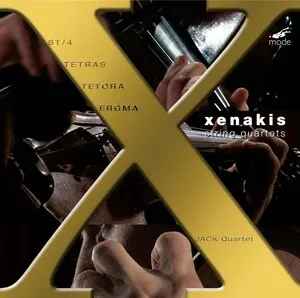
Complete String Quartets: ST/4; Tetras; Tetora; Ergma
Iannis Xenakis Ιάννης Ξενάκης / JACK Quartet
Stochastic Music
Classical
Similar artists
2
/5
Morton Feldman
Chamber Music
Classical
Avant-Garde
1
/5
Irvine Arditti
Chamber Music
Avant-Garde
Étude
3
/5
Kronos Quartet
Classical
Chamber Music
Latin American Classical Music
1
/5
Giacinto Scelsi
Avant-Garde
Microtonal Classical
Chamber Music
1
/5
Quatuor Bozzini
Avant-Garde
Chamber Music
Classical
3
/5
Steve Reich
Minimalism
Classical
Modern Classical
2
/5
John Cage
Indeterminacy
Classical
Experimental
1
/5
Jürg Frey
Avant-Garde
Chamber Music
Minimalism
1
/5
Various Artists
Afro-Funk
Alternative Rock
Ambient
2
/5
György Ligeti
Avant-Garde
Étude
Minimalism
Download our mobile app
Get the Melodigging app and start digging for new genres on the go
Download on the App Store
Get it on Google Play
© 2026 Melodigging
Give feedback
Legal
Melodding was created as a tribute to
Every Noise at Once
, which inspired us to help curious minds keep digging into music's ever-evolving genres.