Your digging level
Description
Vintage swing refers to the original, dance‑era swing recorded mainly during the 1930s and 1940s in the United States. It is characterized by a buoyant “swing” rhythmic feel (uneven, lilting eighths), strong four‑to‑the‑bar pulse, walking bass lines, and riff‑driven horn writing.
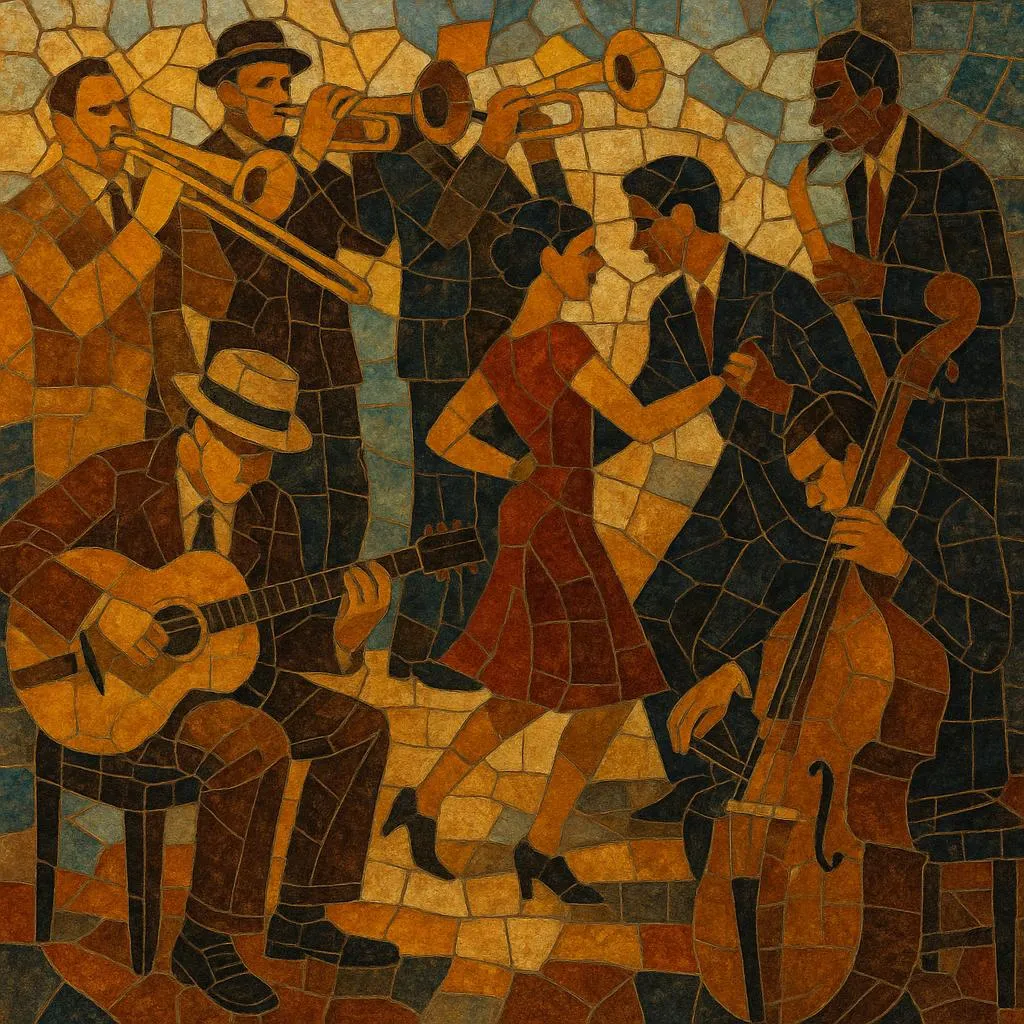
Typical ensembles were big bands with sections of saxophones, trombones, trumpets, and a rhythm section of guitar (four‑to‑the‑bar), piano, double bass, and drums (hi‑hat on 2 and 4). The style balances tightly arranged call‑and‑response figures with spotlighted improvised solos. Vocals often draw on the blues, with scat singing and witty songcraft common.
The “vintage” designation points to the sound of the period: monaural 78‑rpm recordings, ribbon mics, room‑forward balances, and lively ballrooms—music designed for social dance styles like the Lindy Hop and jitterbug.
History
Swing crystallized as dance music out of New Orleans jazz, Chicago jazz, and territory-band traditions at the turn of the 1930s. Arrangers like Fletcher Henderson codified riff‑based horn writing and section call‑and‑response, while rhythm sections tightened the four‑beat feel that made dancers move. In Harlem ballrooms and Midwestern “territory” circuits, bands honed head arrangements, blues forms, and shout choruses.
The classic vintage swing period was dominated by big bands led by Duke Ellington, Benny Goodman, Count Basie, Jimmie Lunceford, Chick Webb, Artie Shaw, Glenn Miller, and others. Radio remotes, hotel ballrooms, and nationwide tours spread the sound, while virtuoso soloists (e.g., Lester Young, Coleman Hawkins) and star vocalists (e.g., Ella Fitzgerald, Billie Holiday) made swing a popular art. Bands emphasized sectional writing, sax soli passages, and hot solo spots over steady four‑to‑the‑bar rhythm.
The American Federation of Musicians recording ban, wartime rationing, and shifting tastes disrupted the big‑band economy. Small‑group spin‑offs and jam sessions carried the idiom forward, even as musicians experimented with faster tempos and richer harmonies.
After the war, bebop and modern jazz drew on swing’s rhythmic and harmonic vocabulary, while jump blues, early rhythm & blues, and ultimately rock & roll borrowed its back‑beat excitement and horn riffing. As a historically bounded term, “vintage swing” now designates the original 1930s–40s recordings and performance practice that continue to power social dance scenes and reissue culture.