Your digging level
Description
Victorian Britain refers to the musical life of the United Kingdom during Queen Victoria’s reign (1837–1901). It spans domestic drawing‑room ballads, mass choral hymnody, the rise of brass bands and choral societies, comic opera and operetta (epitomized by Gilbert & Sullivan), and the booming world of the music hall.
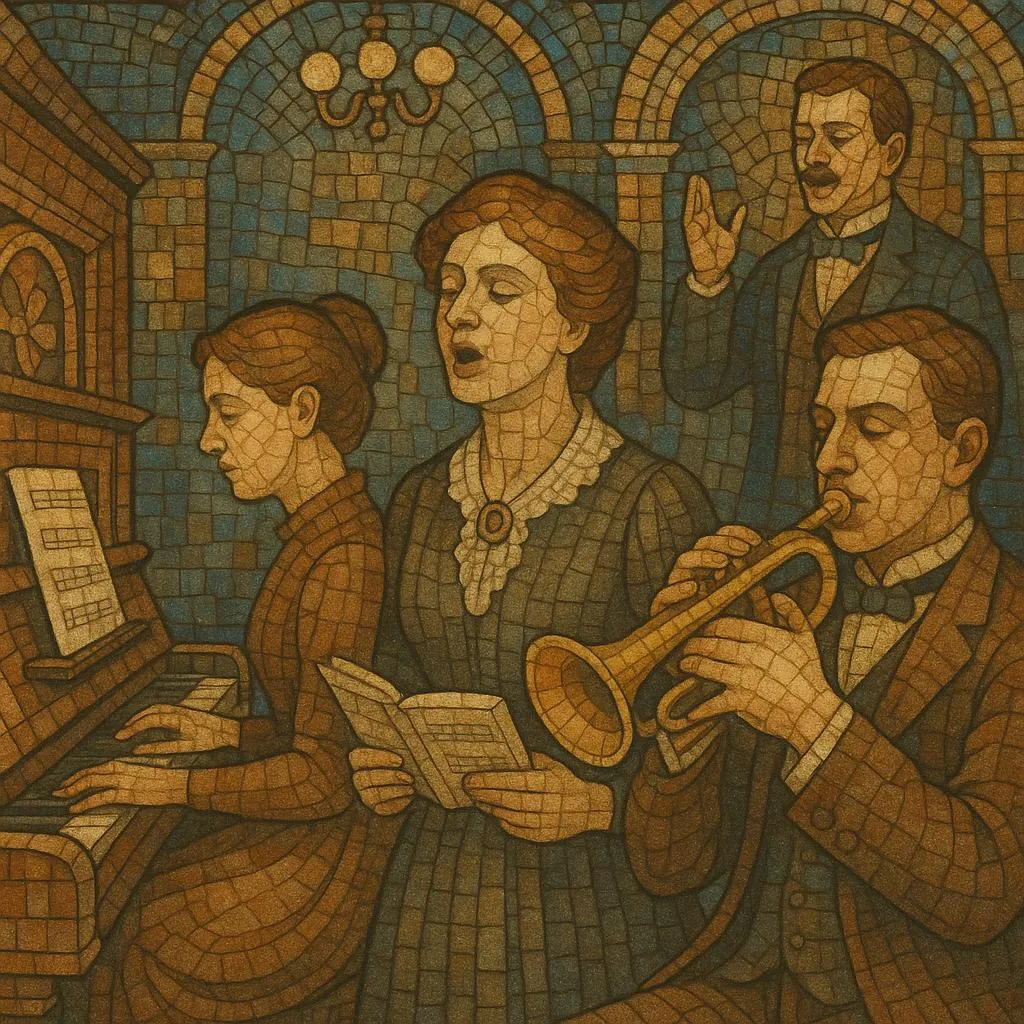
At home, affordable upright pianos and cheap sheet‑music printing nurtured a culture of parlour songs and amateur music‑making. In public, industrial urbanization fostered communal ensembles—brass bands, civic choirs, and church choirs—while theatres and halls offered everything from light opera to comic patter songs. Stylistically, the period blends late‑Romantic harmony and form with Anglican devotional traditions, folk song, and European dance rhythms, yielding music that ranges from sentimental and devotional to witty and theatrical.
History
The Victorian era begins amid the late‑Romantic expansion of European art music. In Britain, a rapidly growing middle class acquires pianos, cheap sheet music, and music literacy, fueling a domestic repertory of parlour ballads and strophic art songs. Anglican chant and hymnody thrive in churches, supported by organ building and the publication of influential hymnals (e.g., Hymns Ancient and Modern, 1861). Simultaneously, industrial towns form brass bands and choral societies, turning music into a communal pastime and civic pride.
From the 1850s, the music hall flourishes, offering comic turns, topical songs, and sing‑along choruses performed by stars like Marie Lloyd and Dan Leno. In the theatre, British comic opera crystallizes in the partnership of W. S. Gilbert and Arthur Sullivan (e.g., The Mikado, H.M.S. Pinafore), marrying witty libretti to elegant, tuneful scores influenced by operetta.
The late 19th century witnesses a strengthening of British compositional voices. Church and concert life nurture oratorios, anthems, and organ works (e.g., John Stainer’s The Crucifixion). Conservatory training (and continental exchange) helps cultivate a generation including Hubert Parry, Charles Villiers Stanford, and, approaching the century’s end, Edward Elgar and Samuel Coleridge‑Taylor. Choral societies and festivals disseminate large‑scale sacred and secular works across the country.
Publishers (e.g., Chappell, Boosey) feed a market for drawing‑room ballads—tuneful, sentimental songs with piano accompaniment (e.g., Sullivan’s The Lost Chord; Stephen Adams/Michael Maybrick’s The Holy City; James L. Molloy’s Love’s Old Sweet Song). European dances (waltzes, polkas) and marches become staples of home and band repertoires, while folk song informs arrangements and popular taste.
By the fin de siècle, British music is poised for an Edwardian bloom and the early 20th‑century renaissance. Theatres evolve toward modern musical theatre, light music idioms consolidate for salon and band, and national ensembles (brass bands, choirs) institutionalize competitions and festivals. The Victorian synthesis—hymnody, parlour song, music hall, and light opera—sets foundations for British musical life in the 20th century.