Your digging level

For this genre
0/8
🏆
Sign in, then listen to this genre to level up

Description

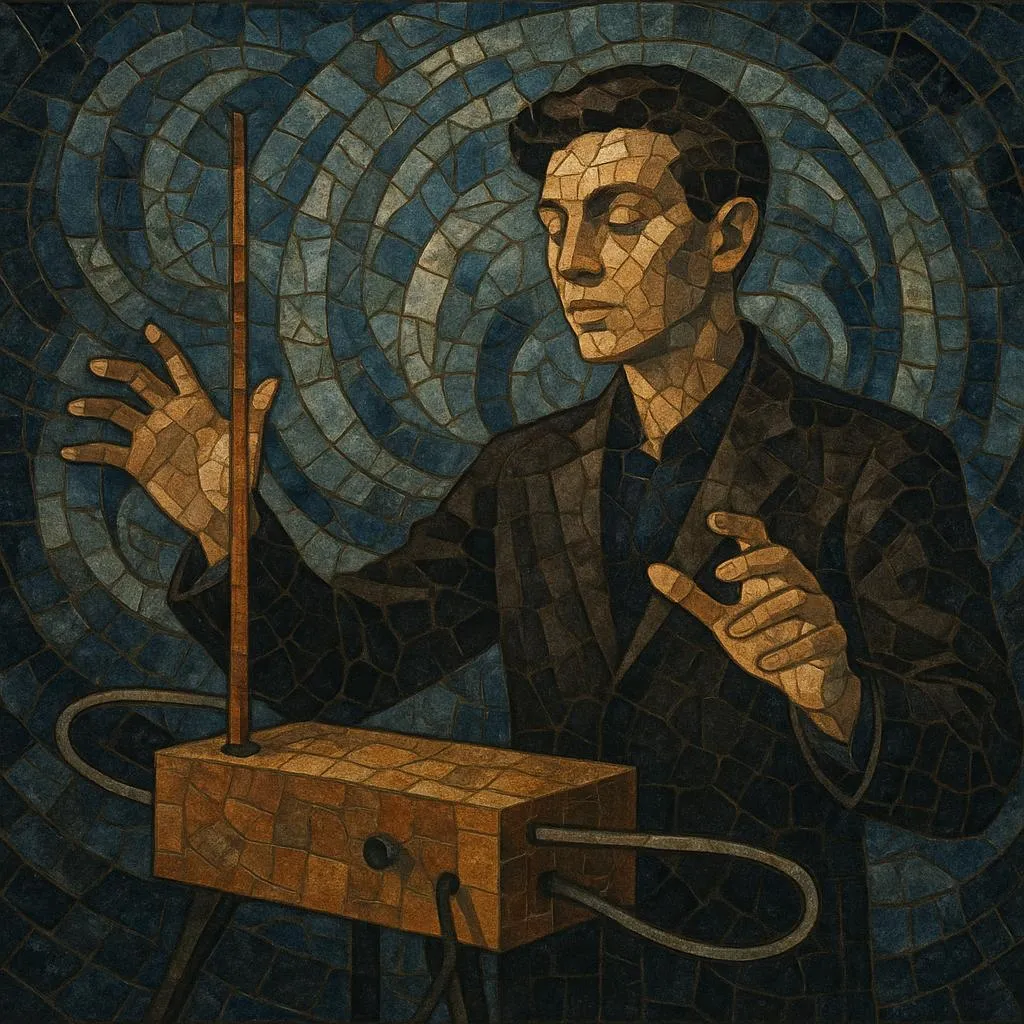
Theremin is a performance-centered genre built around the theremin, one of the earliest fully electronic instruments, invented by Léon Theremin in 1920. Played without physical contact, it produces a continuous, voice‑like tone by controlling pitch and volume with hand movements in electromagnetic fields.

The style ranges from classically inflected repertoire and chamber settings to experimental and ambient soundscapes. Its hallmark is expressive portamento, vibrato, and legato phrasing, often enhanced by reverberation and delay to emphasize its ethereal, otherworldly quality. Because it is monophonic and highly sensitive to micro-movements, theremin music foregrounds melodic contour, timbral nuance, and careful intonation over dense harmony or percussive articulation.

Culturally, the instrument became a sonic emblem of mystery and science fiction in mid‑century film scores, while contemporary practitioners have expanded it into concert music, avant‑pop, and electronic hybrids.


Sources: Spotify, Wikipedia, Discogs, RYM, MB, user feedback and other online sources

History

Invention and Early Concert Life (1920s–1930s)

Léon Theremin (Lev Termen) invented the theremin in 1920 in the Soviet Union and soon demonstrated it across Europe and the United States. Its touchless control and wide expressive range made it a novelty and a serious concert instrument at once. Virtuosos such as Clara Rockmore developed refined techniques and commissioned arrangements of classical repertoire, framing the theremin as a lyrical solo voice with piano or orchestra.

Hollywood and the Mid‑Century Imagination (1940s–1950s)

The theremin’s uncanny timbre became synonymous with psychological unease and the “unknown” in cinema. Hollywood composers integrated theremin solos into noir, thriller, and especially science‑fiction scores, cementing the instrument’s cultural association with the paranormal and outer space. Studio thereminists like Dr. Samuel J. Hoffman brought technical reliability and expressive control to these sessions.

Shifts, Substitutes, and Revivals (1960s–1990s)

As portable synthesizers emerged, many producers replicated theremin‑like glides with oscillators or used related instruments (e.g., electro‑theremin) in pop and surf contexts, reducing the demand for dedicated thereminists. Interest revived in the 1990s through documentaries, new instrument production (notably by Moog Music), and a growing cohort of performers and composers who re‑situated the theremin within concert music, experimental scenes, and academic programs.

Contemporary Practice (2000s–present)

A global community of players now treats the theremin as both a classical and experimental instrument. Modern method books, pitch‑preview systems, and improved designs have raised technical standards. Artists collaborate with chamber ensembles, electronics, and multimedia, extending the palette from romantic lyricism to ambient minimalism, free improvisation, and avant‑pop. The theremin’s sound remains a shorthand for the uncanny, yet its repertoire continues to diversify well beyond its mid‑century film associations.

How to make a track in this genre

Core Technique and Tone
•   Use the theremin as a lyrical, monophonic lead voice. Pitch is controlled by the right hand near the pitch antenna; volume and articulation are controlled by the left hand above the loop antenna. •   Aim for stable intonation through economical hand movements, consistent stance, and a calibrated instrument distance. Employ controlled, wrist‑based vibrato and careful portamento to shape phrases like a human singer.
Harmony and Accompaniment
•   Pair the theremin with piano, strings, or sustained electronic pads to support its legato lines. Keep harmony clear and uncluttered; the instrument excels over slow harmonic rhythm and rich, consonant voicings (e.g., extended triads, modal drones). •   Write in keys and registers that favor clarity (mid to upper register); avoid dense counterpoint that competes with the theremin’s continuous pitch.
Articulation and Rhythm
•   Because there is no natural attack, articulate notes with the volume hand (a quick dip to “gate” sound) for staccato or note re‑entries. For legato, maintain a smooth volume contour while shaping crescendos and decrescendos. •   Rhythms read most clearly with defined volume‑hand gating or with accompaniment providing rhythmic anchors (ostinati, light percussion, or arpeggiated textures).
Timbre and Effects
•   Start with a warm, vocal‑like waveform; modest low‑pass filtering reduces harshness. Tasteful reverb (plate or hall) and light delay accentuate the ethereal quality; avoid excessive wash that blurs pitch. •   For modern styles, integrate looping, granular ambience, ring modulation, or pitch‑shifting for harmonized layers; always preserve a clear fundamental for intonation.
Compositional Tips
•   Write cantabile melodies with room for expressive slides and cadential breaths (brief volume dips). Balance lyrical sections with moments of precise, gated articulation to prevent monotony. •   Use thematic variation: present a simple motif, develop it through intervallic expansion, timbral shifts, or microtonal inflections if the performer is comfortable. •   Provide reference tones (drone, pedal, or discreet in‑ear pitch preview) in rehearsals and performance to support accuracy—especially in modulating passages.

Top tracks

Locked
Share your favorite track to unlock other users’ top tracks

Upcoming concerts

in this genre
Influenced by
Has influenced

Download our mobile app

Get the Melodigging app and start digging for new genres on the go
© 2026 Melodigging
Melodding was created as a tribute to Every Noise at Once, which inspired us to help curious minds keep digging into music's ever-evolving genres.
Buy me a coffee for Melodigging