Your digging level
Description
Staff band refers to the elite Salvation Army brass bands organized at a territorial or international level (e.g., International Staff Band, New York Staff Band). These ensembles draw on the British brass band tradition but focus on sacred repertoire—marches, hymn-tune settings, festival preludes, meditations, and programmatic works with Christian themes.
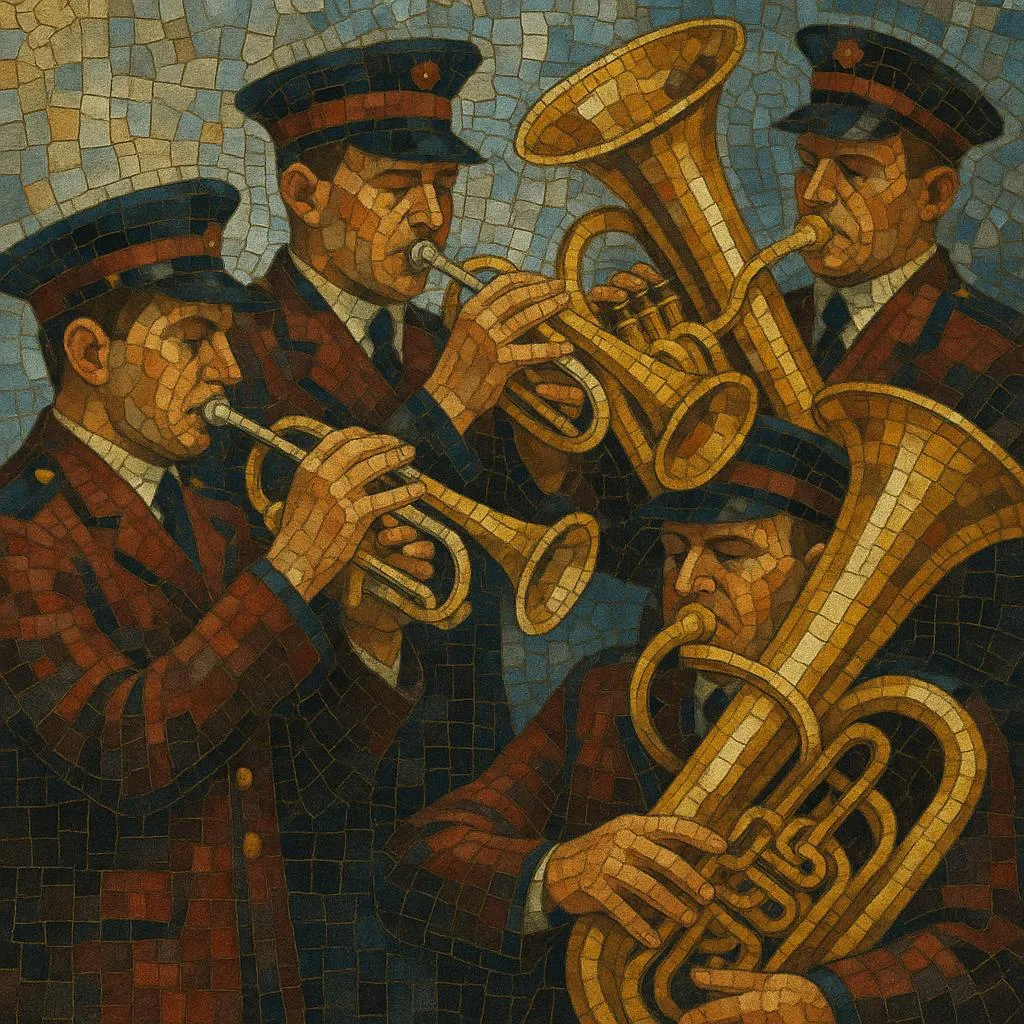
The core sound is that of a full British-style brass band: cornets, flugelhorn, tenor horns, baritones, euphonium, trombones, E♭/B♭ basses (tubas), and percussion. Music is typically tonal, melodically direct, and rhetorically shaped for congregational and outreach contexts, combining the discipline of contesting bands with the devotional character of church music.
Stylistically, staff bands emphasize brilliance and blend (especially in the cornet bench and horn/baritone choir), lyrical euphonium solos, firm bass foundations, and dignified but energetic march rhythms. Their repertoire often re-harmonizes or elaborates familiar hymns to create concert works that are both spiritually communicative and musically sophisticated.
History
The Salvation Army adopted brass bands in the late 1800s because they were portable, affordable, and powerful tools for street evangelism. Within this ecology, "staff bands" emerged as flagship, professional-caliber ensembles that could represent a territory or the international mission at the highest musical standard. The International Staff Band (London, 1891) became a model for similar groups worldwide.
From the 1890s through the interwar years, staff bands consolidated a distinct sacred brass literature: marches suitable for processions and street work; hymn-tune arrangements designed to edify congregations; and more ambitious festival works for concert use. Composers and bandmasters within the Salvation Army—many of whom were also officers—crafted pieces that blended British brass band craft with devotional purpose.
After World War II, staff bands spread across North America, Europe, and Australasia. Improved publishing (via Salvationist Publishing & Supplies and territorial presses) and recording technologies helped standardize a shared repertoire and sound. Transatlantic exchanges, tours, and festival meetings further raised performance standards and compositional ambition.
From the 1970s onward, staff bands increasingly commissioned large-scale works—tone poems, concerti, and sophisticated hymn paraphrases—by Salvationist and mainstream brass composers. Directors and resident composers such as William Himes, Robert Redhead, Kenneth Downie, Ray Steadman‑Allen, Dean Goffin, and Peter Graham expanded stylistic possibilities while retaining clear sacred identity. Today, staff bands remain hubs of training, commissioning, and outreach within a truly global Salvation Army brass culture.