Your digging level

For this genre
0/8
🏆
Sign in, then listen to this genre to level up

Description

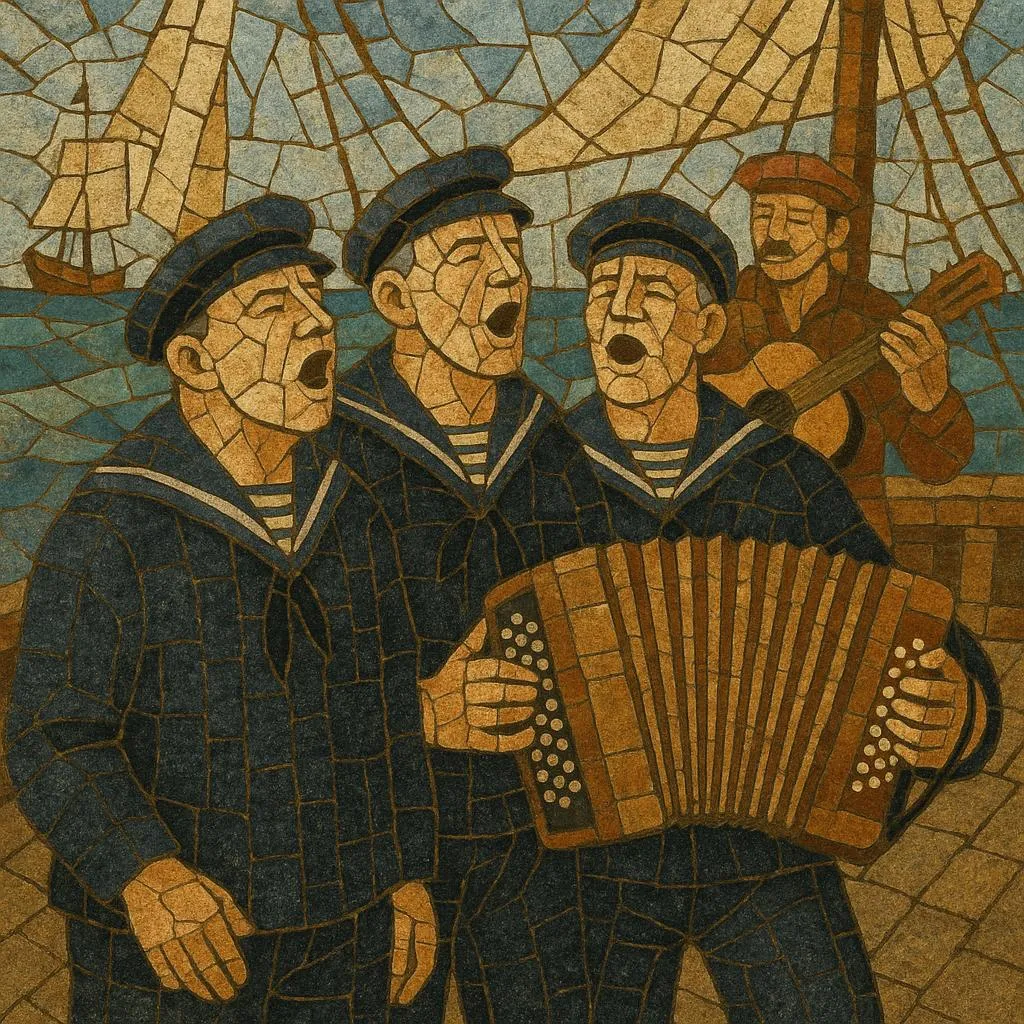
Shantykoren (Dutch for "shanty choirs") are community choirs that perform sea shanties and maritime songs, typically in Dutch, German, and English. They adapt the 19th‑century sailors’ work songs into choral arrangements suitable for stage and festival settings.

These ensembles usually feature robust call‑and‑response refrains, unison or simple 3–4 part harmonies, and accessible, audience‑friendly arrangements. Instrumentation often includes accordion or concertina, acoustic guitar, bass, light percussion (snare, bodhrán, cajón), and occasionally fiddle or harmonica. Choirs frequently perform in nautical attire at port towns, maritime museums, and shanty festivals across the Netherlands and neighboring countries.

While rooted in folk tradition, shantykoren emphasize communal singing, storytelling, and local pride, turning historically functional work songs into participatory concert music for contemporary audiences.


Sources: Spotify, Wikipedia, Discogs, Rate Your Music, MusicBrainz, and other online sources

History

Origins (19th century shanties)

Sea shanties arose in the 1800s aboard merchant and whaling ships as functional work songs. They coordinated labor with strong rhythms and call‑and‑response forms, drawing on Anglo‑American, Celtic, and Afro‑Caribbean influences. After the age of sail, shanties survived as folk repertoire in coastal communities and song collections.

Post‑war folk revival and choral turn

In the mid‑20th century, folk revivals in the UK, Ireland, Germany, and the Netherlands brought maritime songs back to public attention. By the 1970s, community ensembles began arranging shanties for choirs—translating solo shantyman/chorus formats into 3–4 part harmonies with light accompaniment. This was the seed of the modern shanty‑choir movement.

Dutch and German boom (1980s–1990s)

From the late 1970s into the 1990s, port towns and fishing communities in the Netherlands (and across the North Sea region) saw a surge of shanty choirs. Maritime festivals, heritage events, and local clubs fostered dozens of groups. Repertoires blended classic English‑language shanties with Dutch/German translations, sailor ballads, and newer seafaring songs.

2000s to present: festivals, recordings, and crossover

Shanty festivals (often featuring massed‑choir sing‑alongs) became fixtures in coastal calendars. Choirs recorded CDs, standardized arrangements, and embraced audience participation. The 2020s global "sea shanty" social‑media moment further raised visibility, drawing new listeners to continental shanty‑choir culture and encouraging collaborations with folk acts and community choruses.

A living communal tradition

Today, shantykoren remain intergenerational community ensembles that preserve maritime heritage while adapting repertoire for contemporary stages—keeping the social, sing‑together spirit of shanties at the fore.

How to make a track in this genre

Core forms and structure
•   Use call‑and‑response: a lead (shantyman) sings the verse; the choir answers with a strong, memorable refrain. •   Favor strophic verses with repeated choruses to encourage audience participation. •   Typical tempi mirror work rhythms (moderate 70–110 BPM), with steady pulse.
Harmony and melody
•   Keep harmonies accessible: unison melody reinforced by 3–4 part TTBB or SATB blocks on refrains. •   Harmony language is diatonic and modal: I–IV–V progressions, occasional minor or Dorian/Aeolian color. •   Cadences should be clear and communal; sustain final notes for sing‑along impact.
Lyrics and themes
•   Maritime narratives: voyages, storms, homecoming, whaling, shipboard camaraderie, and coastal towns. •   Mix languages (Dutch/German/English) as suits the choir and audience; adapt traditional lyrics with local references. •   Keep lines rhythmic and chant‑friendly; avoid excessive melisma.
Instrumentation and texture
•   Lead with voices; accompany lightly with accordion/concertina, acoustic guitar, bass, and hand percussion (snare/side drum, bodhrán, cajón). •   Add fiddle or harmonica for color; keep textures open so the choir dominates. •   Use dynamic swells and stop‑time claps to punctuate refrains.
Arrangement tips
•   Alternate solo verses and full‑choir refrains; add simple counterlines on repeat choruses. •   Write in choir‑friendly keys (E, F, G, A; or D/E minor) and comfortable vocal ranges. •   Plan audience call‑backs and clap patterns; encourage a communal, celebratory stage presence (nautical attire, unified movement).
Rehearsal and performance
•   Prioritize diction and accent on downbeats; unify vowel shapes for strong block chords. •   Balance the lead shantyman’s storytelling with the choir’s power; mic the lead lightly, the choir broadly.

Top tracks

Locked
Share your favorite track to unlock other users’ top tracks
Influenced by
Has influenced
Challenges
Digger Battle
Let's see who can find the best track in this genre

Download our mobile app

Get the Melodigging app and start digging for new genres on the go
© 2026 Melodigging
Melodding was created as a tribute to Every Noise at Once, which inspired us to help curious minds keep digging into music's ever-evolving genres.
Buy me a coffee for Melodigging